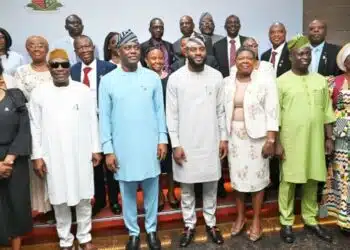


In a significant move to uphold accountability and transparency in the management of public finances, the Oyo State House of Assembly, through its Public Accounts Committee (PAC), has officially commenced a comprehensive probe into the Auditor-General’s reports.
The investigative hearing targets financial records of various Ministries, Departments, and Agencies (MDAs) as well as Local Government Areas (LGAs) across Oyo State, aiming to rectify anomalies identified in the spending of public funds over previous years.
Scope of the Oyo State Public Accounts Committee Hearing
According to the Committee, the public hearing is scheduled to span two weeks. The sessions are currently being held at the Caucus Room of the Oyo State House of Assembly Complex, Secretariat, Ibadan.
The timeline for the audit consideration is structured as follows:
- MDAs: Evaluation of the 2020, 2021, and 2022 financial years.
- Local Government Areas: Evaluation of the 2023 and 2024 financial years.
- Constitutional Mandate and Transparency
The Chairman of the Committee, Hon. Olusola Owolabi, emphasised that the primary objective of the exercise is to ensure that every kobo of taxpayers’ money is accounted for.
Hon. Owolabi, who represents Ibadan North East State Constituency 2, stated that the House is exercising its constitutional powers under Sections 85(5-6), 128, and 129 of the Nigerian Constitution. These provisions empower the legislature to re-examine queries regarding public income, expenditure, and Internally Generated Revenue (IGR) across all state institutions.
Vowing to refer culpable officials to anti-graft agencies, the lawmaker noted that the House is determined to end years of audit negligence.
Legislative Oversight on Public Funds
Speaking on the necessity of the probe, Hon. Owolabi said: “The Constitution has saddled the Oyo State House of Assembly with the responsibility of rechecking what the Auditor-General has raised. What were the responses of our agencies, ministries, and corporations to the audit queries? That is why we have to invite all MDAs and institutions to come and tell us what their answers to the Auditor-General’s queries were.”
He further stressed: “The objective is accountability. Money is being budgeted, and money is being given as releases, but they are not telling us how it is being spent. It is a public fund; it is taxpayers’ money. It belongs to all of us. So, we have to confirm what is being spent on. We have the right as a House of Assembly to scrutinise income and expenditure for accountability and transparency purposes.
Addressing the consequences of financial mismanagement in Oyo State, he added: “Oyo State has an agency that has to do with the rule of law, that’s number one. Another agency we call OYACA has to do with investigation, investigating corrupt officers and corrupt corporations. These agencies were established so that the accountability of Oyo State money will be paramount. When we find out that any person or any corporation or any agency is culpable, we hand them over to the anti-graft agency so that they can answer in detail so that the law will take its place.”
Strict Guidelines for MDAs and LGAs
Hon. Olasunkanmi Babalola, a member of the Committee, outlined the guidelines for the invited agencies. He issued a stern warning that officials found liable for misappropriation, unauthorised spending, diversion of funds, or contract irregularities would be referred to the Oyo State Anti-Corruption Agency (OYACA).
He clarified that the exercise is a legal obligation rather than a political manoeuvre, asserting that the passage of the state budget must be defended by transparent execution.
The Oyo State House of Assembly Committee on Public Accounts also includes Hon. Gbenga Oyekola, Hon. Abiodun Babalola, and Hon. Johnson Ogundele.
Representing the Clerk of the House, Bar. Adenike Taiwo Muraina-Akinola, the Deputy Clerk (Legal), Mrs. Aderonke Ogundeji, urged all invited MDAs and local governments to cooperate fully, reassuring them that the exercise is not a “witch-hunt” but a standard procedure for good governance.