
• About
  • Advertise
  • Careers
  • Contact
Thursday, March 12, 2026
  • Login
No Result
View All Result
NEWSLETTER
Reporters At Large
  • Home
  • News
    • World
    • For The Record
    • Metro
    • Opinion
    • Press Releases
  • Business
    • Auto Trend
  • Politics
  • Tourism
  • Lifestyle
    • People & Events
    • Health
  • RAL TV
    • Video
    • Video News
  • More
    • Advertisement
    • Privacy
    • Disclaimer
    • Contact Us
  • Home
  • News
    • World
    • For The Record
    • Metro
    • Opinion
    • Press Releases
  • Business
    • Auto Trend
  • Politics
  • Tourism
  • Lifestyle
    • People & Events
    • Health
  • RAL TV
    • Video
    • Video News
  • More
    • Advertisement
    • Privacy
    • Disclaimer
    • Contact Us
No Result
View All Result
Reporters At Large
No Result
View All Result
Home Business

Strait Of Hormuz: Impact Of Iran Closing The Global Oil Corridor

by ReportersAtLarge
March 12, 2026
in Business
Reading Time: 4 mins read
0
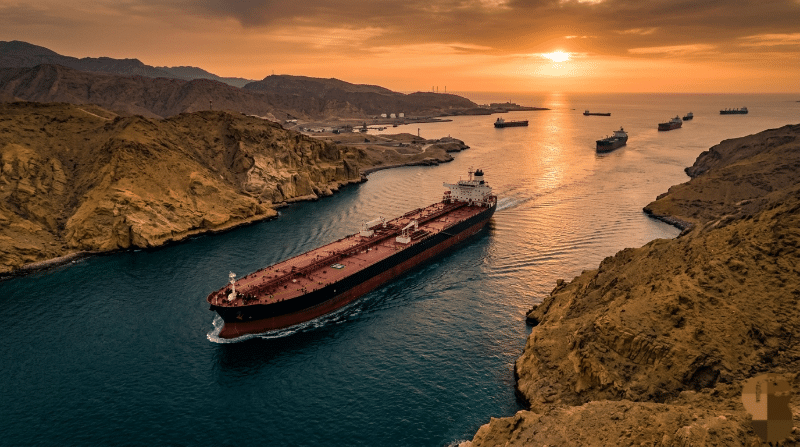
Aerial view of an oil tanker transiting the Strait of Hormuz chokepoint, illustrating the critical global energy shipping route during a dramatic sunset.
Share on WhatsappShare on FacebookShare on TwitterShare on Linkedin

​A series of targeted attacks on commercial vessels in the Strait of Hormuz has ignited fears over the stability of the world’s most critical maritime chokepoint. As the primary artery for global energy, any disruption to this narrow passage sends shockwaves through international markets.

​Recent reports from the UK Maritime Trade Operations (UKMTO) indicate that several tankers were “struck by an unknown projectile” off the coast of Iraq. Simultaneously, a container ship was reportedly hit near the United Arab Emirates (UAE) coastline, further destabilising an already volatile region.

​While Tehran has threatened to “set fire” to vessels attempting to navigate the passage, a fraction of maritime traffic persists. However, with 20% of the world’s petroleum usually transiting the Strait, the conflict has already sent global oil prices soaring towards the $120 mark.

​What is the Strait of Hormuz — and where is it located?

​The Strait of Hormuz is widely regarded as the world’s most vital oil transit chokepoint. Geographically, it is bounded by Iran to the north and Oman and the UAE to the south.

​Connecting the Persian Gulf with the Arabian Sea, the corridor is remarkably narrow—stretching only 50km (31 miles) at its widest and tapering to just 33km at its narrowest point. Despite its limited width, the channel is deep enough to accommodate the world’s largest crude oil tankers (VLCCs), making it indispensable for Middle Eastern energy exporters and their global customers.

RelatedPosts

​E-AquaHealth Launches In Nigeria To Become Africa’s Leading Digital Aquaculture Ecosystem

Trump: Record Oil Prices A ‘Small Price To Pay’ For Global Security

Oil Prices Passe $100 A Barrel For First Time Since 2022 Amid Iran War

​In 2025, an estimated 20 million barrels of oil passed through the Strait daily, according to the US Energy Information Administration (EIA). This represents nearly $600bn (£447bn) in annual energy trade, involving exports from Iran, Iraq, Kuwait, Qatar, Saudi Arabia, and the UAE.

​What would be the impact of a total blockade?

​Under normal conditions, approximately 3,000 ships navigate the Strait every month. Analysts warn that persistent threats to these vessels will inevitably drive up the cost of oil and maritime insurance.

​”It is de facto closed in that no one dares to go through,” Arne Lohmann Rasmussen, chief analyst at Global Risk Management, told CBS News. “You can be attacked, and you can’t get insurance or it is extremely expensive… If oil and gas coming from the strait is cut off, that has significant ramifications for the market.

​Rasmussen noted that even without a physical blockade, the combination of Iranian threats and drone strikes means many shipowners are simply refusing to enter the Gulf. This sentiment was echoed by Esmail Baghaei, a spokesman for Iran’s foreign affairs ministry, who cautioned that tankers “must be very careful.”

​The economic fallout is already visible:

  • ​Surging Prices: Crude oil prices saw massive swings recently, hitting nearly $120 before a slight retreat.
  • ​Shipping Costs: Data from the London Stock Exchange Group shows the cost of hiring a supertanker from the Middle East to China has nearly doubled, reaching a record high of over $400,000 (£298,300).
  • ​Regional Damage: Even oil-rich nations like Saudi Arabia are suffering as their export-dependent economies face logistical paralysis.

​The Asian Connection: Why China is Watching

​A blockade would hit Asian economies hardest. In 2022, roughly 82% of crude oil and condensates leaving the Strait were destined for Asia. China, which buys an estimated 90% of Iran’s total oil exports, is particularly vulnerable. Because China serves as the world’s manufacturing hub, a spike in their energy costs would likely lead to higher prices for consumer goods globally.

​How could Iran physically close the Strait?

​International maritime law allows nations to exercise control over territorial seas up to 12 nautical miles from their coast. At its narrowest, the Strait’s shipping lanes fall entirely within the territorial waters of Iran and Oman.

​Military experts suggest Iran’s most effective strategy would be naval mining. By using fast attack craft and submarines to lay mines, they could effectively deny access to the channel. While the US military has reported “eliminating” 16 Iranian mine-laying vessels, the threat remains high from Iran’s regular navy and the Islamic Revolutionary Guard Corps (IRGC).

​However, a full-scale naval confrontation poses risks for Tehran. Large surface vessels are vulnerable to US air strikes, and the current US administration has signaled a willingness to use military force to re-establish traffic flow—reminiscent of the “Tanker War” in the late 1980s.

​Are there alternative export routes?

​To mitigate the risk of a Hormuz closure, Gulf states have invested in bypass infrastructure:

  1. ​Saudi Arabia: Operates a 1,200km pipeline with a capacity of 5 million barrels per day.
  2. ​The UAE: Utilises a pipeline connecting inland fields to the port of Fujairah, bypassing the Strait entirely with a 1.5 million barrel daily capacity.

​While these routes provide a safety net, they cannot fully replace the Strait. Diverting oil through this infrastructure would still result in a global supply deficit of 8–10 million barrels per day, ensuring that even with alternatives, the closure of Hormuz would remain a global economic catastrophe.


Tags: AsiaEconomicsenergy market disruptionglobal oil prices 2026IranIran oil blockademaritime shipping routesPersian Gulf securityStrait of HormuzUK Maritime Trade Operations
SendShareTweetShare
ReportersAtLarge

ReportersAtLarge

Reporters At Large is the world’s fastest-growing online news platform and public service broadcaster. We’re impartial and independent, and every day we create distinctive, world-class programmes and content which inform, educate and entertain millions of people in Nigeria and around the world.

More

Prof. Idowu Olayinka and Prof. Olanike Adeyemo at the official launch of E-AquaHealth, a digital aquaculture ecosystem in Ibadan, Nigeria
Business

​E-AquaHealth Launches In Nigeria To Become Africa’s Leading Digital Aquaculture Ecosystem

by ReportersAtLarge
March 11, 2026
0

​E-AquaHealth has officially launched in Nigeria, promising to transform the aquaculture sector through digital innovation. By connecting fish farmers with...

Read moreDetails
Iran War - Donald Trump and Oil Prices
Business

Trump: Record Oil Prices A ‘Small Price To Pay’ For Global Security

by ReportersAtLarge
March 10, 2026
0

Donald Trump dismisses oil prices topping $100 a barrel as a "short-term blip" amid the escalating Iran conflict. As the...

Read moreDetails
Nigerian Upstream Petroleum Regulatory Commission Begins Allocation Of New Oil Blocks in Nigeria
Business

Oil Prices Passe $100 A Barrel For First Time Since 2022 Amid Iran War

by ReportersAtLarge
March 9, 2026
0

Oil prices surged past $100 a barrel for the first time since 2022 as fallout from the US-Israel war with Iran continued...

Read moreDetails
Load More

Leave a Reply Cancel reply

Your email address will not be published. Required fields are marked *

Recommended

Electricity

JUST IN: Blackout Hits Nigeria As National Power Grid Collapses Again

2 years ago
PDP Logo governors

PDP Set To End Nigeria’s Woes — Okowa

9 years ago

Popular News

  • Aerial view of an oil tanker transiting the Strait of Hormuz chokepoint, illustrating the critical global energy shipping route during a dramatic sunset.

    Strait Of Hormuz: Impact Of Iran Closing The Global Oil Corridor

    0 shares
    Share 0 Tweet 0
  • How Nigeria’s Hard-Won Sporting Reform Risks Being Undermined By Political Patronage

    0 shares
    Share 0 Tweet 0
  • ​E-AquaHealth Launches In Nigeria To Become Africa’s Leading Digital Aquaculture Ecosystem

    0 shares
    Share 0 Tweet 0
  • Disability Group Petitions Oyo Assembly Over 10-Year Stagnation in Special Homes

    0 shares
    Share 0 Tweet 0
  • Mark Carney’s Indo-Pacific Mission: Repositioning Canada For A New Global Economic Era

    0 shares
    Share 0 Tweet 0

Connect with us

ADVERTISEMENT

About Us

Reporters At Large is the world’s fastest-growing online news platform and public service broadcaster. We’re impartial and independent, and every day we create distinctive, world-class programmes and content which inform, educate and entertain millions of people in Nigeria and around the world.

With a high level of professionalism, fairness, objectivity, accuracy and speed, we publish Breaking News Nigeria Today Headlines and International news on Politics, Tourism and Travel, Entertainment, Sports, Business Lifestyle and Sports.

Category

  • Auto Trend
  • Breaking Bones
  • Business
  • Columns
  • Entertainment
  • Featured
  • For The Record
  • Health
  • Innovation
  • Lifestyle
  • Metro
  • News
  • Opinion
  • People & Events
  • Politics
  • Press Releases
  • Science & Technology
  • Sponsored
  • Sport
  • Tourism & Culture
  • Video
  • Video News
  • WorldNews

Recent Posts

  • Strait Of Hormuz: Impact Of Iran Closing The Global Oil Corridor March 12, 2026
  • How Nigeria’s Hard-Won Sporting Reform Risks Being Undermined By Political Patronage March 12, 2026
  • ​E-AquaHealth Launches In Nigeria To Become Africa’s Leading Digital Aquaculture Ecosystem March 11, 2026
  • Disability Group Petitions Oyo Assembly Over 10-Year Stagnation in Special Homes March 11, 2026
  • Mark Carney’s Indo-Pacific Mission: Repositioning Canada For A New Global Economic Era March 11, 2026
March 2026
SMTWTFS
1234567
891011121314
15161718192021
22232425262728
293031 
« Feb    
  • Home
  • News
  • Business
  • Politics
  • Tourism
  • Lifestyle
  • RAL TV
  • More

© 2016-2024 RAL - Guided by professionalism

Welcome Back!

Login to your account below

Forgotten Password?

Retrieve your password

Please enter your username or email address to reset your password.

Log In
No Result
View All Result
  • Home
  • News
    • World
    • For The Record
    • Metro
    • Opinion
    • Press Releases
  • Business
    • Auto Trend
  • Politics
  • Tourism
  • Lifestyle
    • People & Events
    • Health
  • RAL TV
    • Video
    • Video News
  • More
    • Advertisement
    • Privacy
    • Disclaimer
    • Contact Us

© 2016-2024 RAL - Guided by professionalism

Verified by MonsterInsights