
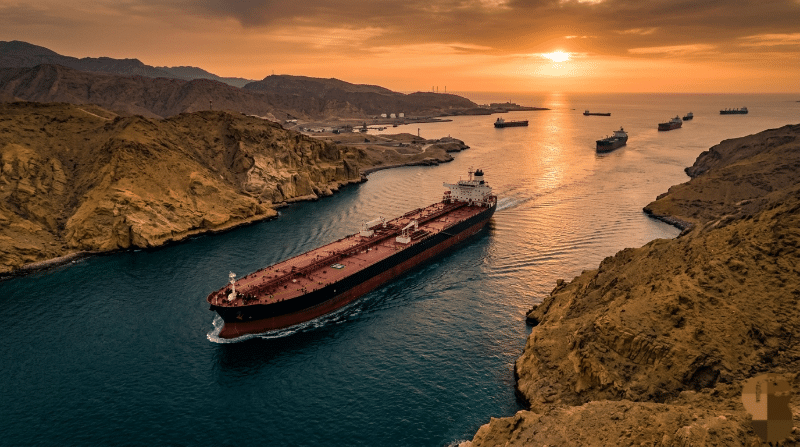
Oil prices rebounded on Tuesday and US gas prices rose as Iran intensified its attacks on energy infrastructure across the Middle East. A senior regime figure suggested that the crucial Strait of Hormuz would not become safe for ships anytime soon.
Brent crude, the global oil benchmark, rose 3% to trade around $103 a barrel. It had jumped more than 4% earlier in the trading session. WTI, the US benchmark, climbed 3.7% to trade around $97 a barrel.
Gasoline prices in the United States continued to march higher. They rose 7 cents on Tuesday to a nationwide average of $3.79 a gallon. This is the highest price for regular gas since October 2023, according to the American Automobile Association.
“No Longer Any Security”
In a televised interview on Tuesday, Iranian parliamentary speaker Mohammad Baqer Qalibaf said the Strait of Hormuz remains under threat. He blamed the American and Israeli presence in the Gulf region.
“The Strait of Hormuz cannot be the same as before and return to its previous conditions,” Qalibaf said, adding that “there is no longer any security.”
He also cautioned that US bombs and jets could not destroy Iran’s weapons facilities.
Iran’s fresh attacks have added to worries about global oil and natural gas supply. The United Arab Emirates suspended operations at its Shah natural gas field following a drone attack on Tuesday. A separate drone strike caused a fire at the key Emirati oil port of Fujairah, while an Iraqi oil field also came under attack.
Escalation in the Persian Gulf
A tanker was struck by an “unknown projectile” late Monday near Fujairah, according to the UK Maritime Trade Operations Centre. The centre has recorded more than a dozen attacks on vessels in the Persian Gulf since US-Israeli strikes on Iran began on 28 February.
In a further sign of escalation, Israel announced that it had killed Iran’s security chief, Ali Larijani, on Monday night. Iran has yet to confirm the alleged killing of Larijani, who was a pivotal figure in the regime’s security council.
Prolonged Market Disruption
Tuesday’s jump in oil prices follows a fall in the previous trading session. On Monday, Brent closed 2.8% lower as hopes mounted for a resumption of oil flows. However, prices remain about 40% higher than before the conflict began. The Strait of Hormuz is a conduit for around a fifth of global oil and liquefied natural gas supply.
US President Donald Trump has called on allies to help reopen the strait. He warned that NATO faces a “very bad future” if countries fail to assist. But European leaders remain wary of becoming embroiled in the war.
“Europe has no interest in an open-ended war,” Kaja Kallas, the EU’s top diplomat, told journalists in Brussels. “This is not Europe’s war,” she said, though she added that Europe’s interests are “directly at stake.”
UK Prime Minister Keir Starmer said on Monday that Britain was working with allies on a plan to restore freedom of navigation. He emphasised, however, that the United Kingdom would “not be drawn into the wider war.”
Emergency Reserves Tapped
The International Energy Agency (IEA) said its member countries can release further emergency oil stocks if needed. This is on top of the 400 million barrels that will start flowing this week.
Fatih Birol, the IEA executive director, cautioned that while stock releases provide a buffer, they are not a lasting solution. He noted that the most important factor for stable markets is the resumption of transit through the Strait of Hormuz.