
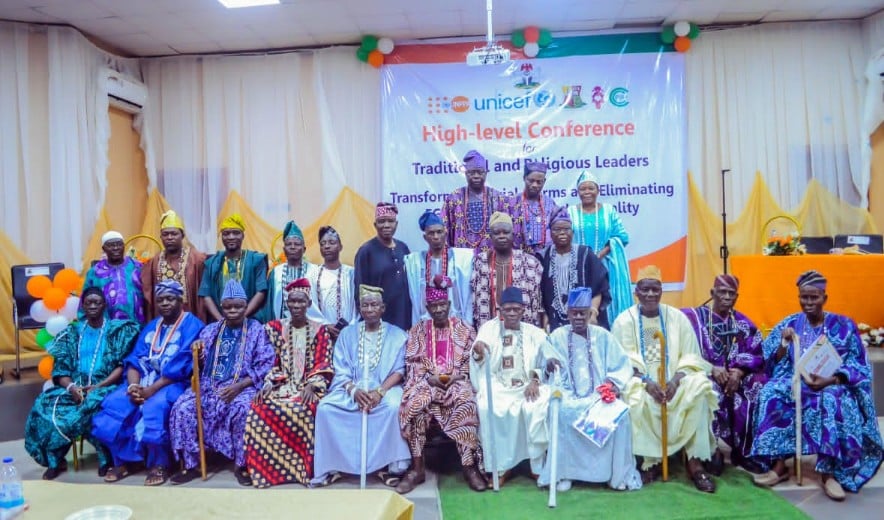
A landmark agreement was signed recently by a diverse coalition of cultural custodians, religious leaders, and FGM-relevant institutions, marking a significant turning point in the fight to eradicate Female Genital Mutilation (FGM) and champion gender equality. The high-level conference, held at the LG Training Centre Secretariat in Ibadan, Oyo State, culminated in a powerful declaration vowing to end the harmful practice.
The historic summit, focused on “Transforming Social Norms and Eliminating FGM to Promote Gender Equality,” brought together influential voices from across the community to confront the devastating consequences of FGM. Speakers underscored the critical need for abandonment, presenting stark evidence and personal testimonies that challenged deeply ingrained beliefs and harmful stereotypes.
Mrs. Balikis Olawoyin of the State Primary Healthcare Board (SPHCB) and Mrs. Awosenusi from the Ministry of Justice were among the key figures who detailed the brutal realities of FGM. Drawing on demographic health surveys from 2013 to 2024, they highlighted the severe health repercussions, including life-threatening bleeding, prolonged and difficult childbirth, debilitating infections, and the creation of painful scar tissue.

“It is not something to write home about,” stated Professor Oladosu Ojengbede, Director of the Center for Comprehensive Promotion of Reproductive Health (CCPRH) and a seasoned gynaecologist. With extensive experience treating FGM victims, Professor Ojengbede emphasised the urgent imperative to eradicate the practice at all costs.
The devastating emotional and psychological toll of FGM was poignantly articulated by an FGM survivor who bravely shared her ongoing struggle with traumatic stress disorder. She detailed the silent suffering of survivors, including dyspareunia (painful intercourse), chronic anxiety, distress, and the strain it places on intimate relationships, sometimes leading to the breakdown of families.
A significant moment of the conference was the address by Baale Oladapo Wasiu Aare, President of the Council of Traditional Baales. He invoked a powerful Yoruba adage, “Omo Ki I ku lowo onikola,” translating to “A child does not die at the hand of the circumciser.” Baale Aare elaborated that while the immediate perpetrator might not witness the fatal outcome, the victim is highly likely to die at home due to excessive bleeding or haemorrhage. This potent reminder underscored the inherent danger and barbarity of continuing such harmful cultural practices against humanity.
Dr. Christiana Bolade Omidiji, an FGM advocate, lauded the conference for its direct engagement with community leaders, describing it as an “eye-opener” that has begun to transform perceptions. She stressed that the summit’s focus on owners of societal norms is crucial for lasting change. Furthermore, she highlighted that failure to comply with the new stance against FGM will now attract severe legal consequences, including jail terms after facing charges in court. Engaging with custodians of culture and religious leaders really makes sense,” she affirmed.
The commitment to ending FGM resonated across all traditional and religious platforms present. Asiwaju Ijo Ose meji, Oja Oba Ibadan, Chief Ojekunle Ifasesan, representing the IFA faith, declared his stance, stating, “Say No to Female Genital Mutilation. Since the Society already accepted, we will do same.” His declaration signifies a powerful shift within traditional belief systems.
The conference was further bolstered by the presence and support of representatives from the Olubadan of Ibadan land, Chief Mrs. Kikelomo Laniyonu Edwards (Member, World Dementia Council, Iyalaje Akinyele LG), other traditional leaders, religious organisations, community heads (Mogaji), WOWICAN (Mrs. Ayodele), CAN (Prophet Solomon Folorunso), MWASI Director (Women Program), and Fomwan Amirah Oyo State (Latifat Dairo).
This impactful event, powerfully powered by the UNFPA-UNICEF Joint Programme for the Abandonment of Female Genital Mutilation, signifies a unified and determined effort by the people of Ibadan to build a future where gender equality prevails and the harmful practice of FGM is relegated to the annals of history.