
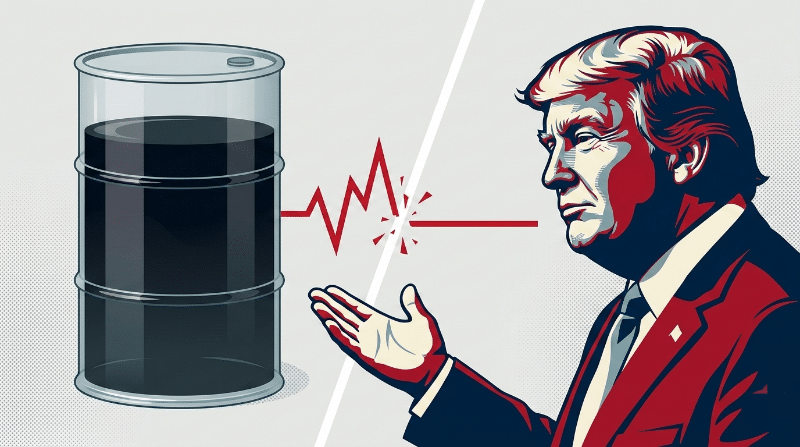
President Donald Trump has dismissed the surge in global oil prices above $100 a barrel as a “short-term blip,” insisting that current market volatility is a necessary trade-off for the “destruction” of the Iranian nuclear threat.
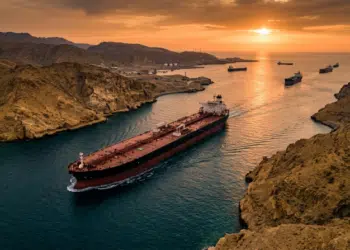
Writing on Truth Social on Sunday evening, the President sought to reassure markets and voters alike as the conflict in the Middle East continues to roil energy sectors. Crude prices have hit their highest levels since the 2022 invasion of Ukraine, driven largely by the effective closure of the Strait of Hormuz—a vital artery through which 20% of the world’s oil flows.

Despite the pressure on Western petrol pumps and the potential impact on his economic agenda ahead of the November midterms, the President remained defiant.
“Short-term oil prices, which will drop rapidly when the destruction of the Iran nuclear threat is over, is a very small price to pay for U.S.A., and World, Safety and Peace,” Mr Trump posted. “ONLY FOOLS WOULD THINK DIFFERENTLY!”
‘Energy Will Flow Soon’
The administration’s optimistic outlook was echoed by Energy Secretary Chris Wright, who appeared on Fox News to signal that the supply crunch would be short-lived.
“Energy will flow soon,” Mr Wright stated, attributing the current price hike to market anxiety over a “drawn-out crisis” that he insists will not materialise.
However, analysts suggest the road to price stability may be longer than the White House predicts. Antonia Syn, a gas and LNG expert at Rystad Energy, noted that even if the conflict de-escalated tomorrow, prices would likely lag. Markets, she argued, would require “confirmation that production and shipping has safely resumed” before the “geopolitical risk premium” currently baked into the price begins to fade.
A Historic Chokepoint
The geopolitical stakes are historically high. The Strait of Hormuz—the only sea passage from the Persian Gulf to the open ocean—has ground to a virtual halt following US-Israeli strikes on 28 February.
While Iran-linked vessels have continued to transit the waterway, non-aligned commercial shipping has vanished. The last independent ship to pass through was a Chinese-owned bulk carrier on Saturday morning.
The closure marks a paradigm shift for global energy security. Natasha Kaneva, an analyst at JPMorgan Chase, told the Wall Street Journal:
“In the whole written history of the strait, it has never been closed, ever. To me, it was not just the worst-case scenario. It was an unthinkable scenario.”
Alternative Routes Under Threat
Before the shutdown, over 14 million barrels of crude passed through the chokepoint daily. Efforts to bypass the conflict zone have seen Saudi Arabia divert record levels of crude to the Red Sea.
Yet, even this alternative is fraught with risk. Iran-aligned Houthi rebels in Yemen have targeted vessels in the area since 2023, meaning the world’s most critical crude markets remain under significant pressure. As Peter McNally of Third Bridge warned, the world simply “cannot replace” the volume of oil that typically flows through the Strait.