

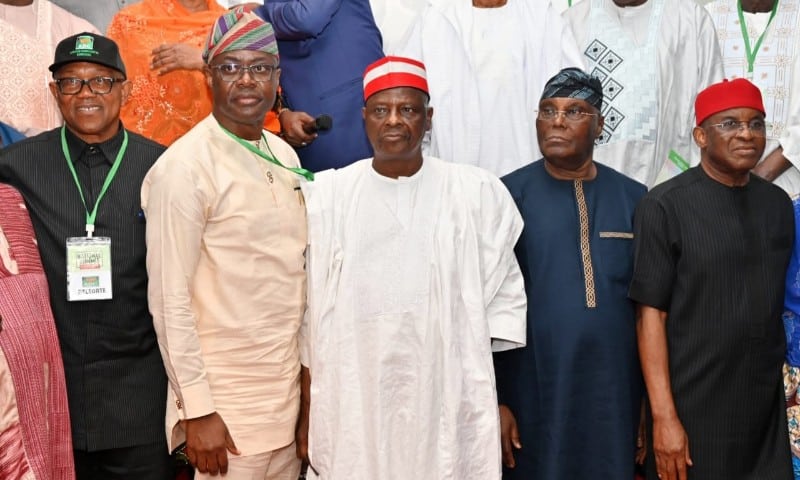
There is a Yoruba proverb whose wisdom travels far beyond tribe, language, or region: Àjànàkú kò ní tí kó máa rìn, àmọ́ ẹsẹ̀ rẹ̀ kan ní yóò yàtọ̀. This translates to: “the elephant may change direction, but it remains the same elephant.” This proverb perfectly captures the current state of Nigerian opposition politics. While many view the recent Ibadan summit as a catalyst for political renewal in Nigeria, we must ask if this is genuine progress or mere performance.
The Illusion of Movement in Nigerian Opposition Politics
The Ibadan summit brought together heavyweights like Atiku Abubakar, Peter Obi, Rabiu Kwankwaso, Rotimi Amaechi, and Seyi Makinde. They spoke of rescue, unity, and democratic survival. For citizens weary of hardship and insecurity, this language offers a glimmer of hope. However, hope must not blind us to memory. The first duty of serious politics is honesty, not excitement.

We must confront a difficult reality: are we seeing true transformation, or just the same elite class under new slogans? As the author Lanre Ogundipe notes: “Yesterday’s ruling elite often returns as today’s opposition reformer. Yesterday’s defenders of power suddenly become custodians of democracy. Yesterday’s architects of the old order reappear as prophets of a new republic. The robe changes.”
Coalitions and the Limits of Political Strategy
The gathering in Ibadan created a strong image of national urgency. Yet, we must remember that a coalition is not a photograph. It is not a press statement or a series of speeches. Coalition politics requires deep sacrifice, mutual trust, and a shared vision. Currently, the primary bond between these leaders seems to be the shared goal of defeating President Bola Ahmed Tinubu.
If the only unifying principle is “Tinubu must go,” then we do not yet have a national alternative. We have an emotional alliance. History warns us that emotion can win applause, but it cannot run a country. In 2015, the APC emerged from a similar broad coalition. It succeeded in its electoral arithmetic, but once in power, the internal contradictions between progressives, conservatives, and regional power brokers proved difficult to manage.
Lessons from Global Governance Reform
Other nations offer cautionary tales. Kenya’s National Rainbow Coalition successfully removed the old order in 2002 but struggled afterward because they were better at removing power than managing it. Conversely, South Africa’s anti-apartheid movement succeeded because it possessed a moral architecture for nation-building that went beyond mere regime change.
The Nigerian opposition must decide if they are merely chasing personal ambition or building a true Nigeria governance reform agenda. The ruling party remains a system builder, leveraging the formidable power of incumbency. However, no government is invincible when faced with the widespread suffering of its people. Inflation, fuel costs, and insecurity are potent political forces that no speech can fully dismiss.
The Role of the Citizen in National Progress
Ultimately, we cannot blame politicians alone. Bad systems survive because citizens often participate in their preservation. Vote-buying persists because people accept the cash. Ethnic politics thrives because we prioritise “our own” over national interest. As the Yoruba wisdom reminds us: Bí ọmọde bá fi ọwọ́ ọ̀tún bà èérú, a fi ọwọ́ òsì fà á mọ́ra —when a child touches ash with the right hand, the left hand pulls it closer.
The victim often helps sustain the fire. Until we demand a new political culture rather than just a new set of leaders, the elephant will continue to change direction while remaining the same. History is watching, and it is rarely deceived by a change in costume.