
Ten Nigerian underwriters face potential liquidation after failing to secure regulatory clearance during the recent Nigerian insurance recapitalisation exercise.
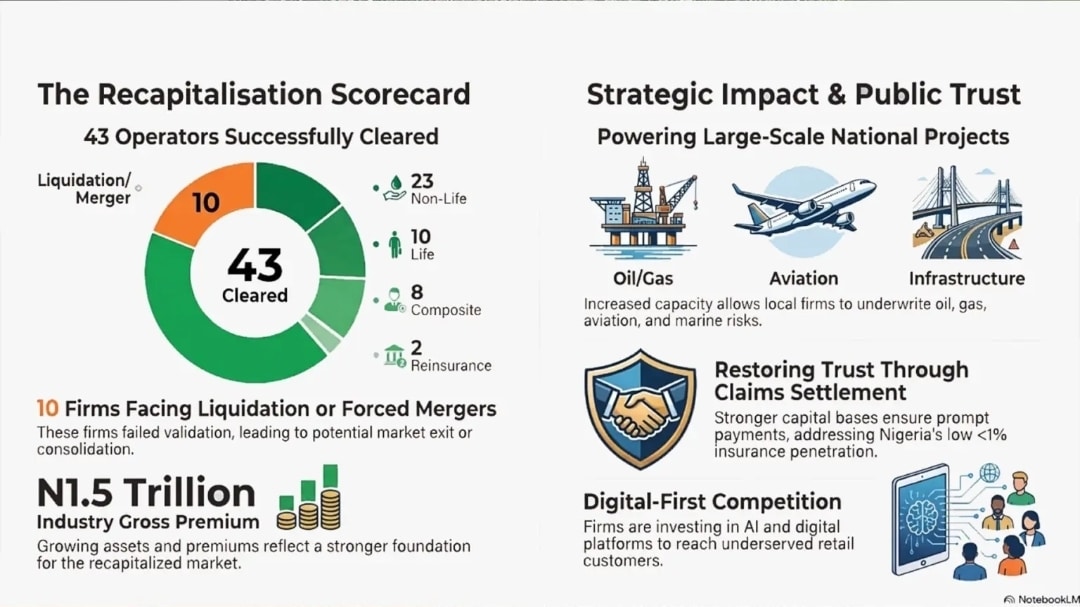
The National Insurance Commission (NAICOM) confirmed that 43 operators met the mandatory funding thresholds by the time the fundraising window closed on 31 July.
A status report revealed that eight additional firms submitted validation paperwork shortly before the deadline. Regulatory auditors are currently evaluating these filings, with final decisions expected within a fortnight.
The regulatory review has split cleared operators across distinct functional categories.
The regulator approved 23 non-life operators, 10 life insurers, eight composite firms, and two reinsurance companies.
However, NAICOM has not publicly named the unverified entities. Market tracking indicates that active firms lacking clearance include African Alliance Insurance, Universal Insurance, Sovereign Trust Insurance, Guinea Insurance Plc, Goldlink Insurance, and emPle General Insurance Company Nigeria.
Regulators are also assessing Regency Alliance Insurance, Alliance and General Insurance, and Royal Exchange Prudential Life.
Uncertainty surrounding compliance has severely depressed equity prices across the sector.
Investors engaged in heavy stock dumping throughout the first half of the year, freezing market momentum.
The sector rallied late last year after lawmakers passed the Nigerian Insurance Industry Reform Act (NIIRA) 2025. By December, the insurance index outperformed the Nigerian Exchange (NGX) All-Share Index by nearly 20 percentage points, crossing 1,200 points.
That growth stalled entirely by July. While the broader stock market gained roughly 58 per cent year-on-year, the insurance index remained trapped at 1,200 points due to persistent recapitalisation anxiety.
NAICOM subsequently released its list of approved operators. Cleared entities include Zenith (non-life), Leadway (composite), Custodian (life), Custodian and Allied (non-life), NEM (non-life), Aiico (composite), CHI (life), Heirs General Insurance (non-life), Heirs Life (life), Fin (non-life), Cornerstone (composite), and Mutual Benefits (non-life).
The regulator also cleared Tangerine (non-life), Capital Express (non-life), Continental (reinsurance), FBS (reinsurance), Sanlem-Allianz (non-life), Prudential Zenith (life), Consolidated Hallmark (non-life), Stanbic IBTC (life), Sanlem-Allianz Life (life), Sterling Assurance (non-life), Axa Mansard (composite), and Great Nigeria (composite).
Communication throughout the exercise remained unusually restricted. Unlike previous banking sector overhauls, both NAICOM and corporate executives released minimal operational updates.
Only 15 companies held verified status weeks before the window closed, prompting trade groups to request a six-month extension. NAICOM rejected the request, closing the window on schedule.
Market Consolidation Reshapes West Africa’s Financial Sector
The NAICOM insurance reform marks the most extensive structural overhaul of the country’s insurance market since the introduction of risk-based supervision.
Rather than simply increasing cash reserves, the framework aims to build institutions capable of underwriting major industrial risks locally.
Nigerian insurance penetration remains among the lowest globally, hovering around 0.6 per cent of gross domestic product (GDP).
Regulators expect recapitalised firms to absorb larger liabilities in infrastructure, aviation, maritime operations, agriculture, and oil projects, which were previously ceded to offshore underwriters.
Corporate restructuring accelerated behind closed doors before the deadline. Several underwriters executed multi-billion-naira rights issues, while others brought in foreign strategic investors or negotiated emergency corporate mergers.
Analysts view this wave of consolidation as the largest restructuring of the national financial framework since the 2004 banking consolidation.
Nigerian Insurance Recapitalisation: Integration Risks and Digital Expansion
Post-reform strategies now depend heavily on technological adoption. Recapitalised insurers plan to deploy capital into digital distribution networks to capture informal retail markets and small businesses.
“The NAICOM announcement marks the conclusion of one of the most ambitious reforms undertaken by the Commission since the introduction of risk-based supervision and signals the beginning of a new phase for NIIRA 2025.”
Industry experts warn that structural mergers carry significant operational hazards. Integration friction, cultural misalignment, executive disputes, and IT harmonisation issues routinely disrupt corporate realignments.
NAICOM confirmed that post-recapitalisation supervision will focus heavily on governance and claims settlement efficiency.
“Although NAICOM confirmed that 43 companies met the new capital requirements, the Commission disclosed that eight insurers remain under final verification after submitting evidence of compliance shortly before the deadline,” official documents noted.
The regulator reiterated that its review of the remaining eight entities would conclude within 14 days.
For surviving underwriters, the end of the fundraising window marks the beginning of an aggressive market share battle. Success under the Nigerian Insurance Industry Reform Act framework will ultimately depend on balance sheet strength, execution speed, and consumer trust.