
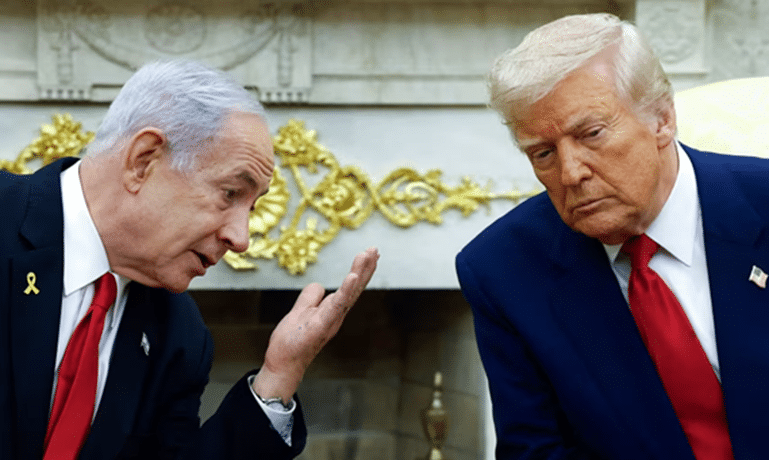
Prime Minister Benjamin Netanyahu rejected the latest US Gaza peace plan in Jerusalem on Sunday, ruling out troop withdrawals without complete Hamas disarmament.
The formal rejection marks a major diplomatic breach between Israel and Washington just ten days after Donald Trump announced his 15-point framework.

It also undermines White House efforts to lock in a permanent ceasefire before Israel holds general elections in October.
Addressing reporters, Netanyahu confirmed Israeli forces would maintain positions across Gaza and continue targeting security threats directly.
Strategic Shift Signals Growing Coalition Rift Over US Diplomatic Pressure
Netanyahu’s outright rejection of the Gaza peace plan highlights the severe domestic political pressures constraining Israeli foreign policy.
Trailing in opinion polls ahead of the October election, the prime minister remains reliant on hardline coalition partners who fiercely oppose territorial concessions.
Accepting Washington’s proposed drawdown would risk collapsing his government, as far-right ministers demand expanded military control over the enclave.
For the international community, this stance threatens to stall months of delicate regional mediation and prolong military operations across occupied areas.
The standoff creates severe uncertainty for millions of displaced civilians who had looked to the US roadmap for permanent humanitarian relief.
By publicly defying Washington, Netanyahu is betting that defying his closest foreign ally will shore up his domestic political survival.
However, escalating friction with the White House risks isolating Israel diplomatically as military actions continue across Gaza and southern Lebanon.
Gaza Peace Plan: Netanyahu Insists on Military Control as Hamas Calls for US Pressure
In his first direct remarks on the proposal, Netanyahu stated: “I want to be precise here: Israel rejects the 15-point document.”
He stressed that military forces would retain their positions until militant groups lay down their weapons.
“We are now discussing this with the Americans,” he added. “They have ideas, some of which are acceptable to us and some are not, and we know how to stand up to those things.”
Netanyahu also reiterated his firm opposition to Palestinian statehood in any post-war arrangement.
“As long as I am prime minister, no Palestinian state will be established — not in Gaza and not in the West Bank,” Netanyahu said.
Defending his record on regional operations, he signalled a readiness to resist foreign diplomatic demands.
“Contrary to all those who preach to us, we do what must be done for Israel’s security and we can and will stand our ground even against our best friends when necessary.”
Hamas leaders responded by demanding that Washington compel Israel to abide by earlier ceasefire commitments.
“We expect the mediators and the American guarantor to pressure Netanyahu and his government to adhere to the roadmap and not obstruct the process for internal political and electoral reasons” said Bassem Naim, a member of Hamas’ politburo on X.
Within Israel, far-right cabinet ministers welcomed the prime minister’s uncompromising stance.
“The (Israel Defense Forces) cannot retreat one millimetre in the Gaza Strip,” said Finance Minister Bezalel Smotrich.
The public disagreement places unprecedented strain on a relationship that had previously appeared unbreakable.
Trump had previously offered strong personal support to the Israeli leader, even suggesting legal leniency regarding his domestic corruption trial.
Trump remarked in March that “President Herzog must give Bibi a pardon today. I don’t want there to be anything troubling Bibi other than the war with Iran.”
However, repeated Israeli strikes in Lebanon and reluctant compliance with earlier regional ceasefires have steadily eroded trust between the two leaderships.