
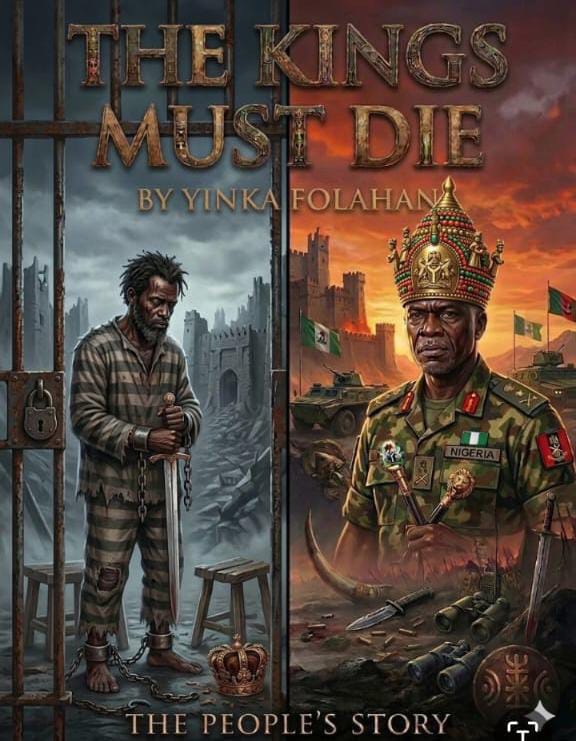
Yinka Folahan’s drama The Kings Must Die offers a searing, poetic lens through which one of the most traumatic episodes in Nigerian history is revisited: the annulment of the June 12 election and the subsequent June 12 political crisis. Set in the fictional city-state of Ilu Odo, the play centres on Atobatele—a wealthy, populist figure who holds the affection of the masses but suffers denial of his legitimate mandate. Through this character, Folahan constructs a compelling political allegory about power, betrayal, and the manipulation of popular sovereignty.
At the heart of the narrative lies a disturbing proposition: sometimes, for a new order to emerge, the old system does not merely surrender. Its competing claimants must entirely disappear. This dark logic makes the text particularly relevant when reflecting on Nigerian democratic history, especially the pivotal events of 1998.

The Dual Monarchs: A Mirror to June 12
The metaphor of the “two kings” provides the most revealing entry point into Folahan’s political imagination. Read against real-world history, the first ruler evokes the entrenched military establishment. The second represents Chief Moshood Kashimawo Olawale Abiola, the businessman widely regarded as the winner of the annulled 1993 presidential vote.
Abiola occupies a singular place in national memory. He was not merely a wealthy politician who lost an election; he became the ultimate symbol of a democratic mandate denied space to mature. Atobatele’s predicament in The Kings Must Die mirrors this exact dilemma. He has vast resources and popular goodwill, yet his fate rests with an elite ruling council that holds the power to disregard the people’s choice.
Folahan’s fictional Ilu Odo becomes far more than a theatrical backdrop. It becomes a political allegory in Nigerian literature, representing a society where citizens have numerical strength at the ballot box but lack the institutional power to enforce their choices.
1998: Colliding Political Realities
The narrative resonance deepens when examining the dramatic timeline of 1998. On 8 June 1998, military ruler General Sani Abacha died suddenly, an event officially attributed to a heart attack. His unexpected demise immediately reshaped the national landscape. For years, Abiola had remained in detention after declaring his presidency. With Abacha gone, expectations soared that the new administration under General Abdulsalami Abubakar would release Abiola and restore civilian rule.
Then came 7 July. Exactly one month after Abacha’s death, Abiola fell ill during a high-level meeting in Abuja and died shortly afterwards. An international autopsy team concluded that natural heart disease caused his death. Nevertheless, the close timing of both deaths generated persistent suspicion, feeding endless theories of foul play.
There is a distinction between asserting unproven poisoning claims as fact and acknowledging that these sudden deaths created lasting public doubt. It is precisely within this space of historical uncertainty that Folahan’s themes of deception acquire dramatic force.
The Dark Logic of Transition
The deaths of Abacha and Abiola within thirty days removed the two most influential figures on opposing sides of the June 12 political crisis. Abacha’s passing ended military obstruction, while Abiola’s death removed the primary civilian claimant to democratic legitimacy.
In this context, the central premise of The Kings Must Die functions less as a literal accusation and more as a profound metaphor. The disappearance of both rivals suddenly made the political transition far easier for the elite class to control. The nation moved forward into the Fourth Republic without having to answer its most difficult political question: whether Abiola should take office.
Atobatele and the Unfinished Journey
Atobatele ultimately stands as a tragic symbol of the “dream deferred.” He highlights a core truth within Nigerian democratic history: democracy is not merely the act of voting, but the willingness of state institutions to respect the outcome.
The Kings Must Die
Recently staged for World Theatre Day at the Lagos Theatre, Igando, in collaboration with the Lagos State Council for Arts and Culture, the production was directed by Tolu Fagbure. Fagbure used sharp ensemble pacing and high-stakes dramatic tension to translate Folahan’s heavy commentary onto the stage. Crucially, the play uses simple, accessible diction—the language of the common people—to emphasise that the struggle for legitimacy belongs to every citizen.
Atobatele may belong to the stage, but his dilemma belongs to the nation. Folahan’s work leaves us with a lingering warning: the death of a king does not guarantee the death of the system that created him.