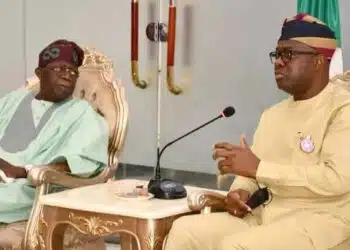


There is an intriguing logic guiding how President Bola Tinubu approaches his 2027 presidential election strategy. He appears determined not to run the Tinubu Campaign as though the primary business of governing Nigeria must pause for political rallies. Rather than physically taking his message across the federation, he is placing major responsibility on state governors, ministers, and key political allies to carry the fight into the country.
Rethinking Strategy for the Tinubu Campaign
At first glance, this approach might look like a candidate stepping back from the electorate. Yet it reflects a more calculated move. Tinubu is testing whether the political organisation he has built over several decades is now robust enough to drive a presidential campaign on his behalf.

The upcoming vote may serve as the first major test of whether he can transform a national campaign from a single candidate-centred operation into a broad, system-wide political enterprise. If successful, it will demonstrate the sophistication of his political machinery. However, it also exposes the inherent limits of political engineering: an organisation can carry a message into every state, but it cannot force citizens to believe it.
Tinubu is no accidental politician. He has spent decades studying the mechanics of power, from opposition struggles to the Lagos political machine, the coalition that created the ruling party, and ultimately the presidency. He understands a truth many politicians learn too late: a serious political structure cannot rely entirely on the physical presence of one man.
How the APC Campaign Structure Works Across States
The revised APC campaign structure reveals precisely this calculation. The structure places all 32 APC state governors in charge of presidential campaign efforts within their respective domains. It also reaches beyond the ruling party itself, assigning campaign roles to key figures such as Nyesom Wike in Rivers and the FCT, Chukwuma Soludo in Anambra, and Ademola Adeleke in Osun. Tinubu remains at the centre of the network, supported by Vice President Kashim Shettima and APC National Chairman Nentawe Yilwatda.
This is more than a simple division of labor. It represents an attempt to make the campaign a decentralized network rather than a single procession behind one candidate.
The President governs from Abuja while governors lead the debate in the states. Ministers defend policies, legislators mobilise constituencies, and party officials coordinate local networks. External political allies help broaden the coalition. Effectively, the President is testing whether the political machinery he built can execute the ground campaign traditionally expected of the presidential candidate himself.
Historical precedent exists for this approach, though history offers a nuanced lesson. Richard Nixon’s 1972 campaign allowed him to focus on governing while surrogates travelled the country, leading to a landslide victory. Conversely, Jimmy Carter’s limited campaigning during the 1980 Iran hostage crisis failed amidst economic dissatisfaction. Four years later, Ronald Reagan benefited from a recovering economy that allowed his record to speak for itself. In Nigeria, Shehu Shagari’s 1983 re-election demonstrated the reach of party machinery, even as controversies surrounding that vote showed that political power and democratic legitimacy are distinct.
The core lesson remains clear: political organization can amplify a favorable environment, but it cannot manufacture one.
Evaluating Public Impact and Nigerian Economic Reforms
This reality will prove decisive for the ruling party. Governors can explain administrative policies and ministers can defend strategy, but citizens will not evaluate the election purely through speeches. They will assess it through daily economic realities: the cost of food, transportation, housing, electricity, security, and jobs.
Public hardship is politically significant, though not always decisive. Nigerians often endure painful sacrifices if they believe those sacrifices are necessary, temporary, and leading to visible progress. However, voters will reject any administration whose promises conflict with their lived experience.
The central political question is not whether hardship exists—it clearly does. The question is whether enough voters believe current Nigerian economic reforms are laying the groundwork for a better future. Tinubu maintains that sacrifices are necessary to build a stronger economy, acknowledging that the benefits must soon reach ordinary households.
By 2027, economic arguments will become an explicit electoral proposition. If food becomes more affordable, transport less punishing, electricity more reliable, and purchasing power stronger, the administration’s record will campaign for itself. But if household hardship persists, political organisation alone will face an uphill battle.
Building Coalitions and the Final Electoral Test
Governors are independent political actors with local interests, factions, and ambitions. Their goals may align with the presidency, but they are not identical. Deploying 32 governors gives extraordinary reach, but it creates a complex web of state-level dynamics.
Tinubu’s long political career shows that his strength has rarely depended on speechmaking alone. It rests on political engineering: building coalitions, managing competing interests, and holding broad structures together. Including figures outside the ruling party reflects this philosophy, focusing on electoral arithmetic rather than ideological purity.
Yet political sophistication carries risks. Leaders can confuse the strength of their organization with the strength of their argument. The electorate is not a council of governors; it consists of millions of individual decisions.
A voter may attend a rally yet vote differently at the ballot box. This is why the President must remain present where arguments are most difficult, explaining policy choices and showing an understanding of household economic realities.
The machine can carry the message, but it cannot force voters to accept it. That remains the ultimate test of the strategy as the country approaches the ballot box.