
The Eleyele River crossing in Ibadan, Oyo State, carries an estimated 700 to 1,000 passenger journeys a day for just ₦100 a ride, easing the Apete transport cost burden for workers, traders and schoolchildren. But as the boats grow busier, the question of boat safety in Ibadan grows harder to ignore.
I learnt that on an ordinary evening. At about 7:30 p.m., the boat I was travelling in was halfway across the river when its engine died.
For a few seconds, there was only the sound of water against the plastic hull. Then the wind began to rise. Passengers shifted uneasily on the wooden planks. I looked towards the far bank, close enough to see, yet suddenly too far.
The operator did not panic. He reassured us and tried the engine again, but it would not start. We waited. Minutes later, another boat appeared and towed us to safety.
We reached the other side. But the crossing had changed for me.
I had used the Eleyele water route for years. It was fast, cheap and familiar. That evening, however, I understood the question beneath every ₦100 ride: what happens when the river that carries hundreds of people to work, school and home turns hostile?
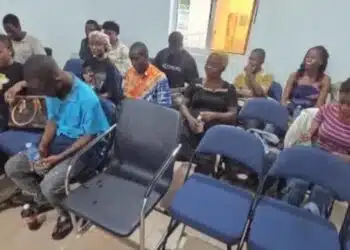
By 7:30 a.m., the queue at the crossing is already growing. Workers, traders, schoolchildren and other residents wait their turn to board boats connecting Eleyele with communities around Apete and Awotan in Ibadan.
For many, the crossing is part of the daily routine. A journey that could cost considerably more by road takes only a few minutes by water.
The service links residents of Idunnu, Oba-Ido, Alakuta, Aderogba, Ogo Oluwa and Idi Mango, among other adjoining communities. Some use it to get to work, others to school, markets, churches and other destinations across the river.
Sodiq, a commercial motorcyclist familiar with the route, estimates that between 700 and 1,000 passenger journeys are made across the river daily. The steady movement of boats and the queues of commuters offer a glimpse of how much these communities depend on the service.
How the Eleyele River crossing cuts Apete transport cost
For 22-year-old Medina, who lives in Alakuta and works around Jericho, the river crossing is more than a convenient alternative. It helps her make her monthly income go further.
She earns ₦60,000 a month. By her estimate, travelling to work by road through Awotan, Apete and Eleyele would require at least three commercial motorcycle rides and cost about ₦3,000 daily. Over 30 days, that would come to ₦90,000, more than her monthly salary.
The boat crossing changes the calculation.
Medina says she usually spends less than ₦500 on her daily return journey, although the amount sometimes rises to between ₦600 and ₦700. From the landing point, she walks home. She also benefits from an informal arrangement among passengers who know one another: sometimes one person pays another’s fare, with the favour returned on another day.
Mr Adeshina, a civil servant at the Oyo State Secretariat, has used the route for more than four years, since moving into a house less than a kilometre from the river. He describes the river as a blessing that has drastically reduced his transport expenses.
His wife, a trader, also crosses Eleyele River daily to get to her business, while their three children rely on the boats to get to school. For the family, the river is not an occasional shortcut. It is part of the routine that keeps work, trade and education within reach.
The fare was previously ₦50 but rose to ₦100 a few months before this report, following an increase in fuel prices. Even at the new rate, the crossing remains considerably cheaper than making the entire journey by road. For residents on modest incomes, that difference can determine whether a journey is affordable at all.
Why the Apete Bridge collapse made the Eleyele River crossing essential
The importance of the water route is closely tied to the history of Apete Bridge. On August 26, 2011, torrential rainfall caused devastating flooding across parts of Ibadan. The Eleyele Reservoir overflowed, more than 120 people lost their lives and property was destroyed. Apete Bridge also collapsed, disrupting movement between communities.
The Oyo State Government later established the Ibadan Urban Flood Management Project (IUFMP), with World Bank funding and technical support, to strengthen flood-risk management and improve infrastructure.
With the bridge gone, residents had to rely on alternative road routes. Some travelled through Fanawole, Osajin, Ajibode and the University of Ibadan axis to reach Sango and Ojoo. Others used the Lifeforte, Adeosun and Unity Road axis to get to Ologuneru, then travelled through Eleyele to other parts of Ibadan.
Restoration was not immediate. A wooden crossing was first built so pedestrians, particularly students of The Polytechnic, Ibadan, could pass. Rain later washed it away. A second temporary bridge was built, and that too was washed away.
A better bridge was eventually constructed, alongside improvements to the road linking Awotan. By then, however, the river crossing had become an important alternative for residents living close to the water. Even after the road connection improved, many continued to use the boats because the journey was faster and cheaper.
For them, the river is not necessarily the only way across. It is often the more practical one.
Eleyele River: The fatal 2015 canoe accident and the boat safety history in Ibadan
The convenience of the route comes with a painful history. On February 10, 2015, five people drowned after a canoe capsized while returning from Eleyele during a windstorm and heavy rainfall. They were two couples from two families and a woman visiting one of them.
Among the victims was Nafiu Tunde Yusuf, chairman of the Idunnu Community Landlords’ Association. Idunnu is the community closest to the crossing. Yusuf was known for helping residents cross the water. He had learnt to paddle and sometimes ferried people when regular canoe operators had stopped for the day.
But on that journey, he was among those who did not make it back.
He died alongside his wife, Moriliat Alaba Yusuf. The other couple, Sulaiman Ahmed and his wife, Mulikat Ahmed, also drowned. The fifth victim was Ramotalai Mudashiru, who was visiting the Yusuf family. Yusuf and his wife left behind three children.
A Nigerian Tribune report at the time quoted Martins Akinyosoye, then security committee chairman of Awotan Community, as saying eyewitnesses attributed the incident to storm waves.
The tragedy involved a traditional canoe, not the motorised passenger boats commonly used today. But the memory remains a sobering reminder of how quickly an ordinary journey across the water can turn fatal.
Inside the daily rush at the Eleyele River crossing
Today, about 10 to 15 boat operators run the crossing. Weekday mornings are especially busy. Ajetunmobi, a commercial motorcyclist familiar with the route, says activity usually begins around 7:30 a.m. and stays busy until about 10 a.m. The rush picks up again as workers and other commuters return home, and boats can run until about 8:30 p.m. Weekends are generally quieter, although churchgoers still use the crossing on Sundays.
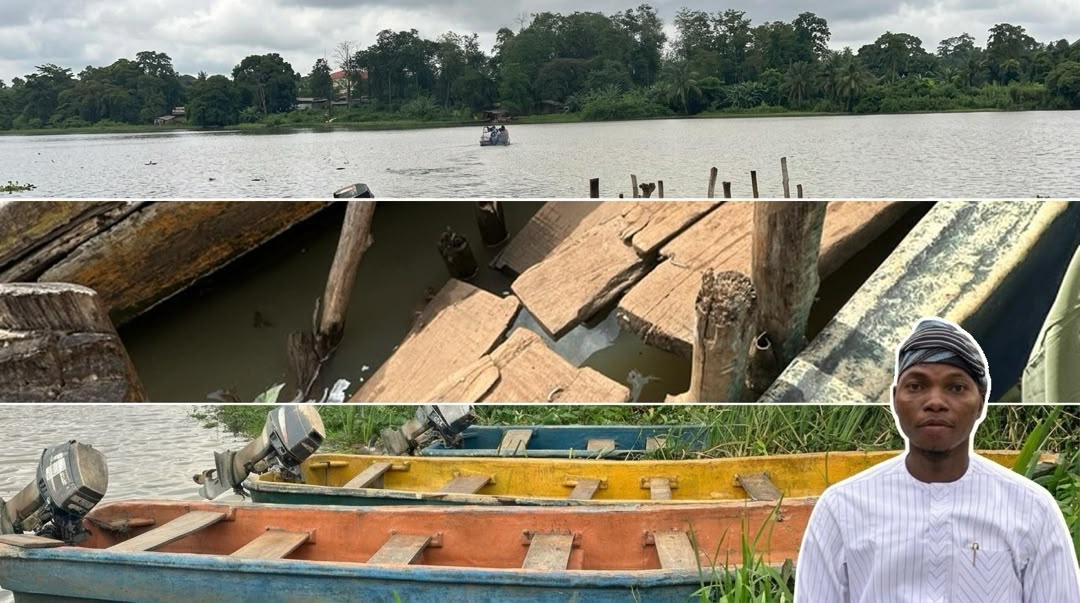
The boats are motorised, with plastic bodies, foam padding and flat wooden seats. A commonly observed arrangement has five wooden planks with about three passengers on each, giving an approximate capacity of 15, though this varies from boat to boat.
There are no conventional backrests. Passengers sit on the planks, sometimes with children on their laps. Operators sometimes ask adults travelling with more than one child to seat the children together rather than carry several at once. Passengers are also asked to adjust their positions to distribute weight and keep the boat balanced.
The crossing can take less than a minute when the operator accelerates. At other times it takes two to three minutes, depending on passenger load, water conditions, approaching boats and how the engine is regulated. At quieter periods, operators sometimes wait for enough passengers to make a trip worthwhile. Those in a hurry can pay for extra seats.
Boat safety in Ibadan: life jackets, capacity and fuel handling
Life jackets are available at the crossing, and some operators insist that passengers wear them. Their use, however, is not consistent. Some regular passengers, including children, board without asking for one.
The seating arrangement also raises questions about capacity. Although about 15 people can fit into the commonly observed layout, the approved passenger limit for each boat could not be established.
Fuel handling deserves attention too. I have observed some operators using ordinary plastic beverage bottles as fuel containers, with hoses connected to the engines. The practice raises questions about safe storage and handling, particularly when passengers are on board.
The wooden planks and structures at the boarding points also need regular maintenance. Some are exposed to the elements and show signs of wear, and water vegetation can obstruct parts of the route.
These observations do not mean every operator ignores safety. Practices differ. Some make life jackets compulsory, while others appear less strict. The challenge is that passengers should not have to depend on the individual attitude of whoever is operating their boat.
The crossing needs consistent safety standards that apply to everyone.
Why the Eleyele River crossing is a lifeline that needs protection
I have used the crossing for about three years and now rely on it for roughly 60 per cent of my journeys to Eleyele and other destinations, including Dugbe, Oke Ado, Challenge, Ring Road, Mokola and Ologuneru. I learnt about the route many years ago but was initially afraid of travelling by water. Repeated journeys made me more comfortable.
I have also introduced friends to the crossing, although many have declined because of their fear of water. For all the familiarity that comes with regular use, the possibility of something going wrong remains.
This report is based on interviews with commuters and residents, direct observation at the crossing, and my experience as a regular passenger. Several boat operators declined or were unavailable for interviews. One initially agreed to speak but later stopped responding.
For residents of Idunnu, Alakuta, Aderogba, Ogo Oluwa, Idi Mango and neighbouring communities, the Eleyele River crossing is an important transport service. Its affordability helps people save money, cut travel time and reach destinations that would otherwise cost more.
But the people who depend on it deserve more than a cheap ride.
Relevant government agencies and waterway authorities should work with boat operators and community representatives to:
- set clear passenger limits;
- encourage consistent life-jacket use;
- conduct routine boat inspections;
- promote safe fuel storage;
- put basic emergency-response arrangements in place; and, most importantly,
- provide safer and more sophisticated boats.
Operators also need safety training and properly maintained engines and boats, while the wooden boarding structures should be assessed and improved.
Beyond the river, the road infrastructure serving these communities also needs attention. In March 2024, Hon. Remi Oseni, representing Ido/Ibarapa East Federal Constituency, announced the reconstruction of the Awotan-Orioda-Alakuta Road, a project he facilitated. However, the road, which has a drainage structure on one side, does not extend fully to Alakuta, leaving residents of Idunnu and adjoining areas with continuing access challenges. Government intervention is needed to extend and properly reconstruct the road towards these communities, making it easier to reach the crossing and other destinations.
There is also room for responsible private investment in safer boats, better landing facilities and maintenance services, provided it does not make fares unaffordable for the residents who rely on them. The Idunnu Community Landlords’ Association and other stakeholders can also work with authorities and operators to encourage safer practices.
The Eleyele River has become a blessing to many households, particularly those who cannot afford the longer road journey every day. Its value is evident in the people who queue for boats each morning and return to the river in the evening.
But a blessing should not depend on luck.
For the hundreds of commuters who depend on the crossing, the goal should not simply be to get across the water for ₦100. It should be to get there and back safely.