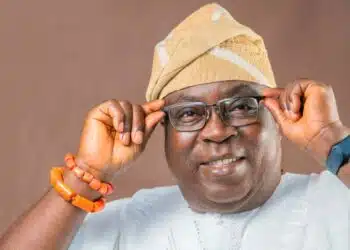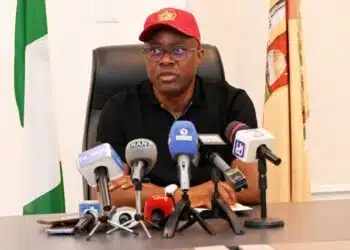

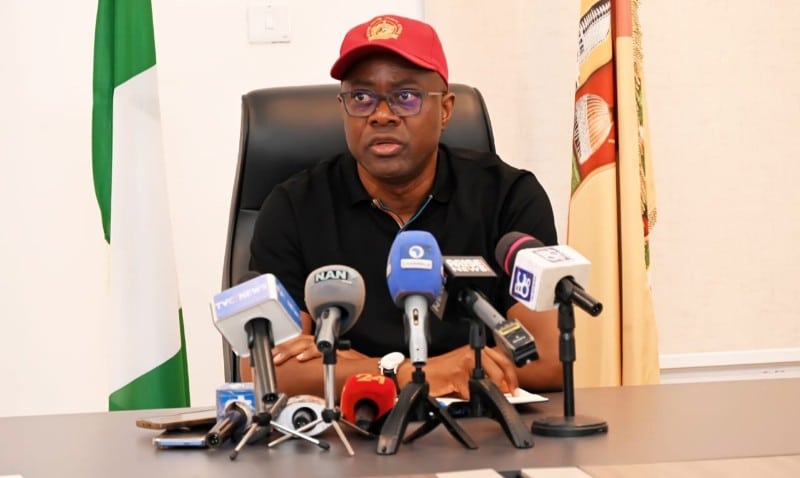
Oyo State Governor, ‘Seyi Makinde, has assured the public that his administration will thoroughly examine the recommendations of the Oriire Abduction Inquiry Report to reform the broader Oyo State security architecture.
Speaking at the executive chamber in Agodi, Ibadan, the governor stressed that confidentiality would not serve as an excuse to avoid accountability following the kidnapping of students and teachers in the Olorunsogo Local Government Area.

Governor Makinde gave the assurance on Tuesday while receiving the findings from the Commission’s Chairman, Hon. Justice (Prof.) Mojeed Owoade (rtd). He acknowledged that the incident severely tested the protective measures built by his government over recent years.
“When we came into office, the 615 toll free number had been approved but was not yet operational,” Makinde stated. “The City Watch and Security Control Room infrastructure had also been initiated, although parts of the system were not functioning as they should. We operationalized the 615, refurbished and expanded the control room, expanded its coverage, and connected the Police, Amotekun, Operation Burst, and other relevant services through a communication system that helped them coordinate a response.”
Addressing the Breakdown in Oyo State Security Architecture
The governor noted that previous security successes cannot obscure local operational failures. He emphasized that no responsible leadership can ask affected families to look past protective breakdowns simply because overall crime figures had declined elsewhere across the region.
“Some people will say that under this administration, we brought down the crime rate,” he remarked. “But Oriire is part of the record. No responsible government can point to earlier progress and ask families to overlook a grave failure of protection.”
Makinde expressed gratitude to the combined tactical teams, highlighting the vital role played by local search parties and the Amotekun corps security response alongside federal law enforcement partners during the rescue operations.
“We can never diminish the effort of those who contributed — the Operational Coordination Center, Amotekun personnel, hunters, vigilantes, the military, police, intelligence services, and other federal agencies,” he said. “I must also thank the DG DSS and the State Directors of Security in Oyo and Lagos States who relocated to Oyo during this period.”
Why Governor Seyi Makinde Ordered the Probe
For Governor Seyi Makinde, recovering victims represents only part of the state’s responsibility. True success requires addressing systemic vulnerabilities to stop future incursions before they begin.
“Rescue cannot be the only measure of success,” Makinde explained. “We must ask: What could have prevented the attack? What could have shortened the ordeal? What will make children safer in their schools?”
Connecting the lessons learned to broader regional protection, the governor reiterated his call for structural changes across Nigeria’s defense networks.
“This is why, at the national level, I have discussed a security reset for Nigeria,” he declared. “We must have distinct systems. The reason we could ask the commission to see where there may have been failure is because we have a system — so we can point to where it broke. Nigeria must also have a working system.”
He assured citizens that the findings would trigger concrete policy decisions rather than gather dust on administrative shelves.
“This commission’s report will lead to decisions, assigning responsibilities, and progress that the public can follow,” he promised. “Our children’s safety must be the test of what changes.”
Reflecting on the panel’s setup, the governor added: “We established this Judicial Commission of Inquiry to examine how the attack occurred, what information was available, how institutions responded, whether there were intelligence, administrative, or operational failures, and what must change to prevent another such tragedy.”
Expressing appreciation to the panel, Makinde praised their steady work during tense circumstances. “Let me specially, from the bottom of my heart, thank the chairperson and members of the commission for undertaking this difficult assignment,” he noted. “When it was set up, it was in a politically charged atmosphere. But you took on the assignment and saw it through to a logical conclusion. I say thank you on behalf of myself, the government, and the people of Oyo State.”
Key Findings of the Oriire Abduction Inquiry Report
Presenting the document, Hon. Justice (Prof.) Mojeed Owoade (rtd) outlined the extensive ground operations conducted by panel members to evaluate local vulnerabilities directly.
“We visited the scenes of the crime, inspected the affected schools, and went through the bushes to have first hand knowledge of what actually happened on that fateful day,” Justice Owoade said. “We held public hearings in Ikoyi Ile, Ogbomoso, and Ibadan. On the whole, we took 72 witnesses, including victims, traditional rulers, civil society organizations, individuals, experts, and other stakeholders.”
He explained that their submissions aim to establish proactive measures through sharper intelligence protocols and improved cross-agency communication.
“We produced a report aimed at strengthening preventive security measures for the future through improved intelligence gathering and necessary cooperation between security agencies and government institutions,” Owoade stated.
Crucially, the commission identified federal land management as a key factor in regional safety, calling for updated oversight of dense wilderness sectors often exploited by criminal elements.
“Of particular significance is our opinion that there is a need to review the laws and management of forest reserves, especially the Old Oyo National Park, which belongs to the federal government,” Justice Owoade concluded. “This is essential for maintaining security.”
The presentation was attended by senior officials, including Deputy Governor Barr. Bayo Lawal, Speaker Rt. Hon. Adebo Ogundoyin, cabinet commissioners, heads of security agencies, and traditional leaders.