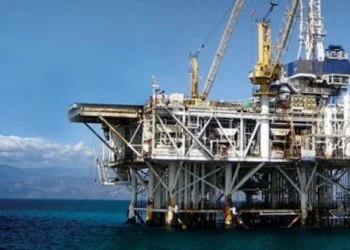


Oil prices surged past $100 a barrel for the first time since 2022 as fallout from the US-Israel war with Iran continued to rattle global markets and leading economies moved to tackle a worsening energy supply crisis.
A weekend of escalating violence in the Middle East intensified concerns around a sustained supply crunch, propelling oil prices to their highest level in four years and triggering a deep stock market sell-off.
At least five energy sites in and around Tehran were hit by strikes, prompting accounts of “apocalyptic” scenes in the Iranian capital. Kuwait’s national oil company also announced a precautionary production cut amid retaliatory attacks by Iran.
The strait of Hormuz – one of the world’s most important trade arteries, through which about a fifth of global oil and seaborne gas tankers typically pass – has in effect been closed for a week.
Brent crude, the international benchmark, climbed as high as $119.50 (£89.40) a barrel – up 29% – as the new week’s trading began in the Asia Pacific markets, the first time market prices have soared above the key psychological $100 threshold since Russia’s invasion of Ukraine.
The increase narrowed, however, after reports that finance ministers from across the G7 group of developed economies would discuss a possible joint release of petroleum from reserves in an effort to tackle the surge in oil prices.
Later in the day, Brent crude was up 8% at about $100 a barrel. The West Texas Intermediate (WTI) benchmark price of US crude also rose 13% to $103 a barrel.
The extraordinary surge in oil prices is “a very small price to pay” for the US “and World, Safety and Peace”, Donald Trump wrote on Social Truth on Sunday. He described it as a short-term consequence of the US-Israel war on Iran, and claimed oil prices would “drop rapidly when the destruction of the Iran nuclear threat” was over.
The Iranian regime said US-Israeli strikes risked pushing prices even higher. “If you can tolerate oil at more than $200 per barrel, continue this game,” a spokesperson for the country’s Revolutionary Guard Corps (IRGC) said after the weekend’s strikes on energy sites.
Stock markets across Europe fell on Monday, with the UK’s blue-chip FTSE 100 index down 1%. The German Dax dropped by 1.2%, while the French Cac 40 was down 1.8%. The Stoxx Europe 600, which tracks the biggest companies across the continent, fell by 1.3%, erasing all of its gains in the year so far.
On Wall Street, the Dow Jones, S&P 500 and tech-focused Nasdaq all fell about 1% at the open.
Japan’s Nikkei 225 dropped 5% on Monday, as South Korea’s Kospi slumped 6.6%. Australia’s ASX 200 finished a volatile day of trading down 2.9%.