

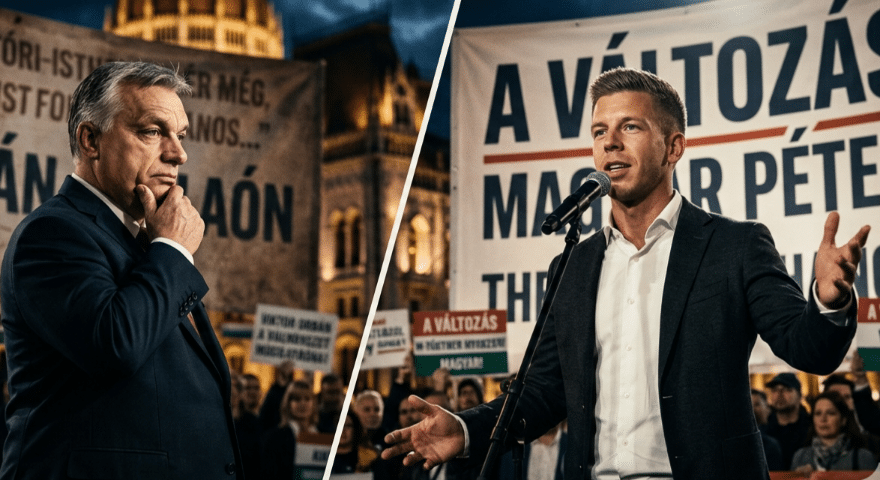
The 16-year reign of Viktor Orbán has reached a dramatic end. The Hungarian Prime Minister conceded defeat after the opposition secured a landslide victory that reshapes the political map of Central Europe.
Péter Magyar, a former ally turned fierce critic, led his Tisza party to a massive majority. With over 98% of votes counted, the result represents an astonishing achievement for a movement that barely existed two years ago. Record turnout suggests that voters viewed this election as a pivotal moment for the future of both Hungary and the European Union.
After 16 years, the Orbán experiment is over
What Viktor Orbán did for the last 16 years in power was an experiment—but even he didn’t know what to call it.
“Illiberal democracy” sounded too negative. His American friends liked to call it “national conservatism”, which sounds better, but it was never strictly true. Unlike most conservatives, Orbán was a rebel. He constantly radicalised himself—so what could he conserve?
He portrayed himself as an “anti-globalist” but invited German car makers and Chinese and South Korean EV battery makers to Hungary. He painted himself as the champion of national sovereignty, but refused to stand up for Ukrainian sovereignty against Russia. He railed against immigration, but quietly encouraged immigration to build his new factories.
One year after winning a two-thirds majority in 2010, he wrote a new constitution. He reshaped Hungary in his own image to suit his own party. He pushed through one law after another to change the structure of the courts, the electoral system, and the economy. But on Sunday, Hungarians decisively told him: “We don’t want to be experimented on any longer.”
#Who is Péter Magyar? The insider-turned-rebel

Péter Magyar is set to replace his former ally Viktor Orbán as prime minister of Hungary after pulling off a massive election win. The 45-year-old became interested in politics from an early age. He studied law at a Catholic university in Budapest before joining Orbán’s Fidesz party shortly after it lost power in 2002.
He was an important behind-the-scenes figure within the group for over two decades. However, in 2024, Magyar stunned Hungarians by publicly breaking with the party. This followed a sex abuse scandal which saw his ex-wife, Hungary’s former justice minister, resign.
Magyar says he never planned to become a mainstream political figure. Driven by what he saw as corruption, he launched a new movement under the Tisza party banner. He built a wide support base by touring small towns and villages where Fidesz usually dominates. On Sunday, that grassroots effort transformed into a total victory.
Orbán bet everything on the Ukraine war—and it cost him
The Hungary election results reveal a significant shift in public anxiety. In 2022, Fidesz successfully used the war in Ukraine to frame the opposition as “pro-war.” However, that tactic failed in 2026.
Hungarian voters were no longer afraid the country could be drawn into the conflict. According to Policy Solutions, the number of people who fear being dragged into the war has halved. Even in regions bordering Ukraine, the opposition outperformed Fidesz.
In the final weeks, Fidesz tried to focus on fuel prices and utility costs. But by that stage, Péter Magyar was already setting the agenda. He forced uncomfortable issues into the public debate and dictated the pace of the campaign. For Orbán, the man who dominated Hungarian life for nearly two decades, the gamble on fear finally ran out of credit.
The party is in full swing in Budapest now
This has turned into a party now – people are dancing in the streets as the celebrations go late into the night in Budapest.
Some were even dancing up on the stage as Péter Magyar finished his victory speech.
The smell of smoke from flares is mixed in with the smell of champagne and beer hanging in the air.
Everyone I’ve spoken to among the crowd has said the relationship between Hungary and Russia was what defined their vote.
“I’m finally proud to be Hungarian,” one woman told me.