
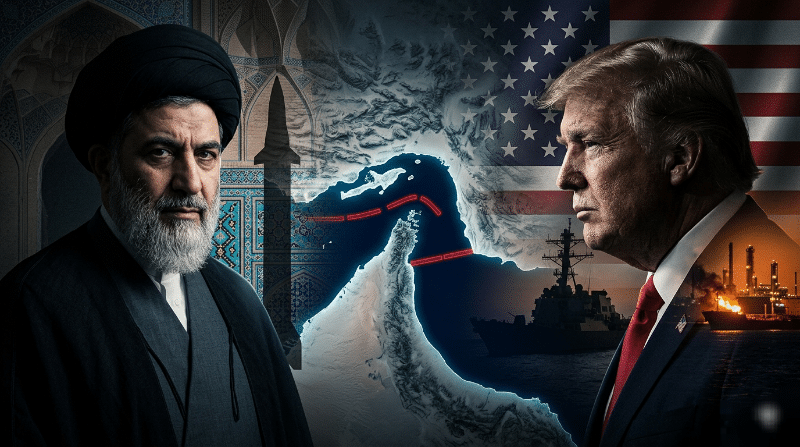
Mojtaba Khamenei, the newly installed Supreme Leader of Iran, has declared that the Strait of Hormuz will “remain closed,” effectively throttling a primary artery of global energy trade.
In his first public address since succeeding his father—who was killed during the opening salvos of the war between Iran, Israel, and the United States—the younger Khamenei signalled a hardline continuation of the conflict.

In official statements circulated via state-run media on Thursday, Mojtaba Khamenei warned that Tehran would maintain its offensive against United States military bases and regional allies. He swore a solemn oath to “avenge the blood of Iranians” shed in the recent escalations.
Escalation in the Gulf
The defiance from Tehran comes as the maritime conflict reaches a fever pitch. Two tankers were reported ablaze in Iraqi waters overnight, the latest victims in a series of Iranian strikes that have crippled Middle East energy supplies. These attacks directly challenge US President Donald Trump’s recent assertions that the United States had already secured a military victory in the region.
Footage obtained by foreign correspondents, reportedly filmed from the shores of Basra, showed thick plumes of black smoke rising from vessels on the horizon. Iraqi authorities confirmed the ships were intercepted by Iranian fast-attack boats laden with explosives. At least one crew member has been confirmed dead.
Global Markets in Turmoil
The economic fallout was instantaneous. Approximately 20 per cent of the world’s total oil and global Liquefied Natural Gas (LNG) supplies transit through the narrow chokepoint. Following news of the fresh attacks, Brent crude surged past the $100-a-barrel mark, as traders braced for a prolonged disruption to global supply chains.
The persistent instability has forced the hand of the world’s largest shipping conglomerates. Giants including MSC, Hapag-Lloyd, and Maersk have officially suspended all bookings to and from major Gulf ports. The suspension covers critical hubs in Saudi Arabia, the UAE, Kuwait, Iraq, and Qatar.
The Impact on Nigeria
For Nigeria, the crisis is hitting home with devastating precision. With major shipping lines imposing extraordinary war-risk surcharges and halting operations in the Gulf, Nigerian exporters are being forced into a corner.
Businesses are now facing a choice between using significantly more expensive, time-consuming alternative routes or forfeiting their shipments entirely. For a nation reliant on foreign exchange, the effective closure of the Gulf threatens to drain crucial revenue at a time of global economic fragility.