

President Bola Ahmed Tinubu has declared that his administration will not negotiate with kidnappers, bandits, or violent criminal syndicates. Highlighting a critical shift in the broader Nigeria security strategy, the President revealed how the federal government successfully defied terrorists during a recent school abduction in Oyo State.
The criminal gang demanded money alongside the release of detained accomplices, but officials rejected these demands, demonstrating a strict anti-kidnapping policy aimed at starving criminal networks of funds and operational momentum.

The President’s unequivocal stance comes as Nigeria confronts persistent threats from mass abductions, terrorism, and banditry across several regions. Over the past decade, kidnapping for ransom has transformed from isolated criminality into a lucrative enterprise, with armed gangs using vast forest reserves as operational bases. Security analysts consistently emphasise that paying ransoms only fuels this ecosystem by enabling syndicates to acquire heavier arms and recruit more fighters.
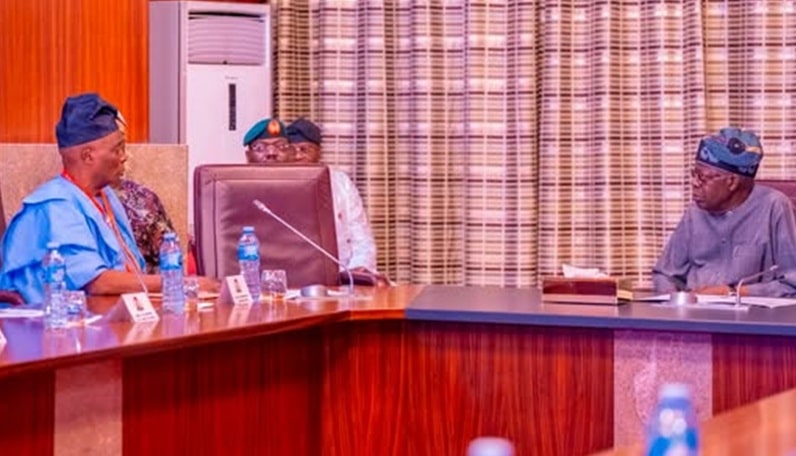
Speaking to a delegation of Oyo State traditional rulers led by the Olubadan of Ibadanland, Oba Rashidi Ladoja, at the State House in Abuja, President Bola Ahmed Tinubu reaffirmed that the state would remain resolute against criminal blackmail.
He noted that abductors in the Oriire Local Government Area attempted to force a prisoner exchange in addition to a monetary payout. “We refuse to negotiate with criminals. They wanted us to release members of their criminal gangs already in detention in addition to demanding money, but we said no deal. We will not negotiate with murderers and terrorists,” he emphasised.
This confirmation highlights a concerning shift in tactics, with criminal gangs adopting methods long associated with extremist groups across the Sahel. However, President Bola Ahmed Tinubu praised the Armed Forces and joint security units for their tactical precision during the rescue operation, noting that every successful intervention offers actionable lessons to refine the overarching Nigeria security strategy.
“I agree with you that we should commend the men and women of the Armed Forces for their excellent performance. Every security operation teaches us new lessons, challenges us to review our security architecture, strategy and operational plans, and strengthens our resolve to defeat terrorism and banditry,” he said.
Expanding Military Capacity and State Police Safeguards
To address these security challenges systematically, the federal government is executing structural reforms across the defence establishment. Key among these measures is expanding the Nigerian Army from eight to twelve divisions to improve field deployment and reduce response times to emerging threats.
Furthermore, President Bola Ahmed Tinubu highlighted progress on decentralised policing, confirming that the administration is working to establish local forces equipped with strong state police safeguards to prevent political abuse. Complementing this approach is the empowerment of forest guards to reclaim ungoverned spaces where criminal gangs operate.
“There will be state police, but with guardrails against abuse. Traditional rulers will also have greater roles to play. We are equally enhancing the capacity of forest guards, not to chase animals, but to pursue criminals and deal decisively with them,” the Nigerian leader stressed.
Countering Cross-Border Threats and Sahel Border Security
Addressing regional instability, President Bola Ahmed Tinubu connected domestic security challenges to volatile conditions in West Africa. Political instability and insurgencies in neighbouring Mali, Burkina Faso, and the Niger Republic have created porous corridors, enabling foreign fighters and illegal weapons to cross national borders into Nigerian territory. Strengthening Sahel border security remains central to stopping this influx.
He noted that several suspects involved in the Oriire abduction were non-Nigerians, underscoring the urgent need for heightened vigilance, border management, and community-led intelligence sharing.
“We are enhancing the capacity of the forest guards. They will not only protect wildlife; they will pursue criminals in the forests. Intelligence is important, and I urge people to be vigilant, know their neighbourhoods and report strangers,” he pointed out.
While acknowledging the scope of the problem, President Bola Ahmed Tinubu expressed confidence in ongoing reforms: “The immediate challenge is monumental, but I asked for this responsibility and I accept both its assets and liabilities. I can assure Nigerians that the security situation is improving. Whenever you see our soldiers and police officers, encourage them and thank them because they are making tremendous sacrifices to keep our country safe.”
He also urged state governors to allocate funds toward rural road infrastructure rather than non-essential urban projects, emphasising that accessible road networks allow security forces to navigate vulnerable areas efficiently.
“You need to help us communicate to these governors. Today, the economy of operation is high. But the money that I’m pushing to the states, if you had it during your own time or during my time, it would have been different. They are taking four to five times their money. Nobody is borrowing money to pay salaries now. Pensioners are receiving their pay, and they should do more to, instead of flyovers where there is no numeric traffic, build roads and arteries network to really enhance the quality of life and the accessibility of the security agencies to penetrate those areas,” he advised.
Local Endorsement and Strategic Forest Corridors
In his remarks, the Olubadan of Ibadanland, Oba Rashidi Ladoja, commended the federal government’s resolute approach to the Oyo State kidnappings, calling the rejection of ransom demands a pivotal milestone in national security administration.
“We were apprehensive after that first major kidnapping in Oyo State, but between you and your security people, you have made a turning point. The fact that you did not pay ransom shows we now have a government that knows what it is doing,” he said.
The Olubadan of Ibadanland, Oba Rashidi Ladoja, urged sustained security coverage across the forest corridor connecting Oyo, Kwara, and Niger states—specifically highlighting Iseyin, Igboho, Kishi, and Baruten as critical areas requiring continuous monitoring. He also acknowledged ongoing federal infrastructure projects in Oyo State, noting that improved transportation links will strengthen both economic growth and regional security.