
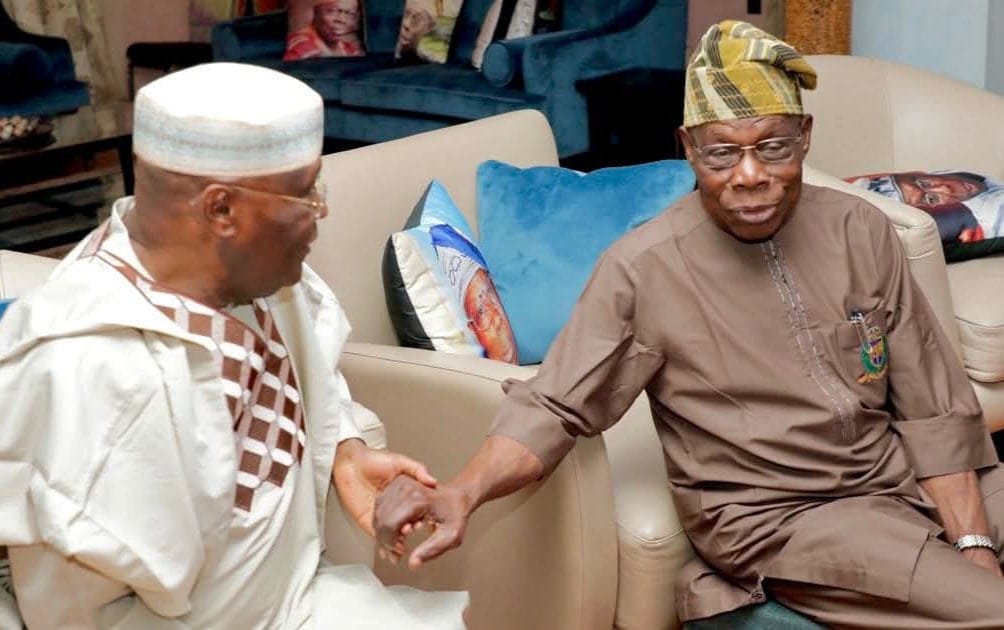
Former Vice-President Atiku Abubakar has defended his role in blocking Olusegun Obasanjo’s third-term presidential ambition, rejecting accusations of betrayal.
Speaking through his spokesman Phrank Shaibu on Saturday, Mr Abubakar responded directly to recent comments made by former President Obasanjo, who had called selecting Mr Abubakar as his running mate in 1999 the “biggest mistake” of his presidency.

Mr Obasanjo made the remarks in Lagos during a public presentation for activist Charles Oputa.
In a sharp rebuttal, Mr Abubakar accused his former superior of attempting to rewrite history, insisting his opposition to an unconstitutional third term saved Nigerian democracy.
“I am proud that I stood against the third-term agenda. I am proud that I stood by the Constitution of the Federal Republic of Nigeria. I have no apology whatsoever for frustrating every attempt to subvert our democracy for personal ambition,” Mr Abubakar said.
“If Chief Obasanjo’s bitterness stems from my refusal to support an unconstitutional third term, then I wear that resentment as a badge of honour. No individual, regardless of his status or accomplishments, is bigger than the Federal Republic of Nigeria. The Constitution is supreme, and I chose Nigeria over personal loyalty.”
The former vice-president emphasised that the struggle was “never about two individuals but about preserving Nigeria’s constitutional democracy for future generations.
“The Nigerian people won that battle. Democracy won that battle. History has already delivered its verdict,” he added.
Historical Fractures and Nigeria’s Democratic Safeguards
The reignited Atiku Abubakar Obasanjo row highlights the enduring political divisions that continue to shape West Africa’s largest democracy. By framing his opposition to Mr Obasanjo as a constitutional duty, Mr Abubakar aims to consolidate his legacy as a defender of democratic institutions—a critical narrative ahead of future political contests.
The third-term agenda of 2006 remains one of the most controversial episodes in Nigeria’s post-1999 political era. Had the constitutional amendment succeeded, it would have established a dangerous precedent across the region, where executive overreach remains a persistent threat.
By grounding his defense in constitutionalism, Mr Abubakar shifts the narrative away from personal animosity toward institutional integrity.
Addressing claims regarding their early political partnership, Mr Abubakar detailed his role during Mr Obasanjo’s incarceration under military rule and his subsequent ascension to power.
“History records that while Chief Obasanjo was in prison, I stood firmly by him. I supported his family, worked tirelessly with other patriots for his release and never wavered in my belief that he deserved his freedom,” he said.
“When he eventually regained his freedom, he had little to his name. I received him, clothed him, ensured he was properly cared for and extended every support necessary to help him regain his footing.”
“Beyond that, I mobilised political structures, built alliances and made enormous personal and political sacrifices that culminated in his emergence as President of the Federal Republic of Nigeria.”
Mr Abubakar stressed he held no regrets over aiding his former commander, noting that “acts of kindness are matters of conscience, not commercial transactions,” while warning that “gratitude should never be replaced with revisionism.”
Economic Records and the 2027 Horizon
Mr Abubakar also referenced recent comments from Ngozi Okonjo-Iweala, Director-General of the World Trade Organisation, who praised the administration’s economic team—which Mr Abubakar led as head of the National Economic Council.
“Whether or not the timing is merely coincidental is for Nigerians to judge. What is beyond dispute, however, is that while distinguished Nigerians who served at the highest levels continue to acknowledge my contributions to one of Nigeria’s most successful periods of economic management, Chief Obasanjo appears determined to diminish them,” he noted.
He expressed frustration that former leaders were “recycling old grudges instead of contributing solutions” during a period marked by high inflation and security challenges.
“The 2027 election should be about rebuilding Nigeria, restoring security, reviving the economy and giving hope to the next generation—not reopening old political wounds,” Mr Abubakar said.
“Chief Obasanjo is entitled to his opinions. He is entitled to his personal grievances. What he is not entitled to are his own facts.”