

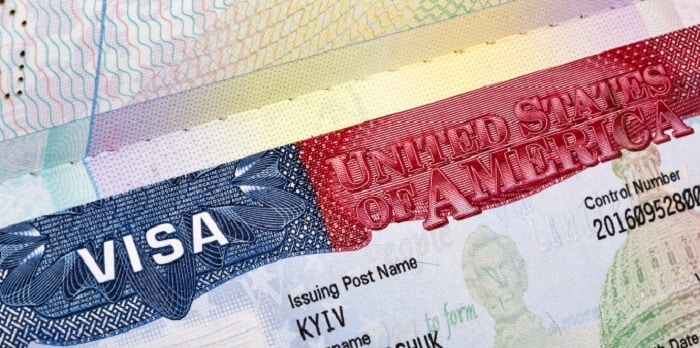
Washington has permanently introduced the US visa bond programme, requiring travellers from 50 nations to post up to $20,000 before entry.
The regulation, published by the US Department of State, takes full effect on 3 August. Under the rules, consular officers gain permanent authority to demand refundable financial guarantees from individuals applying for short-term entry. The requirement applies directly to applicants seeking B1 (business) and B2 (tourism) travel authorisations from designated countries.
According to the official notice, “Consular officers may require covered nonimmigrant visa applicants to post a bond of up to $20,000 as a condition of visa issuance, as determined by the consular officers.”
Washington previously tested the financial mechanisms through a trial scheme designed to monitor overstay statistics. Officials confirmed the strategy works as a deterrent against non-immigrant overstays, prompting the decision to codify the rules into federal regulations.
The Department of State confirmed: “The 2025 visa bond pilot, which provided a framework for the Department of State, the Department of Homeland Security, and the Department of the Treasury to assess the feasibility of administering a visa bond programme, has provided sufficient data to suggest that a visa bond programme is an effective tool for enforcing compliance among bonded visa holders.”
During the trial period, officials set bond tiers at $5,000, $10,000, and $15,000. The permanent framework completely removes the lowest $5,000 tier while raising the maximum penalty ceiling to $20,000.
African states account for 30 of the 50 impacted territories, with Nigeria representing the largest economy on the list. Asian and Latin American states, including Pakistan, Venezuela, and Afghanistan, face identical measures under the updated framework.
Economic Barrier Shifts Global Mobility Dynamics
The decision to solidify these US immigration rules creates an unprecedented financial barrier for international travellers from developing economies. By eliminating the $5,000 baseline tier, Washington effectively excludes middle-income business travellers and families who cannot secure liquid capital worth tens of thousands of dollars.
For nations like Nigeria, where foreign currency reserves remain constrained, sourcing $20,000 in upfront capital presents a formidable hurdle. Business delegations, academic exchanges, and medical tourists will face immediate liquidity disruptions. Critics argue the measure functions as a de facto entry ban for ordinary citizens, regardless of their intent to comply with departure dates.
However, Washington maintains the strategy is necessary to safeguard domestic borders and enforce compliance. US authorities said the policy is intended to reduce the number of visitors who overstay their visas.
Widening Diplomatic Divide and Systemic Impact
Immigration policy analysts warn that the move threatens to strain diplomatic relations with key allies across the Global South. The heavy focus on African nations has drawn sharp criticism from international advocacy groups who view the policy as punitive rather than preventive.
However, immigration advocates have criticised the measure, arguing that it could discourage legitimate travellers from visiting the United States and further restrict legal immigration.
The measure forms part of a broader, systemic tightening of American border controls. The visa bond policy is one of several immigration measures introduced under President Donald Trump’s administration, which has also imposed higher visa fees and expanded social media screening for visa applicants.
The complete list of affected countries includes: Afghanistan, Angola, Benin, Bhutan, Burkina Faso, Burundi, Cabo Verde, Cambodia, Cameroon, Chad, Republic of the Congo, Democratic Republic of the Congo, Djibouti, Equatorial Guinea, Eritrea, Ethiopia, Gabon, The Gambia, Guinea, Guinea-Bissau, Haiti, Ivory Coast (Côte d’Ivoire), Laos, Liberia, Libya, Malawi, Mali, Mauritania, Myanmar, Nigeria, Pakistan, Papua New Guinea, São Tomé and Príncipe, Senegal, Sierra Leone, Solomon Islands, Somalia, South Sudan, Sudan, Syria, Timor-Leste, Togo, Tonga, Tuvalu, Uganda, Vanuatu, Venezuela, Yemen, Zambia, and Zimbabwe.