

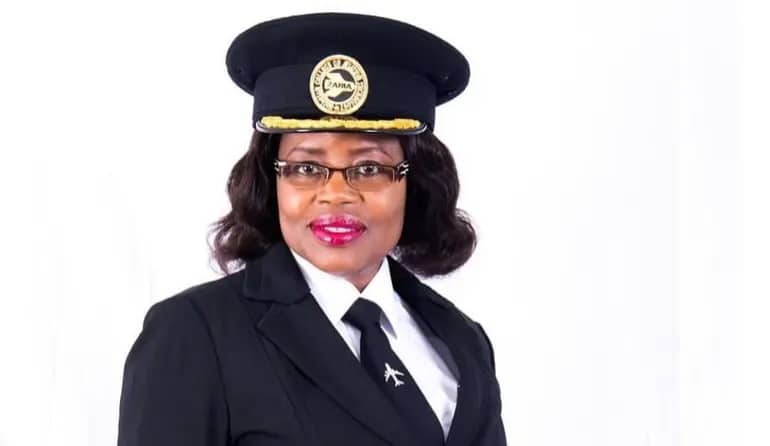
When the twin-engine trainer banked sharply over the northern plains of Kaduna State on 6 June 1978, the teenager at the controls was doing something no Nigerian woman had ever done before. Sitting alone in the cockpit for her first solo flight, surrounded by the hum of the engine and the wide expanse of the West African sky, Captain Chinyere Onyenucheya Kalu did not freeze. Instead, she sang. And she made history as the pioneer female commercial Pilot in Nigeria.
Moments earlier, her flight instructor had offered a blunt, parting push: “Go, if you like, kill yourself.”

It was the sort of sink-or-swim moment that defined aviation training in the late 1970s, but for Kalu, it was pure liberation. “Instead of being afraid, I felt relaxed,” she later recalled. “I was singing and praising God while flying. It was one of the happiest days of my life.”
Three years after that solitary flight, on 20 May 1981, Kalu officially collected her licence at the Nigerian College of Aviation Technology (NCAT) in Zaria. With a single signature, she took her place as Nigeria’s first female commercial pilot, tearing down a stubborn barrier in an industry that had long treated the flight deck as an exclusively male enclave.
The Making of Nigeria’s First Female Commercial Pilot
Kalu’s journey to the flight deck began far from any tarmac. Born in 1970 in Akwete, a historic town in the Ukwa East local government area of Abia State, her childhood was anchored by her mother and a close-knit extended family following her parents’ separation.
In a community where traditional expectations for young girls were strictly defined, Kalu found an unexpected mentor in her maternal aunt, a nurse who held the distinction of being the first person from their village to travel to the United Kingdom.
When a young Kalu voiced a bold ambition to fly airplanes, her aunt did not dismiss it as a childhood fantasy.
“My aunt felt, ‘This is your opportunity, don’t even look back, just make the most of it, grab it,’” Kalu shared in a 2012 interview. With her aunt’s enthusiastic backing and her mother’s steadfast support, Kalu completed her secondary education at Anglican Girls Grammar School in Yaba, Lagos, before packing her bags for the aviation academy in Zaria.
Navigating Gender Bias and Regional Barriers
Stepping onto the runway at NCAT as part of the SP.12 training batch, Kalu entered an environment completely unaccustomed to women in pilot uniforms. The physical demands of flight training were only part of the ordeal; navigating the cultural politics of the era proved equally taxing.
Throughout her career, Kalu spoke openly about the double-edged sword of prejudice she faced as a woman from the South East competing in a tight-knit, male-dominated sector.
“If you are not from the right part of the country, if you don’t speak the right language, you won’t get all the support and encouragement. I suffered a lot because of that. Some people felt I was a threat to them, but God has been faithful.”
Rather than letting hostility stall her ambitions, Kalu focused on mastering her craft. After securing her initial licence as a female commercial pilot, she undertook advanced flight and transport management courses across the United Kingdom and the United States, building an undeniable portfolio of credentials.
Choosing Family, Training, and Surviving a Mid-Air Emergency
For many aviators, the primary goal is a long-haul career with a major global airline. Kalu, however, chose a different flight plan—one rooted in ground instruction and institutional leadership.
After marrying her husband, Mr. Onyenucheya, and starting a family that would grow to include three children, Kalu made a deliberate decision to build her career around flight training at NCAT rather than the unpredictable schedules of long-haul commercial routes.
As a commercial pilot, I would have to travel constantly,” she explained in 2020. “I felt that would be difficult for me as a wife and mother.”
That decision kept her on the front line of training Nigeria’s next generation of aviators, though it did not keep her out of harm’s way. In 2006, while conducting an instructional flight with students, the aircraft suffered a sudden, catastrophic mid-air engine failure.
With seconds to react as the plane lost altitude, Kalu’s training took over. She assumed manual control, scanned the landscape below, and dead-sticked the dying aircraft onto a clear patch of terrain.
“By God’s grace, we landed safely on a guinea corn field,” she recalled. “None of us came out with a scratch; it was a miracle.”
From Trainee to Rector: Leading National Aviation Infrastructure
The defining full-circle moment of Kalu’s career arrived in October 2011, when President Goodluck Jonathan appointed her as the Rector and Chief Executive Officer of the Nigerian College of Aviation Technology—the very institution where she had taken her first flight three decades earlier. As the first woman ever appointed to head the country’s premier flight academy, she oversaw sweeping upgrades to training infrastructure, flight simulators, and safety protocols between 2011 and 2014.
Her historic achievements earned her widespread national recognition, including the conferment of Member of the Order of the Federal Republic (MFR) in 2006 and her inclusion among Nigeria’s 50 Greatest Women during the Golden Jubilee celebrations in 2011.
Today, as more young West African women enter cockpit crews, flight schools, and aerospace engineering programmes, they walk down a runway that Captain Chinyere Kalu cleared for them decades ago—proving the lasting legacy of Nigeria’s first female commercial pilot.