
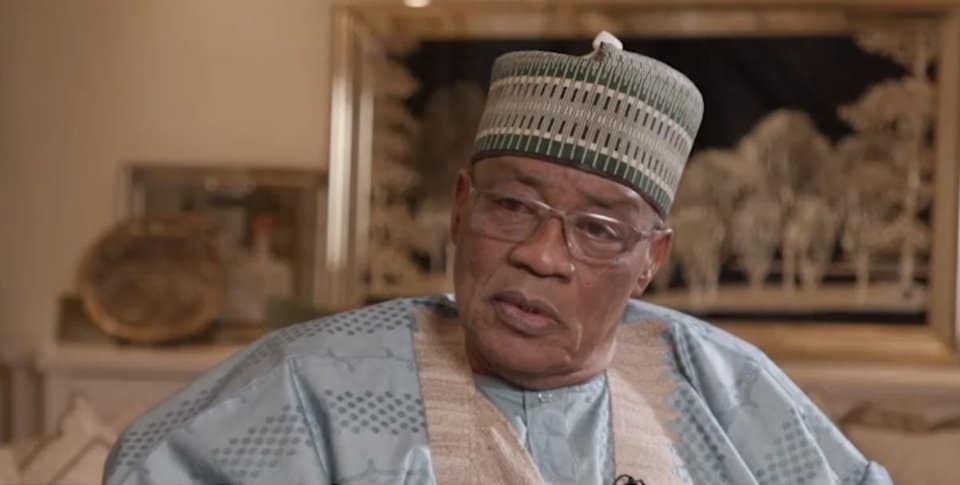
Former Nigerian military president General Ibrahim Badamasi Babangida (retd.), widely known as IBB, has revealed that wealthy civilians historically played a decisive role in financing military coups across the country.
In a candid reflection on Nigerian political history, the former leader emphasised that financial and logistical civilian involvement in coups was a constant feature of every successful overthrow of government in the nation’s past.

Speaking during an exclusive interview with Badeggi 90.1 FM in Minna, Niger State, to mark his 85th birthday, the former military ruler—who governed Nigeria between 1985 and 1993—addressed the complex mechanics behind historical power shifts. He insisted that the armed forces never acted entirely in isolation when taking over power.
“No successful coup in Nigeria’s history had occurred without civilian involvement,” he said.
Financial Backing and Civilian Involvement in Coups
Babangida explained that public perceptions of past overthrown governments often focus solely on soldiers in uniform, overlooking the influential private figures funding those operations. According to the former president, elite civilians provided the funding, ideological backing, and strategic alignment necessary to execute successful military coups.
His remarks offer a rare insight into the hidden networks that shaped Nigeria’s turbulent political landscape during the late 20th century, confirming long-held suspicions among political analysts regarding elite collaboration in governance disruptions.
The Mamman Vatsa Execution and Internal Betrayal
Revisiting one of the most painful episodes of his presidency, Babangida spoke openly about the 1985 plot against his administration and the subsequent Mamman Vatsa execution. Major-General Mamman Vatsa, who served as Minister of the Federal Capital Territory, was a lifelong friend and close confidant of Babangida.
The former president admitted that he initially struggled to process the intelligence reports implicating his childhood friend in a plot to overthrow his government.
“Initially, I found it difficult to believe reports linking Vatsa to a planned coup because of our long-standing friendship and shared history,” he said.
Attempting to address the matter directly, Babangida summoned both Vatsa and Major-General Mohammed Gado Nasko to his office to confront them with the intelligence gathered by military authorities.
“When they arrived, I asked them about the reports that they had been mentioned in a plot to topple my government. Both of them denied any involvement,” he said.
Military Inquiries and the Consequences of Military Coups
Following their initial denials, a formal military commission of inquiry was established to investigate the conspiracy thoroughly. The panel carefully reviewed the available evidence before reaching its final verdict.
“While General Gado Nasko was cleared of any wrongdoing, the panel found evidence linking Vatsa to the coup plot,” Babangida said.
The findings left the military chief facing an agonizing personal and official dilemma. Despite their decades-long friendship, the legal framework governing the armed forces left no room for executive leniency in cases of high treason.
Babangida stated that the panel’s conclusion left him “shocked, devastated and deeply disappointed”.
“There was nothing I could do to exonerate him from the consequences prescribed by military law. My hands were tied. That was how I lost my brother, General Mamman Vatsa,” he said.
General Vatsa was subsequently executed by firing squad in March 1986. The two men had grown up together, attended Bida Middle School (now Government College Bida), graduated in the same year, and enlisted in the military side by side.
Looking Ahead at Nigeria’s National Trajectory
Reflecting on the broader impact of historical military coups and the country’s ongoing economic and security struggles, Babangida expressed confidence in Nigeria’s resilience. He urged citizens to remain patient and support the current democratic administration under President Bola Tinubu as it implements economic reforms.
He expressed optimism that ongoing national policies would eventually bring stability and economic recovery to the nation.