
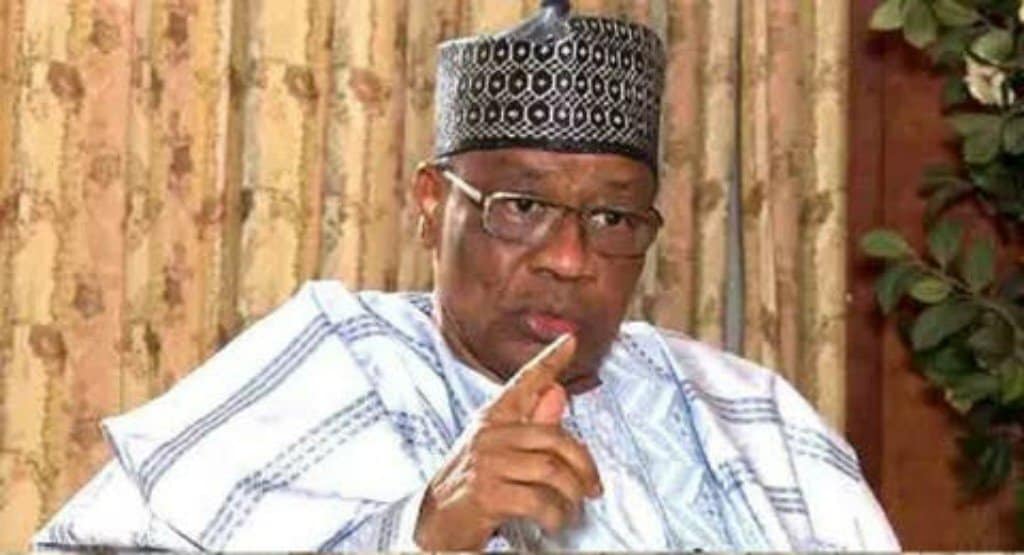
The ongoing national debate regarding systemic corruption in Nigeria has taken a dramatic turn as a resurfaced television exchange involving former military head of state General Ibrahim Badamasi Babangida (retd.), returns to public view.
In the historic broadcast, the former leader reflected on the governance standards of his military administration, asserting that the financial indiscretions of his era pale in comparison to modern political scandals.

General Ibrahim Babangida on Historical Governance and Accountability
The newly recirculated General Ibrahim Babangida interview has reignited intense conversations surrounding historical accountability, institutional governance, and the evolution of public sector transparency in Africa’s most populous nation.
Ibrahim Babangida served as the military ruler of Nigeria from August 1985 until he stepped aside from office in August 1993. His tenure remains one of the most thoroughly analysed periods in the nation’s political evolution, marked by dynamic economic structural adjustments, intricate political transition programmes, and significant institutional reforms.
However, the recent emergence of archived footage from the Nigerian Television Authority (NTA) has shifted public focus back toward his governance record, drawing stark contrasts between the financial discipline enforced during the late twentieth century and the present economic climate.
During the broadcast, the former General offered a direct assessment of historical accountability, pointing to specific disciplinary measures taken during his regime to demonstrate the zero-tolerance policy his government maintained against official misconduct. He cited a prominent case involving the swift removal of a high-ranking state official to illustrate the strict standards applied to public servants under his command.
“We are not corrupt. I will proudly say it because what I read in the papers, if it is true, then I think I used to say we are saints,” Babangida said.
To substantiate the defence of his military administration, the former president referenced a concrete instance where financial negligence led to immediate administrative consequences.
He highlighted the dismissal of a state governor over an amount that, while significant at the time, appears remarkably modest when evaluated against modern financial infractions.
“I keep on giving an example. I sacked a governor for N300,000. Today, there are N300 billion, still not issued, not solved.”
How Escalating Corruption in Nigeria Reshapes Public Perception
The contrast highlighted by the former leader underscores the staggering inflation of financial misappropriation reported in contemporary public affairs. The handling of the N300,000 incident was viewed as an essential enforcement mechanism to preserve institutional integrity. By comparison, modern allegations frequently involve figures running into hundreds of billions of Naira, often lingering in legal and administrative limbo without decisive resolution.
This comparison highlights how public perception of governance and institutional integrity has shifted over the decades. While the military regime faced significant criticism from civil society organisations and pro-democracy advocates during its tenure, the scale of modern political financial scandals has led some commentators to re-examine the administrative enforcement mechanisms of that era.
Critics and political analysts continue to debate the broader legacy of military rule, emphasising that financial accountability is only one aspect of comprehensive national governance.
Nevertheless, the resurfaced commentary serves as a stark reminder of how public expectations regarding transparency, executive discipline, and anti-corruption efforts have evolved.
As discussions around state accountability continue to dominate the national discourse, the historical record left by past leaders remains a vital benchmark for evaluating current standards of public trust.