
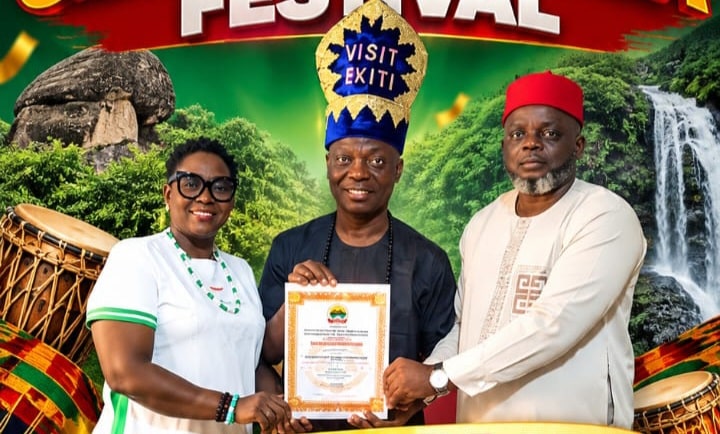
The Gbagede Ule Ewa Festival has secured official state recognition as the Ekiti State Bureau of Tourism Development certified the maiden edition for 5 December, boosting Ekiti State tourism and cultural heritage preservation.
A delegation representing the Elemure of Emure-Ekiti, Oba James Babatunde Ajiboye, received the official certificate and licence at the Bureau’s headquarters. The delegation included the Technical Adviser to the Governor on Sports, Dr Olusola Osetoba, alongside the former Chairman of Emure Local Government and Public Relations Officer of the festival, Hon. Olu Okeya. Director-General Wale Ojo-Lanre, Esq., presented the documents in the presence of key officials, including the Bureau’s Director of Finance and Administration, Mr Sunday Adewunmi, and the Technical Adviser to the Governor on Youth Inclusion, Mr Ayo Ojo.
Official Registration Drive Transforms Ekiti State Tourism
During the presentation, Ojo-Lanre explained that registering local celebrations is part of a broader drive to document, regulate, and market traditional events across the state as viable commercial products. He urged traditional rulers and event organisers to align with the Bureau, emphasizing that state recognition grants events corporate legitimacy while easing promotion to global audiences.
The Bureau is building a comprehensive cultural festival calendar and diary to give tourists, operators, and hospitality businesses early details on venues, dates, and features across the region.
“A tourist should not hear about a festival when the drums have already started beating. The date must be known and promoted well ahead of time so that people can mark their diaries and plan to attend,” Ojo-Lanre said. He clarified that registration does not strip communities of event ownership, but rather offers a framework for marketing, partnership, and investment.
Economic Value and Emure-Ekiti Cultural Heritage
Highlighting the financial opportunities of cultural heritage events, Ojo-Lanre stressed that well-packaged celebrations channel funds directly into host towns through accommodation, dining, transport, fashion, and artisan crafts.
“When people travel for festivals, they spend. They pay for transportation, accommodation, food, clothes, photography and other services. That expenditure goes directly into the local economy. This is why festivals must be seen not only as cultural celebrations but also as economic assets,” Ojo-Lanre stated, noting the alignment with Governor Biodun Oyebanji’s shared prosperity agenda.
Speaking on the vision for the Gbagede Ule Ewa Festival, Hon. Olu Okeya and Dr Olusola Osetoba noted that the celebration aims to unite the people of Emure-Ekiti at home and in the diaspora while spotlighting local destinations.
Beyond a traditional pageant, the event will highlight beauty, intellect, character, and regional history. The festival itinerary includes 27 cultural amulets, a parade, masquerade performances, recognition awards, and a guided tour of the historic Emure-Ekiti Rock Formation. The inaugural edition will take place in Emure-Ekiti on 5 December.