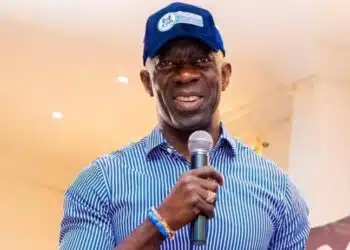

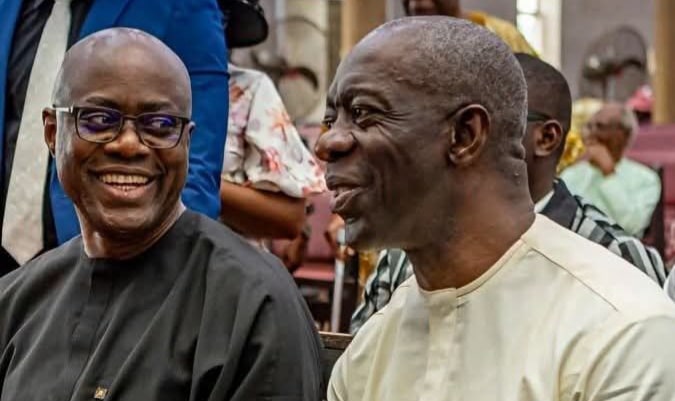
At the unveiling of his Omituntun 3.0 manifesto in Ibadan last Thursday, Allied Peoples Movement (APM) governorship candidate Hon. Bimbo Adekanmbi was upstaged by a member of his own camp. Dr Saka Balogun, Chairman of the APM Council of Elders, described Governor Seyi Makinde’s administration as a “terrible system” before party loyalists and stakeholders at Felicia Hall, Jogor Centre.
Politics has a way of exposing in public what leaders try hard to conceal behind closed doors. The event was meant to be Adekanmbi’s defining afternoon, a chance to look Oyo people in the eye and prove he has an independent vision for the state. Instead, the biggest headline came from an elder in his own camp, delivering a blunt verdict on the very government he wants to inherit.
Saka Balogun’s “Terrible System” Verdict
Balogun stepped up to the podium not with the rehearsed cheerleading of a campaign surrogate, but with a candid confession that left the hall visibly unsettled. Speaking in a tone laced with frustration, he described the Makinde administration as a “terrible system” and admitted plainly that the governor “did not perform well” in managing the affairs of the state.
He went further, pleading with aggrieved party faithful who felt sidelined over the past seven years to swallow their anger. He openly lamented that he, alongside other members of the political family who laboured for the administration, had been shut out from the benefits of governance.
The awkwardness in the hall was unmistakable. While Adekanmbi was marketing Omituntun 3.0 as the path forward, a prominent leader of his own movement was practically apologising to the electorate for the outgoing administration. It left a straightforward question hanging over the event: if the system was truly terrible, what exactly is Adekanmbi asking Oyo voters to continue?
A Farewell Rally for Makinde, Not Adekanmbi
Anyone who sat through the programme could tell who the central figure of the afternoon was, and it was not the candidate on the ballot.
By the time the speeches ended, Governor Makinde’s name had been mentioned roughly 347 times, averaging nearly eight mentions every minute. Rather than hearing fresh ideas on how Adekanmbi intends to ease the daily economic pressures facing families in Ibadan, Ogbomoso, Oyo, Oke-Ogun and Ibarapa, the audience was treated to what felt like an extended farewell ceremony for an outgoing governor.
The remarks from top government officials reinforced that impression:
• Speaker of the Oyo State House of Assembly, Rt. Hon. Adebo Ogundoyin, framed the occasion around the outgoing governor’s legacy. He described the document as “a realistic blueprint for consolidating Oyo State’s development and building on the solid foundation laid by our amiable Governor, Engr. Seyi Makinde.” He urged members to “close ranks, embrace unity and work together” after “the different aspirations that preceded the governorship primary.”
• Secretary to the State Government, Prof. Musbau Babatunde, revealed that Makinde personally mandated him to draft the Omituntun 1.0, 2.0 and 3.0 frameworks. He assured guests that Adekanmbi would “hit the ground running from his first day in office.”
• Kehinde Salami summed up the posture of the gathering by declaring that the party’s rallying cry remained “A Wa Pelu Makinde” (We are with Makinde).
Taken together, those speeches painted a picture of a candidate running not on his own convictions, but as a caretaker for an existing political structure. Even Adekanmbi felt compelled to push back, telling the crowd: “I am not a stooge.” He insisted that “the finished and unfinished projects of the Makinde administration serve as the exact starting point for his government.”
For an electorate looking ahead to 2027, that dependency is a difficult sell. Across the state, Senator Sharafadeen Alli and the All Progressives Congress (APC) have built steady momentum because their Oyo Ahead platform offers a clear alternative: independent leadership, grassroots accountability and a clean break from the politics of succession.
Whose Interest Comes First After Saka Balogun’s Remarks?
Beyond the embarrassment, what should concern ordinary residents from Bodija to Saki is the nature of the grievance Balogun voiced.
He did not express regret over poor rural infrastructure or the rising cost of living. His complaint was that party insiders had been excluded from enjoying the spoils of office. When a political coalition quarrels publicly over how patronage was shared, citizens immediately see where their own welfare ranks on the list of priorities.
Ogundoyin’s appeal for aggrieved factions to “close ranks” after a contentious primary further underscored the friction beneath the surface of the APM campaign. Government is a constitutional trust meant to deliver functional local councils, reliable public services and economic relief, not a private arrangement for settling internal political debts.
Routine Duties Dressed Up as Omituntun 3.0 Achievements
Speakers at the unveiling spent considerable time celebrating the regular payment of civil servants’ salaries as a major milestone.
Paying workers on time is good governance, but it is a basic statutory obligation, not an economic invention. Turning a routine responsibility into a central selling point overlooks the harsh realities workers face once those salaries hit their accounts.
A monthly salary loses its value quickly when daily transport fares eat up half of a worker’s income before the second week of the month. What workers and traders need are practical measures to reduce commuting costs, boost local food production and restore autonomy to local governments so development reaches the wards directly. These are core priorities championed by Senator Alli and the APC.
Big Targets, Familiar Questions for Adekanmbi
When Adekanmbi outlined the highlights of Omituntun 3.0, the numbers were ambitious: seven anchor pillars, eleven enabling pillars, a 100-day action plan, a target of growing Oyo’s economy to $25 billion by 2031, and a pledge to bridge the state’s 167-megawatt electricity deficit.
Yet bold targets cannot mask unanswered practical questions:
- Sustainable power: How will a 167-megawatt gap be closed sustainably when the current administration still relies heavily on expensive, diesel-powered generators to keep public streetlights running?
- Agricultural value chains: Farmers in Oke-Ogun and Ibarapa need more than promises of rural roads. They need affordable inputs, storage facilities and protection from post-harvest losses.
- Youth employment: Training young people in digital skills will only yield results if backed by real private-sector investment that creates lasting jobs.
A Contradiction Voters Will Not Ignore
Ultimately, the APM campaign is trapped in a contradiction of its own making. At the very event where Adekanmbi, Ogundoyin and Prof. Babatunde asked Oyo residents to reward Omituntun with another four years, the Chairman of the party’s Council of Elders stood before the cameras and declared that Makinde “did not perform well” and ran a “terrible system.”
You cannot market continuity as a virtue when your own elder statesman is apologising to the public for the past seven years.
As the 2027 race takes shape, the choice before Oyo voters is becoming increasingly clear. On one side is an APM ticket burdened by internal grievances, political dependency and the admitted shortcomings of an outgoing administration. On the other is Senator Sharafadeen Alli and the APC, offering fresh leadership, deep community roots and a governance agenda focused on the people rather than political godfathers.
At Jogor Centre, Saka Balogun said out loud what many in Oyo State have been thinking. No amount of speeches about continuity can erase that confession from the minds of voters.