

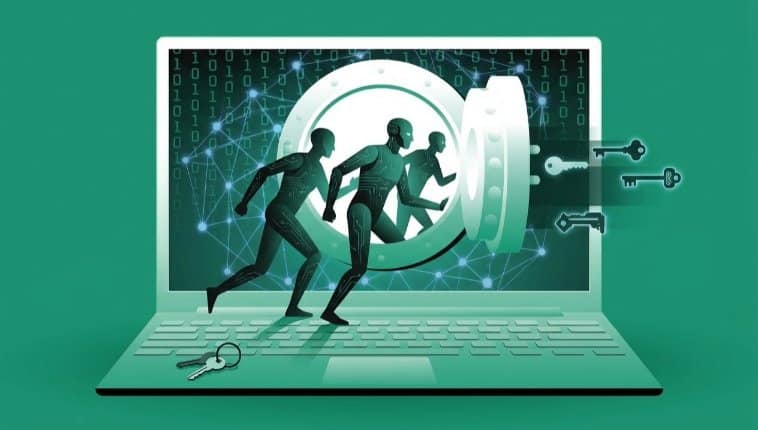
Cybersecurity threats move at an overwhelming pace and often go unnoticed. Because they are invisible, they are easily overshadowed by physical dangers, which makes them even more insidious. Fuelled by complacency and our tendency to stick with familiar routines, they grow more dangerous every day.
Cybersecurity threats and the convenience trap
Too many companies still prioritise employee efficiency and convenience over cybersecurity best practice. Not enough businesses insist on multi-factor authentication (MFA) for logging into company computers, with verification on a separate device as one of the requirements. Biometric logins can speed up the process and improve security. But they require investment in technology and training.
In deferring to employee convenience, companies are not being proactive enough. They must play offence against the rising tide of attacks from hackers. As AI advances, firms that fail to treat cybersecurity with the same urgency as physical security risk unprecedented vulnerability.
How AI is making cybersecurity threats worse
Cybersecurity risks are expected to rise in the near future, in no small part because of AI. It is likely to accelerate the pace of attacks and change the nature of cybersecurity in ways we do not yet understand.
Deepfake fraud: Deepfakes will become more advanced and prevalent. In Hong Kong, an employee was tricked into sending $25 million to fraudsters who used deepfake recreations of the company’s CFO and other colleagues. The request was unusual, yet the employee complied with what appeared to be a top executive’s instructions. Proper training and verification protocols could have stopped the fraud. Without awareness of how advanced these tools have become, employees are at a severe disadvantage.
AI-orchestrated espionage: In November 2025, the world saw the first reported AI-orchestrated cyber-espionage campaign. Anthropic revealed that state-sponsored attackers had bypassed the safety controls of its Claude Code model. They used it to scan networks autonomously, exploit vulnerabilities, steal credentials and exfiltrate data, with the AI performing 80% to 90% of the work. The episode shook the industry and underlined a bigger truth: we still do not fully grasp what advanced AI systems can do.
Vibe coding: Entirely new forms of AI misuse are emerging. In “vibe coding”, people use AI to generate functional code from simple instructions instead of relying on technical expertise. This lowers the barrier to entry and makes it easier for less skilled actors to run increasingly sophisticated cyber operations.
Why AI-driven cyberattacks defeat traditional cybersecurity threats defences
Traditional threats rely heavily on human hackers probing systems manually. AI enables autonomous, adaptive, large-scale operations. Models can scan massive datasets, identify weaknesses in real time, tailor attacks on the fly and evade detection. That lets attackers run stealthy, coordinated espionage campaigns across several organisations at once, dramatically widening the global threat. And because AI can evolve mid-operation, the signature-based defences that once anchored cybersecurity are rapidly becoming ineffective.
Cybersecurity is no longer just about defending against human adversaries. It is about confronting intelligent systems that can operate faster and at greater scale than any individual hacker.
Defending against cybersecurity threats: the road ahead
For security teams, the message is clear: AI must become a central part of the defensive stack. Stronger controls over AI model access, tighter jailbreak prevention and real-time detection of machine-driven behaviour are now essential. Attackers have already embraced AI. If defenders do not evolve just as quickly, they will be fighting tomorrow’s threats with yesterday’s tools.
Just as important is closer collaboration across private industry, government agencies and international partners. When dealing with technologies we do not fully understand, shared intelligence and coordinated strategies are critical. The blend of experienced human judgement and AI’s analytical speed will be our most effective defence against an increasingly autonomous and sophisticated threat landscape.
The rise of AI-driven attacks can feel overwhelming, but organisations are not powerless. Many of the best defences are already within reach. They simply need to be strengthened and consistently applied. The first step for corporate leaders is to take their heads out of the sand.
The rising cost of cybersecurity threats and data breaches
Despite several high-profile breaches over the past year, many organisations still treat cybersecurity as a compliance requirement rather than an operational imperative. That approach can be costly. IBM’s Cost of a Data Breach Report puts the global average cost of a single breach at about $4.44 million. In the United States, the average reached a record $10.22 million for the period from March 2024 to February 2025.