
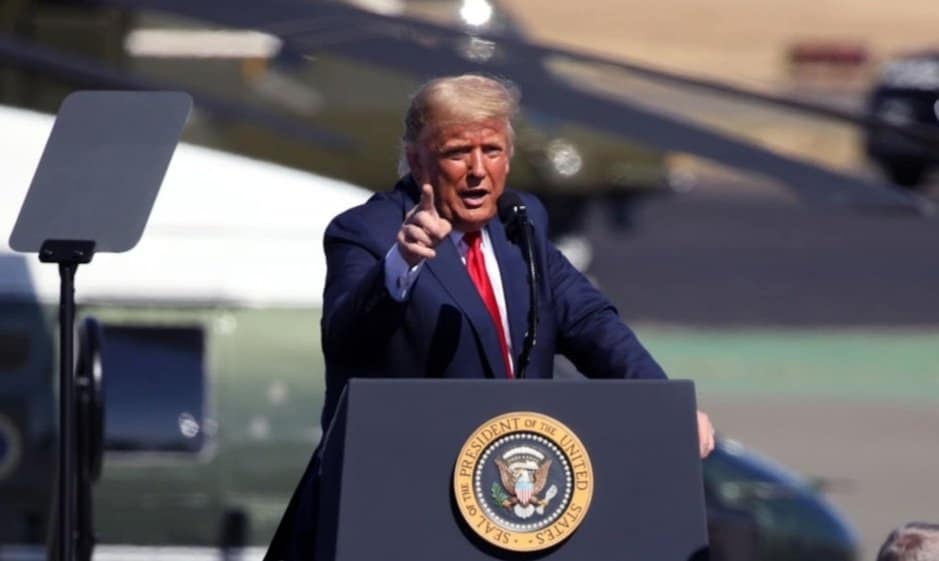
US President Donald Trump has imposed 50 per cent import duties on Canadian goods, triggering a severe US-Canada tariff escalation.
The new levies target everyday items such as wine and hockey sticks, alongside industrial materials like cement. Vital exports including energy, potash, critical minerals, and fish remain exempt from the immediate tax burden.

In response to Washington’s decree, Prime Minister Mark Carney stated that Canada stood ready to “intensify” trade talks with the US over the coming weeks.
The White House confirmed the duties will take effect in 30 days, creating a tense standoff between the historic trading partners.

Relations have remained under severe strain since Trump returned to office in January 2025 and launched an assertive global trade strategy.
Tariffs operate as import duties paid directly to the government by domestic companies bringing foreign products across the border.
US-Canada tariff escalation threatens trade deal stability
This aggressive move signals a structural breakdown in cross-border diplomacy and exposes the fragile architecture of the USMCA trade agreement.
By bypassing conventional treaty exemptions, Washington is challenging the foundation of North American integration. American authorities cite grievances over Canadian automotive taxes, dairy supply limits, and provincial bans on American spirits.
Yet the decision to deploy Section 338 of the 1930 Tariff Act represents a high-stakes legal gambit. The provision focuses on alleged discrimination rather than national emergencies.
Earlier this year, the US Supreme Court struck down sweeping international duties imposed under emergency powers, ruling that the White House had exceeded its statutory limits.
Consequently, legal experts expect this new, untested mechanism to face immediate court challenges from industrial groups and state governors.
“This is the latest in a series of unilateral US trade actions that began with the US imposing a series of tariffs in direct violation of the Canada-United States-Mexico Agreement,” Carney said in a statement on X.
Carney also cited “threats to Canadian sovereignty,” pointing toward broader diplomatic friction between the two capitals.
Provincial leaders have reacted swiftly to the development. In a post of his own on X, Ontario Premier Doug Ford wrote, “If these tariffs proceed, Canada should respond tariff for tariff, dollar for dollar.”
50% Tariffs On Canadian Goods: Section 338 mechanism bypasses Supreme Court ruling
The legal manoeuvre underscores a deliberate shift in Washington’s strategy to penalise trading partners while side-stepping judicial restrictions.
Trump issued three separate proclamations detailing complaints against Ottawa. The documents focus heavily on Canada’s automotive taxation, which Washington calls “unreasonable” due to levies placed on non-USMCA vehicles.
Automotive production across North America relies on deeply integrated supply chains, making regional plants vulnerable to sudden cost spikes.
Dairy regulation remains another friction point, specifically Canada’s supply management system that applies tariffs up to 300 per cent on excess imports.
Furthermore, most Canadian provinces maintain a persistent boycott of US alcoholic drinks, established last year in response to earlier American metals duties.
Canadian officials have maintained that provincial bans will end once Washington lifts tariffs on core industrial sectors like steel and aluminium.
The current duties pile onto existing American trade barriers, including active tariffs of 15 to 50 per cent on Canadian metals, 35 per cent on softwood lumber, and a 25 per cent tax on non-US car components.
Ottawa currently maintains its own 25 per cent counter-tariff on about C$30bn (£16bn; $21.7bn) worth of American goods, though some measures were previously eased.
The announcement follows recent threats regarding drift from Canadian wildfires, although official proclamations omitted environmental arguments.
It is a significant escalation because it directly targets goods that were previously exempt under the US, Canada, and Mexico trade agreement that President Trump negotiated and signed himself in 2018,” said Michael Devereux, professor of economics at the University of British Columbia.
Devereux questioned whether the policy served as a structured bargaining tool. “I would rather see this as just an impulsive move that came from kind of a grudge that the US government and President Trump have against Canada.”
Industry leaders are urging immediate diplomatic action to stop the levies from taking effect when the 30-day clock expires.
Candance Laing, head of the Canadian Chamber of Commerce, urged officials to make “meaningful progress” in negotiations before the deadline.
Chris Swonger, head of the Distilled Spirits Council of the United States, called for a rapid resolution, warning that the policy “raises the risk of further retaliation.”