

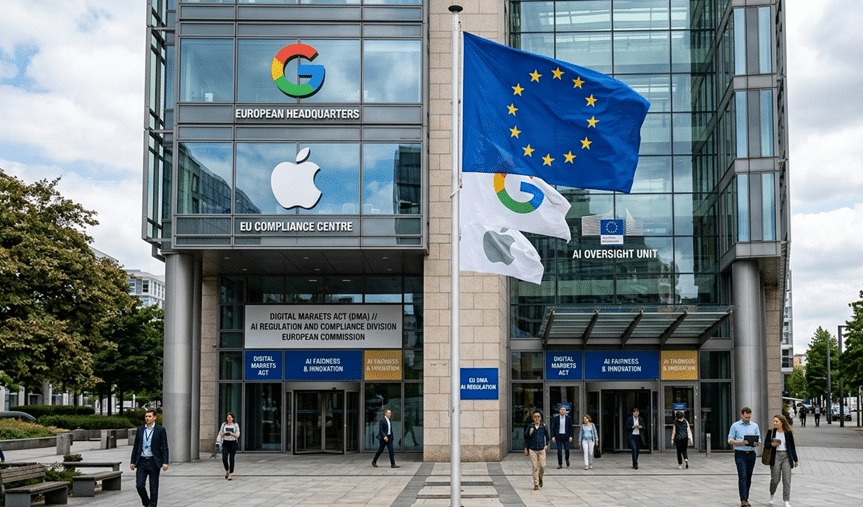
European regulators have ordered Google to grant rival developers deeper system access to Android by July 2027. The directive, enforced under the Digital Markets Act AI regulation, aims to prevent tech conglomerates from leveraging their smartphone operating systems to monopolise the generative artificial intelligence market. Brussels is also instructing Google to share underlying search data with competitor services from January, alongside pressuring Apple to integrate third-party tools into iOS.
Together, the two firms control an estimated five billion active smartphones globally, including 427 million devices within the European Economic Area. Regulators argue this hardware dominance creates an unfair market advantage for proprietary models such as Google Gemini and Apple Siri.

Big Tech Resists Mandated Access
Google and Apple contend that forcing open operating systems creates severe cybersecurity vulnerabilities and compromises user protection.
Kent Walker, Google’s and Alphabet’s president of global affairs, wrote in a statement on Thursday that the Android changes would pose a major security risk because they would give external apps “sensitive and powerful device permissions.” He added that sharing search data would also “weaken citizen privacy, risk business trade secrets and endanger national security.”
Sameer Samat, Google’s Android president, said in an X post on Friday that the European Commission “is on the wrong track” with its rules and that users can choose to switch to another assistant on their own. Apple previously suspended the European launch of its upgraded Siri tools, stating the requirements would force Apple to “give any virtual assistant direct access to users’ private data.”
Digital Markets Act AI Regulation: Systemic Risks and Market Shifts
The dispute highlights a fundamental policy tension between maintaining software security and ensuring market accessibility. Independent policy analysts caution that commercial interests frequently intersect with regulatory compliance arguments.
“I would say that we have to take these tech companies’ arguments with a grain of salt and look at whether they’ve cared about privacy up to the point where suddenly a decision was affecting them in ways they don’t like,” Calli Schroeder, senior counsel and director of the AI & Human Rights program at the Electronic Privacy and Information Centre, told CNN.
Granting external software access to core device features—including microphones, messaging tools, and location telemetry—introduces operational risks if an autonomous agent fails.
“It could exercise the user’s delegated authority to do other things that maybe the user might not have wanted it to happen,” said Michael Stokes, senior vice president of emerging technologies at Veilant.
European officials maintain that gatekeepers “can implement appropriate privacy, security, and integrity safeguards” while following the law. Meanwhile, third-party applications continue gaining market share. ChatGPT is already installed on roughly 30% of European smartphones, pointing toward a shift where third-party AI agents may eventually manage daily digital tasks directly.
“The question is what the implications for Google or the consumer might be if the user can utilise ChatGPT to book an Uber, completely bypassing the need to engage with Android,” Runar Bjorhovde, an analyst with Omdia, told CNN over email.
As software integration deepens, public education regarding system permissions remains crucial. “We also want to make sure that users are aware of the risks they’re taking when they engage with AI systems,” Schroeder said. “And I think that awareness is where we really need to catch up a little bit more.”