

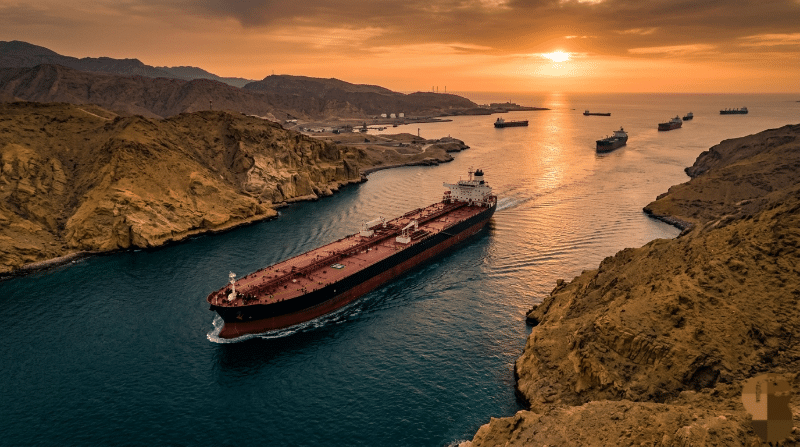
Global oil prices have plummeted after Iran confirmed the Strait of Hormuz reopening would allow commercial ships “completely open” passage for the remainder of the current ceasefire in the US-Israel war with Iran.
The sudden de-escalation in the Persian Gulf has sent shockwaves through energy markets, providing the first significant relief to consumers since the conflict began earlier this year.

Brent Crude Price Volatility Following Announcement
The cost of a barrel of Brent crude fell sharply to $88 a barrel following the announcement, having hovered above $98 earlier on Friday. In some trading sessions, the Brent crude price even touched $86 as traders reacted to the restored flow of energy.
The Strait of Hormuz remains a critical global artery; it is a narrow strip of water south of Iran through which a fifth of the world’s oil and liquefied natural gas is typically transported.
US President Donald Trump welcomed the Iranian statement, although international maritime groups are still in the process of verifying the safety of the route. Iranian Foreign Minister Abbas Araghchi clarified the regime’s position, stating: “The passage for all commercial vessels through Strait of Hormuz is declared completely open for the remaining period of ceasefire.”
Global Oil Prices and Market Reaction
World markets rallied almost immediately on the news. Major US stock indices rose in early trading, with the S&P 500 climbing 1.2%, while the Nasdaq and Dow Jones Industrial Average (DJIA) saw gains of 1.3% and 1.9% respectively. European shares also mirrored this optimism; the Cac index in Paris and Dax in Frankfurt both closed approximately 2% higher, while London’s FTSE 100 ended the day up 0.7%.
The Strait of Hormuz reopening marks a turning point in a waterway that has been effectively shut by Iran since the US and Israel launched military strikes in late February. During the height of the US-Israel war with Iran, tanker traffic slowed to a mere trickle. This scarcity drastically reduced the volume of oil and gas on the market, causing a historic price spike. Before the conflict, Brent crude traded under $70 per barrel, eventually peaking at more than $119 in March.
Safety Concerns Despite the Strait of Hormuz Reopening
While President Trump has voiced his appreciation for the move, the international shipping body BIMCO has expressed caution. Jakob Larsen, BIMCO’s chief safety and security officer, warned: “The status of mine threats in the traffic separation scheme is unclear and BIMCO believes shipping companies should consider avoiding the area. This means that the Traffic Separation Scheme is not declared safe for transit at this point.”
Furthermore, the head of the International Maritime Organization (IMO), Arsenio Dominguez, noted that the organization is verifying the “compliance with freedom of navigation for all merchant vessels” under the new terms.
Economic Impact of the US-Israel War with Iran
The high global oil prices seen in recent weeks have pushed up the cost of petrol and diesel for drivers and sparked fears of flight groundings due to jet fuel shortages. The closure also severed a major supply line for fertiliser; roughly a third of the world’s key fertiliser chemicals pass through the Strait.
In the UK, the RAC noted that pump prices began to ease slightly on Thursday, though they remain significantly higher than February levels. This shift followed a ceasefire agreement between Israel and Lebanon. President Trump, writing on Truth Social, stated: “IRAN HAS JUST ANNOUNCED THAT THE STRAIT OF IRAN IS FULLY OPEN AND READY FOR FULL PASSAGE. THANK YOU!”
However, Trump cautioned that a naval blockade of Iran will remain “in full force and effect” until a permanent deal is reached. For many Nigerians, the news is a vital lifeline. From N760 at the war’s start, petrol prices hit N1,300 per litre, devastating the local standard of living. This reopening offers a glimmer of hope that the Brent crude price will continue its downward trajectory toward pre-war stability.