

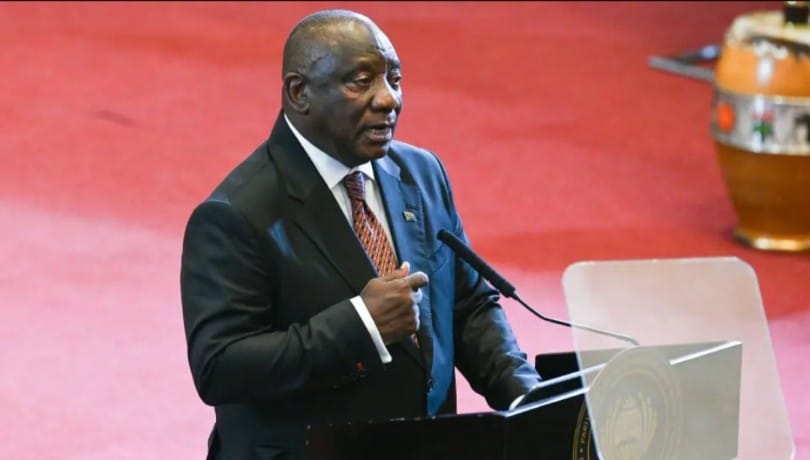
South Africa faces a seismic political shift as the Cyril Ramaphosa impeachment process finds new life following a definitive legal blow. The Constitutional Court ruled on Friday that Parliament acted unlawfully by blocking previous efforts to remove the President in 2022.
This historic South Africa Constitutional Court judgement has immediately reignited calls for the President’s resignation, specifically from his most vocal critics.

The Phala Phala Farmgate Scandal Returns
The roots of the current crisis trace back to the “Farmgate” saga, an incident that has shadowed the presidency for years. In 2020, an estimated $580,000 (£430,000) in cash, allegedly hidden within a sofa, was stolen from Phala Phala, the President’s rural estate in Limpopo.
The Phala Phala Farmgate allegations suggest that the President failed to properly account for the origin of these funds or report the theft through official channels.
While an independent panel previously suggested the President might have a case to answer, the African National Congress (ANC) used its then-majority to quash the inquiry. However, the political landscape has shifted. Following the 2024 general election, the ANC no longer holds an outright majority, governing instead through a complex coalition. This new reality makes the threat of a **Cyril Ramaphosa impeachment** significantly more tangible.
Julius Malema EFF Demands Immediate Resignation
Leading the charge for accountability is Julius Malema (EFF), whose party brought the legal challenge alongside the African Transformation Movement. Speaking with characteristic bluntness outside the court in Johannesburg, Malema made his position clear: Ramaphosa must step down to focus on his legal battles.
“You cannot serve the two – one is going to suffer,” Malema explained, referring to the dual burden of leading a nation while preparing for a formal inquiry. He added that the President should “concentrate on this impeachment process because it has got serious implications on him as an individual.”
Despite his own ongoing legal appeals regarding firearm charges, Malema remains confident that the evidence against the President will eventually force the ANC’s hand, stating “the evidence will be before their eyes.”
Constitutional Court Demands Accountability
The recent ruling from the South Africa Constitutional Court highlights a failure of legislative oversight. The court found that the 2022 vote to block the impeachment committee lacked the necessary constitutional rigour. In response, the President’s office issued a statement noting that he “reaffirms his commitment to the Constitution, the independence of the Judiciary and the rule of law.”
The Presidency further maintained that “President Ramaphosa maintains that no person is above the law and that any allegations should be subjected to due process without fear, favour or prejudice.” The ANC echoed these sentiments on social media, suggesting the judgement validates the independence of South African institutions.
A New Chapter for the Cyril Ramaphosa Impeachment
The EFF has already moved to capitalise on the ruling, writing to National Assembly Speaker Thoko Didiza. They have demanded a “clear indication, within the next 48 hours, of specific steps” regarding the restart of the process. Even within the governing coalition, there is pressure for transparency. Geordin Hill-Lewis, a prominent leader in the Democratic Alliance, noted that the impeachment committee “must now do its work properly, rationally, fairly and constitutionally.”
At the heart of the Phala Phala Farmgate controversy remain unanswered questions about South Africa’s strict currency laws. Regulations require foreign currency to be deposited with an authorised dealer within 30 days. While the President has previously claimed the cash originated from the sale of a buffalo, the lack of a formal audit remains a primary point of contention. With three individuals already on trial for the original theft, the pressure on the Union Buildings is higher than ever before.