

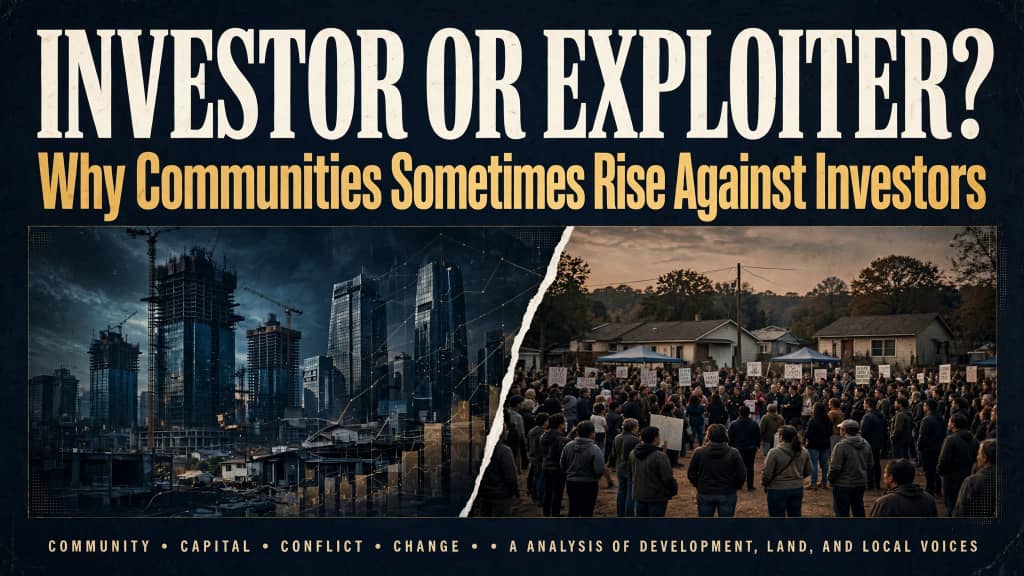
There is a thin but crucial line between ethical investors and exploiters, especially when commercialising local natural and cultural assets. When host communities rise against commercial enterprises, we must look beyond surface tension and examine the underlying community partnership model. Understanding these dynamics is essential for creating long-term sustainable tourism development and ensuring that commercial expansion does not come at the expense of local heritage and dignity.
An investor brings capital, expertise, technology, and enterprise into an asset, creating value not only for themselves but also for the asset owners and the surrounding area. An exploiter may bring the same capital, build impressive infrastructure, and run a profitable business, but gradually behaves as though the asset, the land, the heritage, and the local population have become secondary to commercial profit.

That is where trouble begins. Whenever a community rises against investors, we should resist the temptation to immediately label the people as hostile to investment, troublesome, or ungrateful. Sometimes, the real question is not why these people are fighting, but rather: what happened between the investor and the community?
Understanding Asset Alienation and Investors
Imagine a host community possessing a traditional asset that has belonged to its people for generations—a waterfall, spring, forest, mountain, sacred grove, beach, or historical monument. Before commercialisation, local residents had a natural relationship with that asset. Their fathers knew it, their mothers visited it, and their children grew up around it. Their festivals, histories, livelihoods, and collective memories were intrinsically connected to it.
Then comes an investor who sees commercial possibilities. He commits millions of naira, constructs roads, accommodation facilities, and recreational infrastructure, introducing management systems that transform a neglected attraction into a commercially viable destination.
This deserves acknowledgement. Investment requires courage, and capital deserves a reasonable return. Nobody should expect investors to commit millions to a project and operate it as a charity. But investment does not erase ownership, history, or community interest. Development must not become dispossession.
That an investor has spent millions developing a local asset does not mean the community should suddenly become strangers at the gate of its own heritage.
The Double Deprivation Caused by Unilateral Investors
Sometimes the alienation goes much deeper. The community may discover it cannot even enjoy the services now being derived from its own traditional asset.
First, there is the gate: people who once had a natural relationship with the asset must now pay to approach it. Then, after paying the gate fee, another barrier confronts them: the prices of the services created around the asset are simply beyond the reach of ordinary community members. So what exactly has development brought them?
They cannot freely access what historically belonged to them, nor can they comfortably afford the services provided from it. They watch outsiders arrive, pay, enjoy themselves, and leave. They watch the enterprise grow and see prosperity around an asset inherited from their forefathers, yet many cannot afford to participate in the experience.
A man can live a few kilometres from an attraction belonging historically to his community and yet be economically incapable of experiencing what tourists travelling hundreds or thousands of kilometres come to enjoy. He is geographically close but economically excluded—a dangerous form of alienation.
The Myth of Corporate Philanthropy vs Host Community Relations
When the community complains, investors sometimes behave as though whatever the people receive is a favour. A donation becomes evidence of generosity; a few jobs become evidence of benevolence; a community project is presented almost as philanthropy.
But there is a fundamental difference between philanthropy and structural obligation. The host community should not feel like a beggar around an enterprise built upon its own heritage. Neither side is doing the other a favour—it is supposed to be a partnership.
In a true dual value exchange, both sides contribute essential components to the enterprise. The community brings the cultural heritage, land asset, environmental access, and crucial social licence to operate. In return, the investor contributes capital deployment, technical expertise, market access, and infrastructure. Both sides bring value, and both sides should be treated with dignity.
When addressing host community relations, investors often cite their achievements:
“We have invested heavily here. We created jobs. We employ people from the host community. We occasionally support community programmes, give donations and provide assistance.”
These points are commendable, but they do not end the conversation. There are deeper questions to address:
- What is the community getting structurally from the enterprise?
- How much is paid directly to the community under the governing agreement?
- Is there an agreed royalty, lease payment, revenue share, or development levy?
- What percentage of the economic value generated by the asset returns to the local area?
- What concessions exist to ensure residents are not completely priced out of experiencing their own heritage?
- Beyond cleaners, gardeners, guards, and attendants, how many local members are trained for technical and managerial positions?
- How many local entrepreneurs participate in the supply chain?
Giving bags of rice during festivities or donating money to an occasional program cannot substitute for a properly structured relationship. Corporate charity is not the same as community benefit, and occasional generosity cannot permanently compensate for structural exclusion.
To achieve stability, the relationship must function as a triangle of benefit. At one vertex, the government secures public revenue and successful regional development. At another, the investor obtains a fair return on investment and commercial growth. At the base, the community gains access, dignity, and a clear share of prosperity.
Why Sustainable Tourism Development Requires Local Dignity
When members of a host community raise concerns, how are they treated? Are they listened to, or are they immediately labelled troublemakers and enemies of progress?
A community may remain silent for years, but silence should never be mistaken for satisfaction. Frustration accumulates. People calculate what has been gained and lost. They see money being made, and inevitably ask: “Where are we in this prosperity?” That question should not frighten responsible investors—it should be expected.
The wisest investor understands that a host community provides something capital alone cannot manufacture: social licence. Government may grant a concession, and lawyers may prepare watertight agreements, but sustainable investment requires the continuing confidence of the people living around the asset.
This is particularly important in tourism, where the community itself is often part of the product. Its culture is part of the attraction, its history gives meaning to the destination, and its people are custodians of memories that no investor can construct with concrete.
Therefore, sustainable tourism development must create a triangle of benefit where government, the investor, and the host community all gain. Remove any side of that triangle, and instability becomes inevitable.
Frameworks for True Community Partnership
This does not mean communities should dictate every commercial decision, enter free of charge, or obstruct legitimate business. Investment cannot survive under harassment or arbitrary demands. The responsibility is mutual.
To build a genuine community partnership, enlightened investors can implement practical measures:
- Designated Access Days: Establish clear community access days or resident concessions.
- Educational Integration: Provide educational visits for local children.
- Supply Chain Inclusion: Create preferential opportunities for local enterprises and suppliers.
- Skills Pathways: Develop deliberate skills-development programmes to train indigenes for managerial positions.
- Transparent Revenue Sharing: Ensure agreed community payments and development levies are transparent, measurable, and accountable.
These are not acts of charity—they are instruments of sustainable investment. The best agreement is not the one that gives an investor maximum control, but the one that creates maximum long-term sustainability.
If you invest in a community asset, build more than structures—build trust. If you make profit from their heritage, create visible pathways through which prosperity reaches them. Ultimately, the difference between an investor and an exploiter is determined by a fundamental question: after all the profits are counted, are the original custodians participating in its prosperity, or have they merely become spectators standing outside the gate of their own inheritance?