
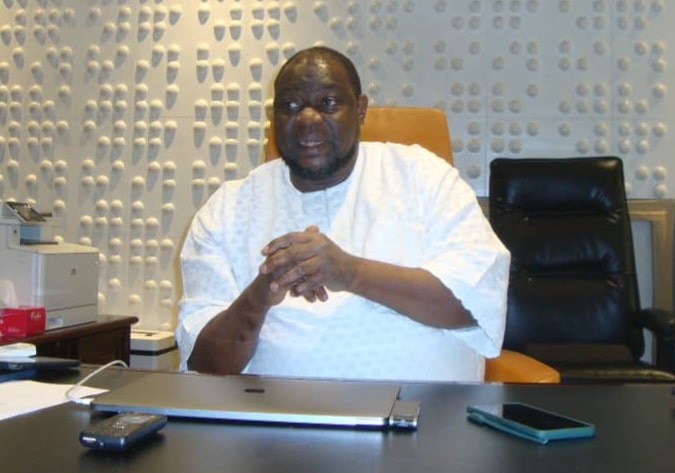
Alhaji Muritadha Adeyemi Adeniji is a leading player in the cocoa and cashew business in Nigeria. Therefore, his insight into the challenges and prospects of the agro-industrial sector cannot be faulted. His company, Starlink Global & Ideal Limited, provides a wide spectrum of marketing and financial services for the procurement and export of agricultural produce and commodities to both local and international markets. SGI agricultural produce also includes raw cocoa beans, raw cashew nuts, shea nuts, and natural sesame seeds. SGI today has grown tremendously and is well represented in all cocoa-producing zones of Nigeria.
In this interview with online news editors, he shares his mind, among other issues, on the status of cocoa production in Nigeria, even as he expressed his fear about the future of the crop. Except:
Sir, Nigerians are concerned about the dwindling production of cocoa in Nigeria because the crop used to be a major contributor to the economic development of the country, most especially in the western region in the 60s and 70s. Do you share their fear?
I appreciate your concern about the future of cocoa in Nigeria. Unfortunately, we used to be number 2 between the period 1968 and 1975. Up to 1992, Nigeria still struggled to be between number 3 and 4, but we are now number 7. As of 2013, the Ivory Coast was producing 1,000,000 tonnes. Today, the Ivory Coast produces 2000400 tonnes. They have doubled their production and have even added more within that period. Looking at the same time, Ghana used to produce 750000 tonnes, but they are now producing 950000 tonnes. Cameroon used to produce 350000 tonnes; it is still on the 350000 tonnes. Indonesia used to produce 450000 tonnes; it is now producing 280000 tonnes. They have had a reduction in their production. Nigeria used to produce 250000 tonnes; it is now 300000 tonnes. Brazil produces 320000 tonnes. All other countries of the world produce the rest of the tonnes.
The total need for Cocoa in the world is four million tonnes in a year. 75 per cent of the production is done by the Ivory Coast and Ghana, which is why they went into a collaboration to ask for Liquid Income Preference from the chocolate makers. I am the first Nigerian and African to be a member of the Federation of Cocoa and Commerce (FCC), which is responsible for regulating the Cocoa economy in the world. This gives me insight into the problems and solutions to cocoa production.
When we talk about Nigeria, it’s not only about Cocoa but the quality of leadership has been the problem. When we have leaders who only think about 4 or 8 years in office and do not have a long-term plan. This is criminal and an injustice to the people they are leading. We must have a well-structured country that has immediate, short, and long-term plans. Developed countries of the world have all these plans with strong institutions that Nigeria lacks.
Unfortunately, corruption has killed almost everything in Nigeria. I don’t like politics, and I won’t be one of them. Take a look at the time of the late Chief Obafemi Awolowo, who was an Ijebu man. What was cocoa production like in Ijebu then? He institutionalised cocoa production across the Southwest. He had a big Cocoa farm, not for himself but for the country in the present-day Edo State. Things need to change. The law of diminishing returns is taking effect on the cocoa trees, as some are now 100 years old, while some are 75 years old. If they are cut down, how many years would it take for us to have the new ones? What incentives are being given to the youths as motivation to engage in farming?
What have they been doing in the Ivory Coast that the Nigerian government has not been doing? In the Ivory Coast, the government allocates 2.5 hectares of land to the youth to engage in farm production. Nigeria’s government needs to create a medium for large farm sites and put necessary social infrastructures in place to make life bearable for the people. West Africa produces almost 75 per cent of Cocoa in the world; all other countries cannot. We are blessed in this part of the world. For instance, in Indonesia, natural disasters destroy farms. The government should start to have long-term plans. This is one of the reasons we are faced with the challenge of insecurity, such as banditry, kidnapping and others. We need to face the reality of how to navigate the perennial problems. Unemployment is directly proportional to poverty, banditry, kidnapping and terrorism.
So how can we get it right?
For Nigeria to get it right in cocoa production, the government needs to remove what is known as the Land Use Act. The people should be allowed to have access to land. This is one of the major problems of agriculture in Nigeria. Physical planning is very key. We are very lucky, Nigeria has the largest arable land in the whole of Africa. You can see the incursion of foreigners into the country; Chinese, Indians and others are buying land in large quantities, and they are collecting documents from the government. We need to be careful about that. We are talking about colonisation; what is going to happen would be worse than colonisation. We should learn from the apartheid in South Africa and Palestine because it is the major cause of what is happening in Palestine, Zambia and Zimbabwe. This is also evident in Kaduna and Jos.
No government agency or parastatal in Nigeria is working; corruption has destroyed all of them. We are not investing in technologies that will improve our agricultural system. We need huge investments in technologies in our institutes for us to have alternatives. The kind of fertilisers we use on our farms is the one killing our soil.
The government should create an enabling environment supported by reasonable laws that wouldn’t be broken. So many people are interested in agriculture, but they are being discouraged by the lack of an enabling environment.
I want to call on the government to have a well-structured system, long-term plans, and be proactive in the needs of the citizens, especially the youth. We don’t have accurate data in Nigeria; we only have estimates.
The Nigerian government has been talking about diversification of the economy, especially into the agro-industrial sector. In your own opinion, do you think they are walking the talk?
As a stakeholder, I have constructively criticised the government to challenge them on the necessary things to be done. Nigeria is retrogressing at a fast pace; something needs to be done. The chocolate factory needs 24 hours of electricity. Are we having this in Nigeria? A factory cannot be successfully run in an unpredictable place like Nigeria. Look at the price of diesel, which used to be N350 and is now N800. So many companies are folding up in Nigeria, not because they are fraudulent, but because they operate in a very harsh economic environment.
How did you get into this business?
I was a biochemistry lecturer at the university for 11 months. Religious discrimination and politics in the institution made me leave my lecturing job. There was a terrible gang-up, as I was the only Muslim, and I didn’t see myself developing quickly in such an environment. When I left, I secured another job in Union Trust before the death of my managing director, which made me leave there after 11 months.
I never wanted to do this business because I have experienced different things in this business. I had so many crises in the cocoa business. Although it is my father’s business. Hunger and desperation forced me to stay in the cocoa business.
How long did it take you to build Starlink Global & Ideal Limited?
We started in 1999. Today, we are the largest exporter of cocoa and palm oil in Nigeria. In the last 10 years, the growth has been wonderful. We are now into processing, and we have just bought the largest and multi-million dollar processing plant in Nigeria.
At SGI, we have 452 direct workers and about 900 appendages. We see human beings as the most important asset. We have warehouses in about 16 states. I motivate my staff for maximum production with sustainable empowerment. Most of them are not self-independent.