

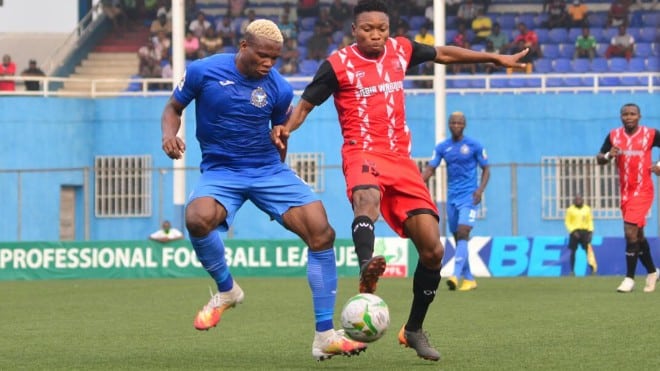
Nine-time Nigerian Premier Football League champions Enyimba International FC collapsed to a fourth consecutive defeat this weekend, dropping critical points in a grueling 2-1 away fixture. The result confirms that the Enyimba crisis deepens as the Aba giants slide down the league standings into uncharacteristic bottom-half territory, leaving supporters and club stakeholders searching for urgent answers amidst a historic slump.
The loss marks the club’s longest domestic losing streak in eight seasons, stripping away early-season title aspirations and exposing structural vulnerabilities across every department on the pitch. Late defensive lapses inside the final 20 minutes once again doomed the visitors, completely nullifying an energetic early attacking effort that had initially offered a glimmer of hope to the traveling contingent.

Systemic Fault Lines Surface as the Enyimba Crisis Deepens
Enyimba crisis has entered the high-stakes encounter intent on halting a disastrous three-match slump, but tactical rigidity and fragile transition defense proved fatal against a disciplined, opportunistic home side. Despite controlling 54 percent of ball possession throughout the opening half, the People’s Elephant failed to translate territorial superiority into high-probability scoring opportunities.
“Enyimba Crisis Deepens After Fourth Straight NPFL Defeat,” technical handlers acknowledged in post-match evaluations, admitting that positional breakdowns in critical transition phases allowed the opposition to strike twice on swift, decisive counter-attacks.
According to tactical tracking and performance analysis conducted by Reporters At Large, Enyimba crisis is also influenced due to defensive structure that has completely disintegrated in high-pressure situations, surrendering seven goals across their last four league outings. That alarming metric stands in stark contrast to their championship-winning campaigns, where the Aba club built its dominance on a suffocating rearguard that conceded fewer than 0.8 goals per 90 minutes.
Midfield Disconnection and Severed Supply Lines
Offensively, the issues plaguing Enyimba crisis extend far beyond a leaky backline. The central midfield unit repeatedly failed to establish passing rhythm, turning over possession in crucial second-phase buildup areas and leaving the back four exposed to rapid direct counter-attacks.
Through 360 minutes of competitive football during this four-game skid, Enyimba has registered a modest 11 shots on target—an unacceptably low metric for a squad equipped with premium international talent. The complete absence of creative penetration from wide areas has forced starting strikers to drop deep into their own half merely to touch the ball, stripping the team of its natural central threat inside the 18-yard box.
Compounding these tactical shortcomings, persistent fitness issues and key injuries to primary playmakers have severely restricted squad depth, forcing the coaching staff to field inexperienced combinations in hostile road environments across the country.
Dissecting the Anatomic Breakdown of the Losing Streak
Looking closely at the numbers behind Enyimba’s recent collapse reveals a broader pattern of second-half stagnation. In three of the four recent losses, the team was either level or holding a lead at the half-time interval, only to surrender physical dominance and structural discipline as matches entered the final half-hour.
Conditioning levels, bench impact, and game management have failed under pressure. Opponents have identified a clear blueprint to defeat the Aba side: absorb initial pressure, compress space in the central third, and exploit the wide channels whenever Enyimba’s full-backs push high in search of an opening goal.
Until the coaching staff implements functional defensive cover for high-marching wing-backs, athletic opponents will continue to punish Enyimba in transition, keeping the club pinned in the bottom half of the NPFL table.
Mounting Pressure on Technical Management Ahead of Home Fixture
With 12 maximum points dropped in rapid succession, fan frustration in Aba has reached a boiling point. The club’s management faces intense pressure to restructure tactical setups, modify personnel selections, or make sweeping changes before the domestic title race disappears entirely out of reach.
Enyimba now returns home to the Aba Township Stadium for a must-win midweek clash where anything short of three points could trigger immediate administrative and technical overhauls.
Holding just five victories from their opening 14 domestic fixtures, the historic club faces a steep climb to restore confidence, fix foundational tactical flaws, and rebuild momentum before the continental qualification window closes.