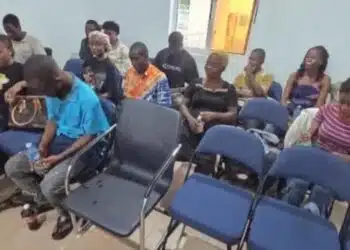


A freed teacher from the Oyo school kidnapping has revealed details of 56 days spent in Islamist captivity.
Zacchaeus Olatunde, speaking during a telephone interview with Nigeria Info FM aired on Friday, said abductors released the hostages before security forces escorted them home.

The disclosure challenges official narratives surrounding the kidnapping of the teachers and pupils abducted from schools in Oriire Local Government Area.
Mr Olatunde stated that captives were permanently blindfolded, leaving them entirely disoriented throughout their two-month ordeal in the bush.
“It is difficult to say on air, but I will just say what I can. When we were there, we were blindfolded, not an ordinary blindfold. We didn’t even know if we were in Nigeria or another country. We were just there. We were saying maybe the government had even forgotten us,” he said.
The captors identified themselves as operatives of the Islamic State West Africa Province (ISWAP), a dominant insurgent faction in the region.
“They said they are not Boko Haram. They said they are ISWAP. I was the last person who was captured in the school and I was the last person that was released,” Mr Olatunde added.
Hostages were fed basic rations of rice, beans, and margarine twice daily, but were denied the ability to bathe or wash clothes.
“For the 56 days, we the teachers did not bathe. We did not wash our clothes,” he said.
Severe restrictions were placed on religious practices, with Christian prayers initially prohibited altogether.
“When we got there, they told us not to pray. After about a month, they allowed us to pray, but they warned us not to mention the name of Jesus and not to pray aloud,” he said.
The Changing Dynamics of Nigeria’s Ransom Crisis
The circumstances of the release point to a sophisticated, highly organised criminal enterprise that operates outside state control. By utilizing logistical networks to transport hostages close to safety, the insurgents demonstrated a high level of operational freedom.
This undermines official communiqués that frequently credit state intelligence and military intervention for the safe resolution of high-profile abductions. For communities in Oyo State, the revelation that an ISWAP faction is operating with such latitude raises urgent questions regarding rural security and intelligence failures.
The sudden decision by the camp commander to release the captives remains unexplained, though it followed weeks of negotiations.
“Until the last day when their commander came and was smiling and laughing and said we should thank God that we had been freed. The next thing they said was that we should open our eyes,” Mr Olatunde recalled.
Logistics of the Release
The teacher was nearly left behind due to a broken handcuff key, which required captors to improvise a solution.
“When they released us, everybody had gone. They said I could not carry the handcuff home because the key had broken. One of them suggested they should cut off my hand, but another said no. They later used a small rope to remove the handcuff,” he said.
After a tense encounter where the commander redirected him at gunpoint, Mr Olatunde joined the fleeing group.
“Their commander called me back. He pointed a gun at me and said, ‘Come.’ I thought I was going to die because I was the only one left in the bush. He asked where I was going, and when I said I didn’t know, he showed me the correct route and told me to follow where the others had passed,” he said.
The group walked for an hour before insurgent motorcycles shuttled them toward a local village, where government forces eventually met them.
“We trekked for about 40 minutes to one hour before they provided motorcycles that took us close to the nearest village. They later stopped and told us they could not go further, so we trekked for another one and a half hours before we got to where the government people who came to rescue us were,” he said.
The initial encounter with state officials caused panic among the traumatised hostages due to unmarked vehicles and a lack of identification.
“When we saw the buses, we were afraid because the people were speaking Hausa. We even asked them to show us their identity cards. They kept assuring us that the government sent them. The buses had no number plates and had Arabic inscriptions. We were afraid they wanted to take us somewhere else,” Mr Olatunde said.
The teacher, who suffers from arthritis, had been captured after a pupil refused to leave his side during the initial raid.
“I had arthritis on my left leg and couldn’t run. I hid under the grass because my clothes blended with it. A student who refused to leave me looked in my direction, and that was how their commander noticed me and ordered me to stand up,” he said.
Despite receiving basic medication from his captors that temporarily eased his chronic pain, Mr Olatunde noted that no state rehabilitation has been provided since his return.
“The utmost support for now should be for my school,” he said.
Oyo School Kidnapping release
The teachers and pupils were abducted in May after armed men attacked schools in Oriire Local Government Area of Oyo State.
Following their release, Oyo State Governor Seyi Makinde announced that the victims had regained their freedom after 56 days in captivity.
The governor also called for a UN-backed investigation into the abduction, saying Nigerians deserved a full account of the circumstances surrounding the incident, while directing that the rescued victims receive medical attention and psychosocial support.
Special Adviser to the President on Information and Strategy, Bayo Onanuga, said the governor’s request suggested a lack of confidence in Nigeria’s security institutions, insisting that the military and other security agencies had already provided explanations on the rescue operation.