
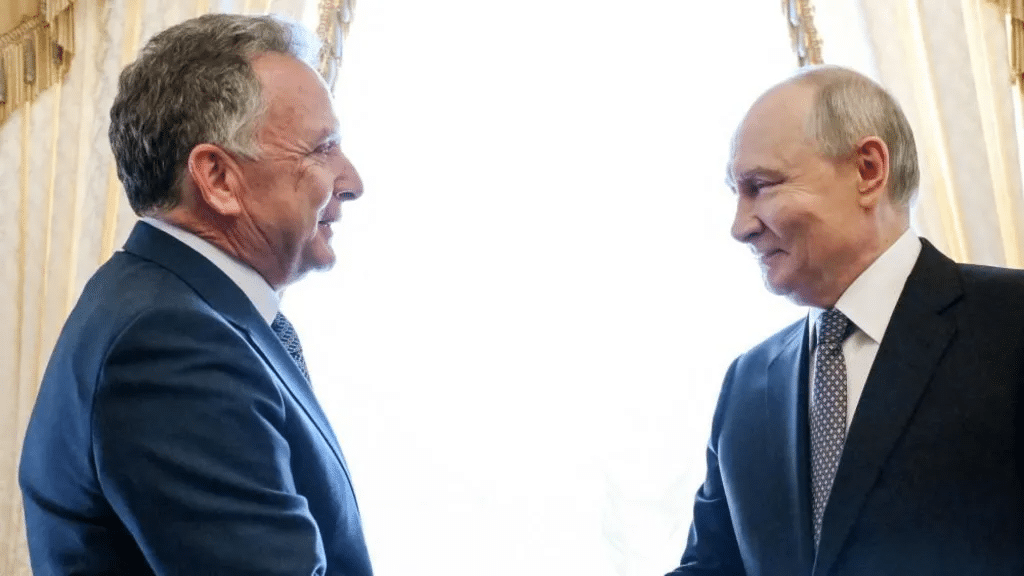
Moscow is “ready in principle” to resume Ukraine peace talks alongside Washington and Kyiv, a senior Kremlin aide confirmed following high-level US-Russia diplomacy in St. Petersburg.
Yuri Ushakov, speaking shortly after President Vladimir Putin concluded talks with US President Donald Trump’s special envoy Steve Witkoff, indicated that a fresh diplomatic round could convene next month. The statement arrives after months of stalled dialogue, during which Moscow resisted negotiations whilst maintaining a relentless battlefield push against Ukrainian air defences.

High-Stakes Diplomacy: St Petersburg Negotiations and the Oslo Precursor
Witkoff’s arrival in Russia followed intense discussions in Oslo with Ukrainian President Volodymyr Zelensky alongside the leadership of Norway and Finland.
While the precise terms presented to Putin remain undisclosed, Zelensky confirmed after the Oslo summit that robust security guarantees and energy-sector ceasefires formed the cornerstone of discussions. However, Ushakov dismissed those initial Kremlin ceasefire proposals as not particularly “useful”.
Despite those reservations, momentum for renewed Ukraine peace talks appears to be building behind closed doors. Officials have held multiple preliminary rounds since Russia launched its full-scale invasion in February 2022, though progress faltered last month when Moscow blamed “massive” Ukrainian strikes during Russian general elections for breaking off dialogue.
Ushakov suggested that a new framework meeting could take place around 10 November in Abu Dhabi. He emphasised that any future dialogue must centre on “building a security system for Russia and Ukraine after the end of the conflict.”
A senior US official subsequently confirmed that Witkoff and key negotiator Jared Kushner proposed “a trilateral meeting at the technical level between the US, Russia, and Ukraine” during the Oslo gathering.
“This was accepted by the Ukrainians in Oslo yesterday and by the Russians in St Petersburg today,” the official stated on condition of anonymity.
Frontline Realities and Disputed Claims in US Russia Diplomacy
The renewed thrust of US Russia diplomacy comes against a backdrop of starkly conflicting battlefield accounts. Ushakov noted that President Putin told Witkoff Russian forces were advancing right across the front line and retained a “strategic initiative”.
Conversely, Ukraine and its European allies firmly reject Moscow’s assessment, highlighting a virtual stalemate along the contested front.
These delicate St Petersburg negotiations also unfolded amidst noticeable friction between Washington and Kyiv. President Trump recently suggested Ukraine requires fresh leadership, remarking it was time “for somebody else to negotiate on behalf of Ukraine”.
Furthermore, Washington has pointed to Ukrainian strikes on Russian oil refineries as a driver behind rising global fuel costs—a strain exacerbated by the US-led war on Iran.
Trump faced sharp criticism from both Democratic and Republican lawmakers after easing sanctions to permit Russian diesel onto global markets, despite having signed legislation authorising new tariffs on Russian energy imports only weeks prior. Zelensky and European leaders openly condemned the sanction relief.
Strategic Tensions, Starlink Constraints, and Kremlin Ceasefire Proposals
Tensions extended into intelligence and operational support. Kyiv recently accused Washington of withholding critical early-warning missile data—a claim US Secretary of State Marco Rubio branded “scandalous. Zelensky later acknowledged in Oslo that intelligence sharing “works now”.
Simultaneously, Ukrainian commanders reported bandwidth restrictions on Elon Musk’s Starlink network, limiting drone operations against Russian positions. US officials denied requesting any network slowdown, prompting a bipartisan group of US senators to demand a formal inquiry.
Yet, despite the strained backdrop, diplomatic channels delivered a tangible result ahead of the St Petersburg negotiations. Russia released Stephen Hubbard, a 74-year-old American citizen detained for nearly seven years over allegations of fighting for Ukraine.
Trump announced the former teacher was “on his way back home” and declared “there was no ‘swap’ necessary”, whilst Witkoff praised Putin as a “humanitarian” for granting the release.
Addressing Witkoff’s characterisation of the Kremlin chief, US Vice-President JD Vance defended the diplomatic strategy:
“I agree with Steve Witkoff saying something nice to a person who just released an American hostage. Whether you agree with the underlying sentiment or not, Steve Witkoff is a diplomat. His job is to go over there and get a job done. I care much less about what Steve said and about the fact that he is bringing an American hostage home to his family.”
Whether these diplomatic openings translate into concrete Kremlin ceasefire proposals remains to be seen, but the Abu Dhabi talks represent the clearest window for de-escalation in months.