

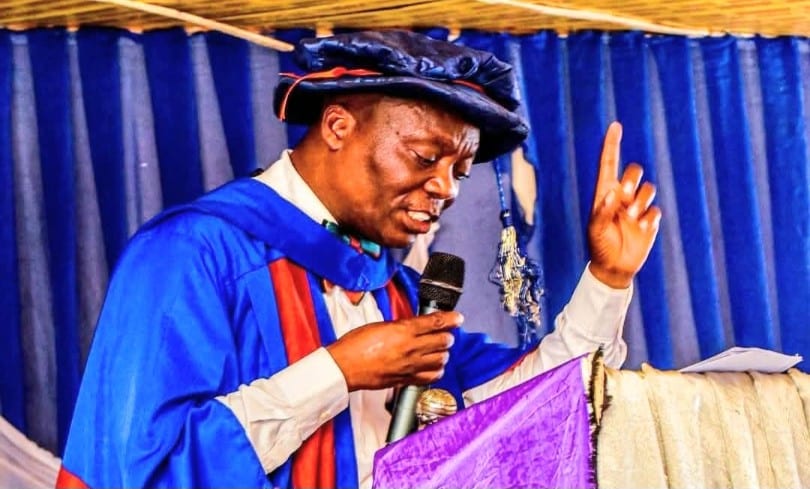
The Director-General of the Ekiti State Bureau of Tourism Development, Barrister Wale Ojo-Lanre, has delivered a firm mandate to aspiring media professionals: embrace development journalism as the only responsible path to navigate the chaotic era of phone journalism.
Speaking to newly admitted students at the International Institute of Journalism (IIJ), Ekiti State Campus, Ojo-Lanre argued that the distinction between a trained professional and a “citizen reporter” lies in the commitment to social progress rather than mere digital noise.
The Danger of Phone Journalism and the Need for Ethics
Addressing the matriculants in Ado-Ekiti, Ojo-Lanre delivered a lecture titled “Development Journalism: The Responsible Pathway for Rookie Journalists in the Age of Phone Journalism.”
He noted that while the mobile device is a revolutionary tool, it has simultaneously introduced significant risks to the sanctity of truth.
Amb. Ojo-Lanre observed that the rise of citizen reporting allows anyone with a data bundle and basic English to “mislead, praise, condemn or destroy reputations.”
He cautioned that this democratisation of media has inadvertently invited “reckless posting, fake news, blackmail, propaganda, rumour and unethical communication” into the public sphere.
For Ojo-Lanre, the antidote is clear: rookie reporters must prove that their craft is a disciplined public service rooted in verification and fairness.
Defining Development Journalism in a Modern Context
To stand out in a saturated market, Ojo-Lanre urged students to adopt a style of reporting that offers depth and conscience.
“Development journalism is the journalism of social progress. It focuses on the welfare of the people, the growth of communities, the performance of institutions and the transformation of society. It does not merely report events; it interrogates their meaning and impact on the people,” he said.
He explained that this approach requires asking “deeper questions” about infrastructure and policy. “For instance, a reporter should not merely announce a new road; they must investigate its utility for farmers and its long-term maintenance plan.”
Similarly, regarding healthcare, he insisted that journalists must look past the ribbon-cutting: “A development journalist must not only report the commissioning of a hospital, but must investigate whether there are doctors, nurses, drugs, electricity, affordability and real benefits to the people.”
Why Professional Journalism Training Matters
Reflecting on his own distinguished career, the former Nigerian Tribune journalist shared a humbling moment from 1997. Despite holding advanced degrees in History, Ojo-Lanre was once denied registration by the Nigeria Union of Journalists because he lacked professional journalism training. This led him to enroll at the International Institute of Journalism (IIJ).
“That experience taught me a lesson I will never forget. A writer may impress, but a journalist must verify. A writer may entertain, but a journalist must inform. A writer may provoke, but a journalist must be responsible. A writer may depend on flair, but a journalist must depend on facts, fairness, ethics, balance and public interest,” he stated.
He reminded the students that fluency in English does not equate to professional status. He drew a sharp parallel to the legal profession, noting that speaking “legalese” does not make one a lawyer without the rigours of Law School.
The Newsroom vs. The Smartphone
Amb. Ojo-Lanre was emphatic that technology is a tool, not a teacher. “A phone is not a newsroom. A phone is only a tool. A phone does not teach ethics. It does not teach balance. It does not teach verification. It does not teach media law. It does not teach fairness. It does not teach public interest. That is why professional training is important.”
He further clarified that development journalism is not a mouthpiece for the state. A practitioner is a “servant of society” who must be brave enough to expose failed projects while also commending effective policies. Even those entering lifestyle or entertainment beats were encouraged to inject a “development consciousness” into their work, looking at how festivals or fashion impact local economies and heritage.
A Call to Credibility at the International Institute of Journalism (IIJ)
Concluding his address, the Director-General reminded the matriculants that the International Institute of Journalism (IIJ) offers something a smartphone cannot: professional character.
“The phone may give you access to publish, but IIJ must give you the wisdom to know what deserves publication. The phone may give you speed, but IIJ must give you accuracy. The phone may give you visibility, but IIJ must give you credibility. The phone may give you followers, but IIJ must give you professional character,” Ojo-Lanre concluded.
He urged the new cohort to move beyond the desire to “trend” and instead focus on building trust and serving the public good through the noble burden of the press.