

Scientists are harnessing the power of AI in neurological research to radically accelerate the hunt for a motor neurone disease treatment that may currently be hiding in plain sight. At the UK Dementia Research Institute in Edinburgh, a pioneering team is analysing vast pools of patient data—including voice recordings, iris scans, and lab-grown brain cells—to determine whether repurposing existing drugs could offer a swift breakthrough for patients globally. By deploying machine learning algorithms to map intricate disease patterns, researchers hope to uncover effective treatments in years rather than decades.
This newfound hope is intensely shared by Steven Barrett, a participant in these ground-breaking MND clinical trials who was diagnosed with the degenerative condition a decade ago. Steven was planning an active retirement following a decorated career in the civil service when he first noticed a persistent numbness in his leg. A few years later came the devastating diagnosis of motor neurone disease (MND)—a progressive neurological condition that currently has no known cure.

“MND is a horrible disease; it strips you of who you are,” Steven explains from his home in Alloa, Scotland. “It rips any sense of future that you may feel that you had planned for yourself – all that goes.”
The Human Toll of MND and the Beacon of Clinical Trials
Steven notes that his family never saw the illness coming. He glances at photographs tracking a vibrant life: smiling at work, laughing at parties, and standing proudly at his son’s wedding. Yet, he describes the ongoing Edinburgh trials as a “bright light” of genuine hope for himself and thousands of others living with MND or similar degenerative conditions.
One specific trial, known as MND-SMART, tests multiple drugs simultaneously. This progressive model stands in stark contrast to traditional trials, where one group receives a single experimental treatment and another receives a dummy drug, or placebo.
“For me the research is much more than taking a tablet – it’s taking a tablet with the intention of delivering outcomes that may or may not help me but help others,” Steven says.
How Data and AI in Neurological Research Spot Early Warnings
To power this clinical innovation, the Institute is building a comprehensive database of individuals living with Parkinson’s, dementia, and MND. Clinicians gather iris scans and voice recordings, using advanced artificial intelligence to sift through massive datasets. This process allows them to pinpoint subtle structural changes that serve as early indicators of future health complications.
Furthermore, scientists extract blood samples from volunteer patients to cultivate stem cells. These are grown into specialised clusters of brain cells called neurones.
[Patient Blood Sample] ➔ [Stem Cell Cultivation] ➔ [Neurone Batches] ➔ [AI Algorithmic Testing]
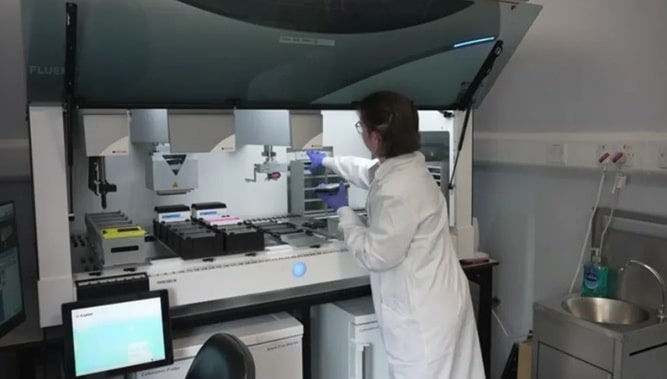
Existing treatments are then tested on multiple batches of these neurones using a sophisticated combination of robotics, traditional laboratory equipment, and computers running specialist algorithms. These machine learning tools are trained to identify specific compounds that can successfully convert a neurological disease signature back into a healthy one. When the system flags a promising match, those therapies can move swiftly into active clinical trials.
Unleashing Technology for Repurposing Existing Drugs
There are roughly 1,500 approved drugs currently used to treat alternative medical conditions. Professor Siddarthan Chandran, Chief Executive of the UK Dementia Research Institute, believes it is highly probable that at least one of these could prove effective within the human brain.
“The brain is the most complicated organ in the body, so we’ve got to contend with the paradox of that complexity,” Professor Chandran explains. He notes that, until recently, this complexity forced researchers to rely on less sophisticated analytical methods. A combination of AI and new technologies means we can now do things which would have been unbelievable when I was at medical school.”
Because these medical compounds have already passed rigorous safety approvals, redeploying them through **repurposing existing drugs** is far faster than developing new formulas from scratch. Bringing a brand-new drug to market typically takes upwards of ten years. However, Professor Chandran and his team believe their automated screening process means affordable, accessible treatments could reach patients significantly sooner.
Global Trends in Automated Medicine
The Edinburgh initiative joins a growing global movement utilising machine learning to extract answers from mountain-sized health databases. In the United States, scientists at the Massachusetts Institute of Technology (MIT) have utilised generative AI to identify novel antibiotic compounds capable of treating drug-resistant superbugs and conditions like Parkinson’s. Similarly, researchers at Harvard University built a neural network model called TxGNN to identify existing therapies that could treat exceptionally rare diseases.
The wider field of neurology has faced recent hurdles. A review of lecanemab and donanemab—once hailed as historic breakthroughs for Alzheimer’s disease—concluded that while the drugs slowed cognitive decline, the real-world difference to patients was not significant. The review scrutinised 17 studies involving 20,342 volunteers, looking at therapies designed to clear amyloid, a misfolded protein present in the disease.
While that conclusion sparked an immediate backlash from parts of the scientific community, Professor Chandran remains remarkably confident about the future of AI in neurological research.
“We’re at the tipping point of change,” Professor Chandran insists, highlighting a profound shift in our fundamental understanding of neurological disease.