
Retaliatory bombardments against Iranian military positions have taken place following an attempted ballistic missile attack targeting American troops.
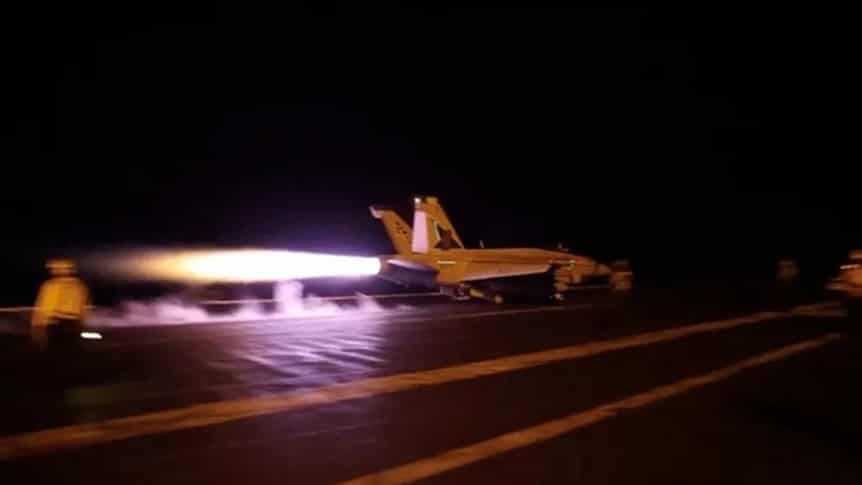
The United States Central Command (Centcom) confirmed the hour-long operation began at 20:00 ET on Wednesday (01:00 BST on Thursday). Precision strikes were directed against Islamic Revolutionary Guard Corps (IRGC) command positions, coastal surveillance posts, and drone storage infrastructure in southern and western Iran.

Iranian state news outlets reported that the bombardment caused civilian fatalities on Qeshm Island, including a two-year-old child, while disrupting oil processing installations in Abadan.
Centcom stated that the action was a direct response to Iranian strikes launched on Tuesday against bases housing American troops in Jordan, as well as commercial vessels traversing the Strait of Hormuz. Defensive systems successfully intercepted all Iranian missiles fired during Tuesday’s raid, according to US defence officials.
Speaking from the White House, Donald Trump vowed further military action. “We’re going to be hitting them very hard because it’s our turn to hit them. They know it’s coming. They asked us not to do it,” he said.
The escalation shatters a fragile, days-long lull in hostilities during which both nations had reportedly explored diplomatic avenues. Iranian officials, however, denied that any formal negotiations had occurred.
Protecting American Troops Triggers Wider Regional Contagion
The renewed military campaign underscores the severe risks facing American troops stationed throughout the region as peripheral Middle Eastern nations are drawn into the crossfire.
Jordanian armed forces confirmed on Thursday that domestic air defence batteries intercepted five Iranian ballistic missiles traversing the Kingdom’s airspace. Concurrently, the Egyptian government reported that a drone strike caused a fire at a commercial port on Wednesday, marking the first direct impact on the American ally during the months-long war.
Diplomatic relations across the region are straining under joint military campaigns. Earlier in the week, combined US-Saudi strikes targeted Iranian proxy positions in eastern Iraq following more than 30 IRGC-directed drone attacks.
Iraq’s Popular Mobilisation Forces (PMF) confirmed that 20 members were killed in the bombardment. While the Iraqi presidency condemned the action as an “unacceptable attack and a blatant violation of Iraq’s sovereignty”, Mr Trump told Fox News that the strikes were “co-ordinated with the Iraqi government.
Escalating Threats to Deployment Base Networks
Beyond immediate tactical engagements, the targeting of American troops threatens to unsettle delicate regional alliances and critical global energy routes.
Strikes hitting Qeshm and Abadan damaged areas fundamental to Tehran’s commercial energy infrastructure. The IRGC previously stated its naval forces had hit three commercial oil tankers in the Strait of Hormuz after the vessels “ignored warnings” and navigated an “unsafe and illegal route” through the waterway.
On the ground, civilians are bearing the direct consequences of interrupted basic utilities. A resident in southern Qeshm told BBC Persian that municipal power networks failed repeatedly after early morning detonations at 03:40, forcing residents to head toward the capital. “There have been loud bangs since 03:40 this morning. We are helpless,” he said.
Local medical personnel confirmed the casualties resulting from the defensive responses. “A US attack on a residential home in the Chah Tangu neighbourhood of Qeshm killed three members of a family: the father, the mother, and their 2-year-old child,” Fars news agency reported, citing the Hormozgan University of Medical Sciences.
The IRGC defended its aggression directed at bases housing American troops in Jordan, asserting it struck a military command centre “in response to the acts of aggression of the American child-killing army”.
Diplomatic avenues to defuse the standoff remain uncertain. Reports from Axios indicate Saudi Defence Minister Prince Khalid bin Salman met Mr Trump to convey Riyadh’s desire to prevent further escalation. Saudi Arabia and Iran have maintained a fierce regional rivalry for decades, and prolonged confrontation risks crippling vital economic channels connecting the Gulf to international markets.
With additional reporting from the BBC