
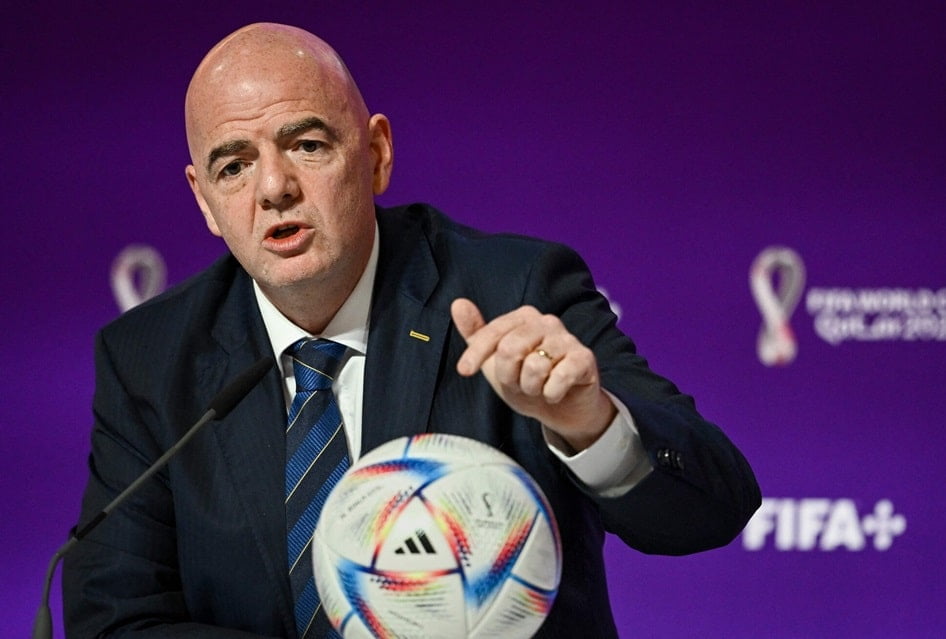
FIFA says “nobody is selling football” as it vowed to press ahead with plans to privatise World Cup commercial assets despite widespread opposition.
The global governing body released a defensive statement on Friday following an unprecedented rebellion from its most powerful regional blocs. UEFA, which governs European football, voted on Thursday to boycott future World Cups if the commercial restructuring goes ahead.
Concacaf, the governing body for North, Central America and the Caribbean, confirmed its 41 member associations also rejected the proposal put forward by FIFA president Gianni Infantino.
Combined, UEFA and Concacaf control 96 of FIFA’s 211 member votes. Mr Infantino requires a majority of 106 votes to pass the measure.
Addressing the escalating crisis, FIFA claimed the consultation process had been “disrupted by incorrect media reports.
“We respect the feedback and concern aired in public and reaffirm our commitment to an open and democratic consultation,” the statement read.
“We will proceed with this consultation process to ensure that each MA (managing organisation) has the ability to express its vote based on facts. Nobody is selling football. This is not something FIFA would ever entertain.”
Under the proposal, FIFA intends to create a commercial subsidiary named FIFA Forward Enterprise (FFE). External investors would be invited to purchase minority, non-controlling stakes in the entity, which would manage broadcast, ticketing, and sponsorship operations for major tournaments.
FIFA stated FFE was designed to “ensure all FIFA member associations have the opportunity to take meaningful ownership of the commercial opportunity of football in their respective countries” without compromising the governance or spirit of the game.
However, European officials reacted sharply. UEFA accused FIFA leadership of using the sport “to enrich themselves and their friends”.
Mr Infantino previously offered national federations a direct financial incentive to back the measure. In a letter sent to members, he pledged $40m (£30m) in total funding for those supporting the plan, setting a deadline of 19 September to access an initial $20m (£15m) payout.
Should member nations approve the structure, venture capital firm Thrive Eternal is expected to lead the investor syndicate. The American firm was founded by Joshua Kushner, the brother of Jared Kushner, son-in-law to US President Donald Trump.
A Structural Schism in Global Sport
The confrontation over plans to privatise World Cup commercial rights represents the most severe governance crisis in international sport since the aborted European Super League in 2021.
By seeking capital from private equity firms, FIFA risks altering the economic foundation of international football. Critics argue that introducing private profit motives to national team competitions fundamentally conflicts with the governing body’s regulatory mandate as a non-profit association.
For European and North American federations, resisting the commercial spin-off is both a philosophical stance and a protection of their own market power. UEFA’s Champions League and Concacaf’s domestic markets generate billions in commercial revenue independently. Allowing a private consortium to dictate global tournament distribution threatens to cannibalise local broadcast valuations and dilute national team scheduling.
Financial Carrots and Political Resistance
The dispute highlights a growing geopolitical divide within world football’s administrative framework.
Mr Infantino’s strategy relies on securing support from smaller member federations across Africa, Asia, and Oceania, where the guaranteed $40m cash injection represents transformative capital. For many developing football associations, access to immediate capital outweighs abstract concerns regarding corporate control.
Conversely, the involvement of political figures and private equity highlights deeper structural tensions. Opponents contend that transferring commercial rights to external investment vehicles undermines democratic oversight, placing control of sport in the hands of private financiers.