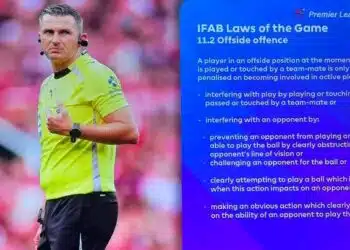


VAR(Video Assistant Referee)was introduced to the Premier League, its purpose seemed straightforward: reduce serious refereeing errors and make football fairer.
Yet years after its arrival, VAR remains one of the most debated developments in modern football. Supporters have seen goals overturned, penalties awarded and red cards corrected. They have also watched celebrations turn into anxious waits while officials review incidents frame by frame.
VAR was designed to improve football’s biggest decisions. Instead, it has changed the way the game is played, watched and discussed.
Why was VAR introduced?
Football has always contained mistakes. Referees make decisions in real time, often with only a fraction of a second to judge incidents involving several players.
The introduction of VAR was intended to provide officials with another layer of assistance in four key areas: goals, penalty decisions, direct red cards and cases of mistaken identity.
The technology allows officials to review incidents from multiple camera angles and communicate with the referee on the pitch. In theory, obvious mistakes can therefore be corrected before they have a decisive impact on a match.
That has undoubtedly produced benefits.
A missed foul in the penalty area or an incorrectly awarded goal can potentially change the result of a match and, over a 38-game Premier League season, those decisions can have significant consequences. VAR provides referees with an opportunity to correct errors that might previously have gone unchallenged.
Has VAR made the Premier League better?
There is a strong argument that it has.
Football is increasingly decided by tiny margins. The difference between winning and losing can influence league positions, European qualification, relegation battles and millions of pounds in revenue.
Having technology available to check crucial decisions can therefore protect teams from some of the most damaging officiating mistakes.
VAR has also exposed incidents that may have been missed completely during live play. A referee may not see a player being fouled away from the ball, for example, while a video review can provide another perspective.
But greater accuracy has come with a price.
When the wrong decision can cost a team
The real problem begins when VAR fails to correct a mistake — or, worse, overturns the correct decision and creates a new one.
Yesterday’s Manchester derby provided a powerful example.
Manchester City defeated Manchester United 1-0 at Old Trafford, with Erling Haaland scoring the only goal of the game. The goal was initially ruled offside, but VAR intervened and overturned the decision, allowing Haaland’s goal to stand.
The controversy centred on Enzo Fernández, who was in an offside position and attempted to play the ball during the attack. Although Haaland himself was found to be onside, Pro Ref, the organisation responsible for Premier League refereeing, later admitted that the VAR had made an “error of judgement” by failing to properly consider Fernández’s position and its likely impact on the play. Pro Ref said the VAR should have recommended an on-field review and contacted Manchester United to acknowledge the mistake.
For United, the timing could hardly have been worse.
Haaland’s goal was the difference between the two sides. Had the goal been disallowed, the match would have remained 0-0, meaning United would have taken a point rather than losing the derby. Of course, football cannot guarantee that the game would have finished level if the goal had been ruled out. United still had opportunities to win the match.
But that is precisely why such decisions matter.
A single VAR decision can determine whether a club gains three points, one point or nothing. Across an entire Premier League season, those points can influence the title race, European qualification or a relegation battle.
For a club that has invested heavily in players, coaches and preparation, losing a match because of a decision that the refereeing body later admits was wrong is understandably frustrating.
The Manchester derby therefore raises an uncomfortable question: if VAR was introduced to prevent major mistakes, what happens when the technology itself becomes responsible for a decisive error?
The answer cannot simply be that mistakes are part of football. That was understandable before VAR existed. But once football introduces technology specifically to help officials avoid serious errors, the expectation of accuracy naturally becomes much higher.
And Manchester United are unlikely to be the last club affected by such a decision.
The problem with marginal decisions
Perhaps the biggest controversy surrounding VAR in the Premier League has been offside.
The offside law itself is relatively simple: a player cannot gain an unfair advantage by being ahead of the second-last opponent when the ball is played. Applying that rule using technology, however, has created some extraordinary situations.
Players have been judged offside by tiny margins that are almost impossible to detect with the naked eye. A toe, shoulder or knee can determine whether a goal stands.
Technically, these decisions may be correct. But they have raised an important question: should football use technology to find microscopic infringements when the original purpose of VAR was to correct clear and obvious mistakes?
The Manchester derby adds another layer to that debate. The issue was not simply whether Haaland was onside. It involved the subjective question of whether Fernández’s position affected the play. That demonstrates that even with video technology, football still depends heavily on human interpretation.
This is where the debate becomes less about technology and more about the philosophy of football.
VAR has changed the emotion of the game
Football is built around emotion.
A goal can produce an explosion of noise in a stadium. Fans hug strangers, players sprint towards supporters and entire communities celebrate together.
VAR has introduced uncertainty into those moments.
Supporters can score a goal and still find themselves waiting for confirmation. Players may celebrate cautiously because they know an incident from several seconds earlier could be reviewed.
That does not mean VAR has eliminated emotion from football. Far from it. A goal confirmed after a lengthy review can produce enormous relief.
But the experience is different.
The spontaneity that has always been central to football has been replaced, at times, by anticipation of a technological verdict.
The human element remains
One of the biggest misconceptions about VAR is that technology makes refereeing completely objective.
It does not.
VAR provides officials with more information, but humans still interpret the laws of the game. Questions such as whether a challenge constitutes serious foul play, whether a player has deliberately handled the ball or whether contact is sufficient for a penalty can remain subjective.
This means VAR has not removed controversy. It has simply moved some of it into a different setting.
Instead of arguing only about what the referee saw, supporters can now debate camera angles, freeze frames, drawing lines and the length of a review.
In some cases, that may actually make controversy more complicated rather than less.
The impact beyond the Premier League
The influence of VAR extends far beyond English football.
It has become an important part of major competitions and leagues around the world, reflecting football’s wider move towards technology.
Goal-line technology had already demonstrated that technological assistance could be introduced without fundamentally interrupting the sport. VAR, however, has a much broader influence because it deals with decisions involving interpretation.
That distinction matters.
Technology can determine whether a ball crossed a goal line with extraordinary precision. It is much harder for technology to determine whether a referee’s interpretation of a foul was correct.
Football therefore faces a balancing act: use technology where it genuinely improves accuracy, while avoiding a situation where every incident becomes an opportunity for lengthy analysis.
So, is VAR good for football?
The answer is not simply yes or no.
VAR has corrected important mistakes and can provide referees with information they could not previously access. Abandoning technology altogether would potentially return football to an era where major errors could decide matches without any possibility of correction.
But VAR is not perfect.
The challenge is improving how it is used.
Reviews need to be efficient. The threshold for intervention needs to be clear. Supporters need greater transparency about why decisions are made, and the application of the laws needs to be as consistent as possible.
Most importantly, football must remember what VAR is supposed to be: an assistant to the referee, not the central character of the match.
VAR The way Forward
The future of football will almost certainly involve even more technology. Better camera systems, improved tracking and developments in artificial intelligence could eventually make decisions faster and more precise.
But technological progress should not automatically mean technological intervention in every situation.
The appeal of football has never been its perfection. It is unpredictable, emotional and occasionally chaotic. Referees are part of that human story.
VAR should therefore aim to protect the integrity of football without taking away its soul.
The technology has undoubtedly changed the Premier League. The question now is whether football can learn to use it without allowing the pursuit of perfect decisions to overshadow the imperfect beauty of the game itself.