
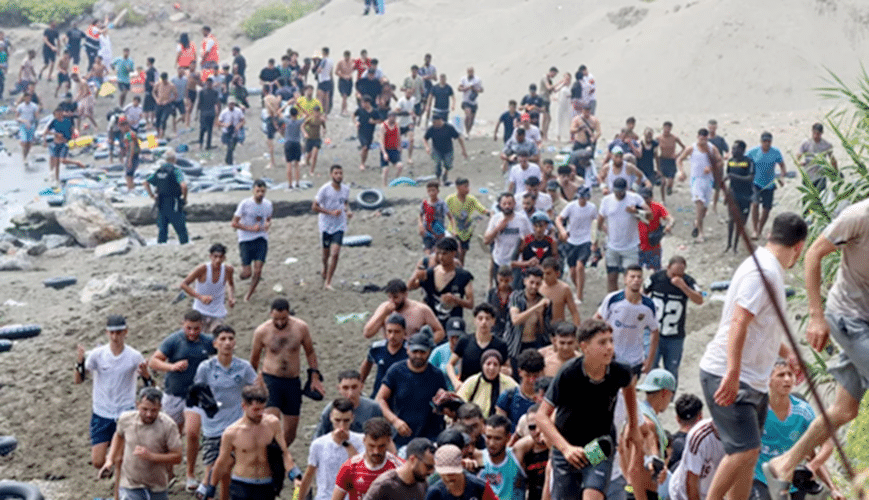
Spanish authorities say most of the 50,000 migrants who entered the North African exclave of Ceuta have returned to Morocco. At least 57 people died after drowning in the Mediterranean Sea during a rapid influx of sea and land crossings that quickly overwhelmed local border forces on Thursday.
By Friday evening, hundreds of people were seen retracing their steps back through border gates and gaps in the perimeter fencing. Many cited severe shortages of food, basic supplies, and emergency shelter inside the territory as their main reason for turning back.
The scale of the crossing forced Spanish Prime Minister Pedro Sánchez to travel directly to the territory, which sits on the North African coast directly opposite mainland Spain.
“What happened yesterday deserves our full reproach, our full condemnation,” Mr Sánchez said. He described the sudden surge as a “violation of Spain’s territorial integrity” and attributed the push to misinformation spread by human traffickers.
The diplomatic fallout spread across the continent within hours of the initial crossings.
EU Allies Reinstate Controls Amid Ceuta Border Crisis
Italy announced the immediate suspension of its border-free Schengen arrangements with Spain, citing security concerns over unmonitored movements.
“The temporary suspension of #Schengen regarding Spain is a necessary step to safeguard our citizens’ security and defend European borders,” stated Antonio Tajani, Italy’s Foreign Minister and Deputy Prime Minister, in a post on X.
Italian authorities confirmed that target checks will focus primarily on non-EU nationals flying or sailing from Spanish hubs to Italian ports. Major carriers operating between the two nations, including Vueling and Iberia, reported no immediate cancellations, though passengers were advised to carry complete documentation.
Meanwhile, French Interior Minister Laurent Nunez confirmed additional police units have been deployed to bolster checks along France’s southern border with Spain.
European Union leaders also expressed concern over the breakdown of border enforcement. EU President Ursula von der Leyen stated on X that “we cannot allow anyone to come to our Union without abiding by our rules.”
Systemic Pressure Mounts on Madrid’s Migration Strategy
The rapid chain of events has intensified political scrutiny on the pro-immigration stance of Mr Sánchez’s Socialist-led coalition government.
Spain’s Supreme Court recently ruled that migrants arriving by sea cannot be summarily returned to Morocco. Despite this legal constraint, Spanish officials confirmed they sought to process illegal entries as rapidly as local infrastructure allowed.
The migration surge has drawn sharp condemnation from both foreign governments and domestic opposition figures. The leader of Spain’s far-right opposition party VOX publicly denounced the government’s handling of the emergency.
“He behaves like an enemy of the Spanish people,” Santiago Abascal wrote on X. “The national emergency can only be resolved by kicking him out.”
The international reaction was equally direct. The US State Department issued a critique of Madrid’s border management, framing the incident as a consequence of “deliberate efforts to enable and facilitate mass illegal migration into Europe.”
US President Donald Trump also weighed in on the events, describing the surge as an example of what lies ahead if Republicans fail to secure victory in the upcoming elections, adding that the event should serve as a “talking point for the midterms.”
Ceuta, a territory of 84,000 residents, previously experienced a sudden entry of 8,000 people over two days in May 2021. However, officials confirm this latest movement represents an unprecedented strain on the enclave’s operational capacity.
For many of those who crossed, the reality on the ground proved unsustainable.
“Honestly, I don’t even know why I came, and now I’m going back,” said a young Moroccan man from Tangier. “I haven’t eaten since lunch yesterday, even though I brought some money with me… What we’re doing is neither good nor enjoyable.”