
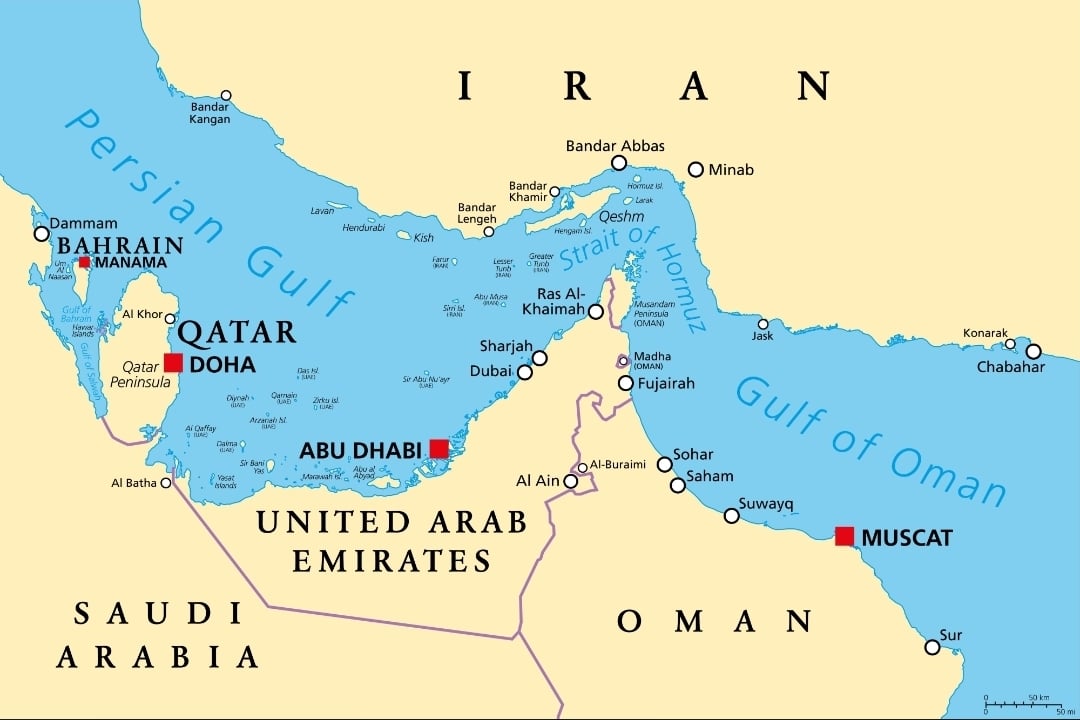
Iran and Oman have reached the final stages of a Strait of Hormuz deal to establish a designated transit passage.
Iranian Foreign Ministry spokesman Esmaeil Baqaei confirmed on Thursday that the geographical coordinates of the route had been agreed with Muscat.

However, Tehran warned that the pact would not ensure safe passage while the US naval blockade on Iranian ports remains in place.
The agreement comes as Washington increases pressure on Tehran to fully reopen the choke point, through which a fifth of global petroleum and liquefied natural gas flows.
US President Donald Trump warned on Tuesday that Iran would be “hit very hard” if maritime traffic did not resume shortly.
Tehran has largely blocked the waterway since February, following joint US and Israeli military strikes against Iranian targets.
Under the proposed framework, the new maritime lane would operate on a temporary basis for two to four months, according to Iran’s Deputy Foreign Minister Kazem Gharibabadi.
Global benchmark Brent crude fell 0.3% to $79.24 (£58.84) per barrel in Thursday morning Asian trade as markets reacted to the potential easing of transit restrictions.
Despite the technical breakthrough with Oman, Iranian officials insist fundamental obstacles to regional security persist.
“The factors making the Strait of Hormuz insecure still exist on the part of the United States, particularly the naval blockade and other aggressive and threatening actions against Iran and its interests,” Mr Baqaei said.
Neither the US Administration nor the Omani Government has publicly commented on the proposal.
Strait of Hormuz deal risks friction over transit levies
The diplomatic manoeuvre reflects Tehran’s attempt to exercise sovereignty over the shipping lane while shifting the responsibility for economic paralysis onto Washington.
By framing the agreement as a bilateral security arrangement with Muscat, Iran aims to establish control over Gulf maritime transit without conceding to direct American demands.
A central point of contention remains Tehran’s insistence on charging commercial vessels a transit fee of between 5% and 7% of cargo value.
Oman has suggested a reduced tariff of roughly 3%, whereas Washington opposes any transit levies on international shipping.
If implemented, the proposal reported by Reuters would grant Tehran authority over merchant vessels entering the Gulf through the conduit.
Previous attempts to stabilise the region have collapsed swiftly.
A Memorandum of Understanding signed by the US and Iran in June to halt hostilities and reopen the strait failed within days as armed clashes resumed.
The current conflict triggered structural instability across the regional maritime sector.
Yemen’s Iran-backed Houthi movement maintains a secondary naval blockade on Saudi Arabia’s Red Sea ports, implemented on 20 July.
Power structure uncertainty in Tehran complicates diplomacy
The military campaign launched on 28 February fundamentally altered Iran’s political landscape following the death of Supreme Leader Ayatollah Ali Khamenei.
His son, Mojtaba Khamenei, succeeded him but was injured in the opening strikes and has not made a public appearance since.
The new leader’s absence from public life, including his father’s funeral ceremonies last month, has fuelled questions regarding internal government cohesiveness.
Iranian President Masoud Pezeshkian acknowledged on Wednesday that direct communication with the Supreme Leader was “difficult at the moment.
In any case, his presence is a very great source of strength for us so that we can continue,” Mr Pezeshkian said, according to state media.
Mr Pezeshkian rejected speculation regarding instability within the leadership, maintaining that recent meetings with Mojtaba Khamenei were productive and marked by “kindness and very sound logic”.
“Unfortunately, the current situation allows some malicious people to describe him differently and to present a different image of him,” he added.
Until leadership dynamics in Tehran clarify, and the US naval blockade addresses transit levies, any shipping agreement through Oman remains structurally fragile.