

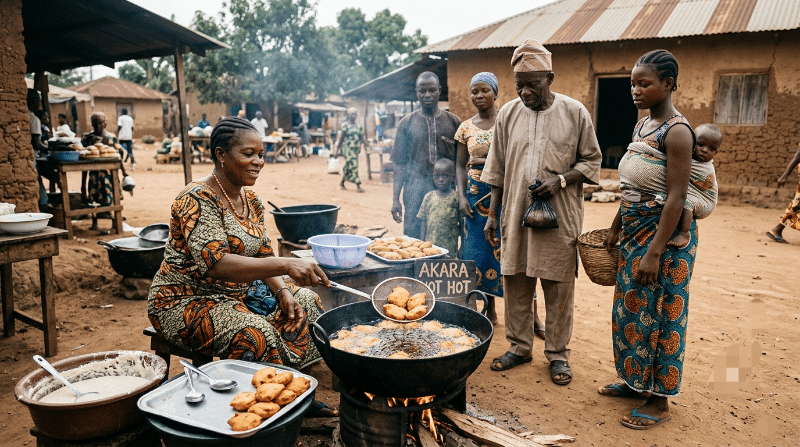
There are folk songs that entertain. There are others that educate. Then there are those rare compositions that outlive generations because they quietly preserve the philosophy of a people. One such timeless Yoruba folklore wisdom is the familiar refrain:
“Ta ló ń pe Ìyá Alákàrà sẹ́rè?”
Ìyá Alákàrà!
“Ó ń ta sánsán, símí nímú.”
Ìyá Alákàrà!
“Ó ń ta dòdò, símí ló fún.”
Ìyá Alákàrà!
“Èmi ò ní pe Ìyá Alákàrà sẹ́rè.”
For decades, children sang those lines without pausing to interrogate their profound meaning. Yet, hidden beneath their playful rhythm is one of the finest statements on the dignity of labour Yoruba culture ever composed in oral tradition. This classic chant unpacks the deep Iya Alakara meaning that extends far beyond the streets. Contrary to popular assumption, the song is not about akara. Neither is it about poverty. It is about character. It is about labour. It is about how society should regard those who earn an honest living.

Understanding the True Iya Alakara Meaning
The opening question of the song is itself an indictment. “Who is mocking Ìyá Alákàrà?” It is a question directed not at the woman frying bean cakes but at those who consider themselves too important to respect her vocation.
The response is even more remarkable. The song does not curse the mocker. It does not glorify the akara seller. It simply describes her. She fries akara. Its aroma—sánsán—fills the air. She fries dòdò. Its fragrance announces industry before her voice does. She is busy. She is productive. She is feeding society.
Then comes the moral climax: “Èmi ò ní pe Ìyá Alákàrà sẹ́rè.” I will not mock the akara seller. Notice the true beauty of Yoruba ethics. The lesson ends not by condemning others but by demanding a personal moral commitment. “I shall not ridicule honest labour.” That is civilisation. That is character formation. That is moral education in its purest form.
Dignity of Labour Yoruba Culture and the Modern State
It was against this cultural background that I reflected on the recent public debate generated by the First Lady, Senator Oluremi Tinubu, encouraging enterprise through humble occupations such as selling akara and kuli-kuli. Predictably, opinions became polarised. Many dismissed the remarks as insensitive to the realities confronting millions of Nigerians. Others defended them as a reminder that no honest occupation should ever attract shame.
Perhaps both sides have overlooked the deeper lesson contained in the old Yoruba folklore wisdom. Our forebears never despised labour. Indeed, Yoruba civilisation was built upon the nobility of work. The farmer who tilled the land. The blacksmith whose forge rang before sunrise. The hunter who ventured into dangerous forests. The cloth weaver. The potter. The carpenter. The market woman. The akara seller. Every one of them occupied a place of honour because they contributed honestly to the welfare of society.
Among the Yoruba, wealth did not command respect simply because it was wealth. Character did. Industry did. Integrity did. That explains why another enduring proverb declares: “Ìṣẹ́ l’ògùn ìṣẹ́.” Work is the cure for poverty. Again, the proverb deserves careful reading. It does not celebrate poverty. Neither does it romanticise hardship. Rather, it presents labour as the instrument through which poverty is overcome. That distinction is crucial.
Real Nigerian Economic Empowerment
Unfortunately, our national conversation has blurred that distinction. To affirm the dignity of labour Yoruba culture does not require us to sanctify deprivation. To respect the akara seller is not to conclude that selling akara should become the highest aspiration of a nation’s youth. The Yoruba never intended that interpretation.
If anything, Yoruba society believed passionately in social mobility. The son of a farmer could become a kingmaker. The apprentice could establish his own flourishing enterprise. The child of a roadside trader could become a renowned scholar. The daughter of Ìyá Alákàrà was never sentenced to inherit only her mother’s frying pan. She inherited something infinitely greater—the discipline of work, the dignity of enterprise and the freedom to dream beyond her circumstances.
That is why I believe the present debate should move beyond unnecessary political quarrels. The real issue is not whether selling akara is honourable. It certainly is. The real issue is driving genuine Nigerian economic empowerment by ensuring our economic policies sufficiently reward honest labour.
The woman selling akara deserves respect. She equally deserves uninterrupted electricity. Affordable credit. Good roads. Quality healthcare. Security. An economy in which enterprise is not suffocated by inflation and diminishing purchasing power. She deserves customers whose incomes have not been eroded by economic hardship. Her children deserve schools where talent, not poverty, determines destiny.
A Path to Nigerian Economic Empowerment
That is the responsibility of government. Government cannot merely celebrate resilience. It must create the conditions under which resilience produces prosperity. The citizen contributes labour. The state must contribute opportunity. The citizen produces enterprise. Government must produce an enabling environment. That is the social contract.
The aroma—sánsán—drifting from Ìyá Alákàrà’s frying pan therefore becomes a powerful national metaphor. It is the fragrance of honest labour. It is the perfume of self-reliance. It is the scent of dignity. But that fragrance should not become the permanent smell of survival. It should blossom into the fragrance of prosperity. That is what good governance exists to accomplish.
As our national conversation continues, perhaps we should return to the Yoruba folklore wisdom of our forebears. The folklore never asked us to become akara sellers. Neither did it encourage us to despise them. It asked us to honour labour. To reject arrogance. To embrace humility. To recognise that every honest occupation possesses dignity because it contributes to the common good.
And perhaps the greatest lesson lies in the song’s final confession. Not they will not mock her. Not you should not mock her. But: “Èmi ò ní pe Ìyá Alákàrà sẹ́rè.” I will not mock the akara seller.
That simple declaration is more than a folk refrain. It is a covenant. A covenant between culture and conscience. A covenant between prosperity and humility. A covenant reminding us that while honest labour deserves our deepest respect, leadership must ensure that honest labour is never imprisoned by perpetual poverty. For the highest tribute we can pay Ìyá Alákàrà is not merely to applaud her industry. It is to build a Nigeria where the aroma from her frying pan is no longer the fragrance of survival alone, but the sweet perfume of opportunity, prosperity and fulfilled aspirations.