
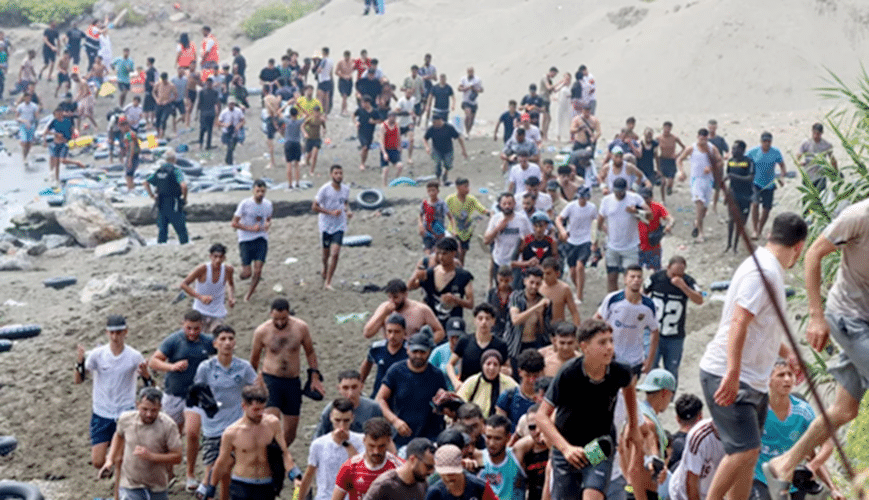
False rumours on social media sparked a massive surge into Ceuta as 60,000 migrants crossed from Morocco this week.
Sixteen-year-old Ayoub El Abyad hitched rides for 12 hours after seeing Instagram videos that claimed Spain had opened its border.
“Migration is about improving our lives. We agreed we would try the idea of crossing and trust in Allah,” El Abyad told Reuters on the Moroccan side near the border with Ceuta.
Calm summer seas and widespread misinformation regarding a recent legal decision created ideal conditions for human traffickers to exploit desperate jobseekers.
Many young Moroccans saw an opportunity after misinterpreting a Spanish Supreme Court ruling on sea interceptions.
Economic stagnation continues to push thousands toward extreme risks. Official data show a quarter of Moroccans aged between 15 and 24 are not in education, employment or training.
“I came here to seek a better future,” said Dounia Kherradi, a waitress from Lqliaa, a centre of last year’s protests. “My salary is not enough to take care of my parents, and I have a daughter… may God help us.”
Social Networks and Economic Despair Accelerate Ceuta Border Crisis
The sudden influx underscores how algorithmic feeds can convert economic frustration into mass border movements within hours.
Spain’s Socialist government reacted firmly to the surge. Prime Minister Pedro Sanchez called it a “violation of Spanish sovereignty” and pledged to return migrants to their countries of origin as quickly as possible.
Officials confirmed that while the court ruling ended immediate pushbacks at sea, legal repatriation channels remain fully operational.
To counter sea crossings, Mr Sanchez announced plans to install maritime buoys to signal a border in the sea.
The government is also considering changes to immigration law to strengthen repatriation measures.
Geopolitical Friction Signals Broader Regional Risk
Beyond social media dynamics, independent analysts point to underlying diplomatic tension between Madrid and Rabat.
Morocco does not recognise Spanish sovereignty over Ceuta and Melilla, characterising the territories as “occupied”.
Despite recent diplomatic repairs over Western Sahara, Mr Sanchez’s recent visit to Algeria reportedly caused friction. Spain’s parliament also approved citizenship rights for Sahrawi descendants, drawing quiet disapproval from Rabat.
“One way of handling that is to send a not very subtle message,” said Haizam Amirah-Fernandez, director of the Centre for Contemporary Arab Studies in Madrid.
Some observers noted the crossings peaked on Throne Day, a national holiday marking King Mohammed VI’s coronation, when border posts were thinly staffed.
Moroccan officials denied political motives. Lahcen Haddad, who heads a Moroccan parliamentary committee on EU relations, rejected suggestions that politics played a role, echoing Spain’s official interpretation that the crossings were triggered by misinformation about the Supreme Court ruling.
Spanish foreign ministry officials insisted bilateral ties with Morocco were “excellent and not affected by our good relationship with Algeria.”
Yet for young Moroccans waiting along the border fence, geopolitical negotiations mean little compared to daily survival. Until regional economies generate stable jobs, social platforms will continue to serve as catalysts for mass movement.