

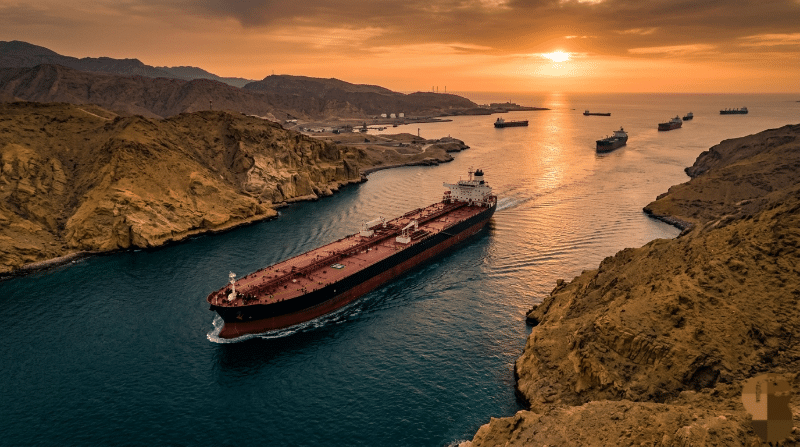
Global oil prices dropped to three-week lows on Tuesday as US and Iranian envoys signalled progress on reopening the Strait of Hormuz.
The global benchmark, Brent crude, fell almost 5% to settle below $80 (£60) a barrel. In tandem, US West Texas Intermediate dropped more than 5% to $76 a barrel. Both benchmarks recorded their lowest price points since 13 July.

The market reaction followed announcements from senior Washington officials regarding Oman-mediated discussions. US Secretary of State Marco Rubio confirmed that negotiations aimed at restoring commercial transit through the waterway had advanced.
“There’s been progress made in those talks, but not finality yet. We’re hoping that will happen very shortly,” he told reporters at the State Department.
US Treasury Secretary Scott Bessent suggested a formal agreement could emerge swiftly. He told CNBC there was a “chance we may have a deal today or tomorrow to open the strait and move towards a more normalised position in this conflict.” Asked whether Tehran would collect transit fees from passing vessels, he added: “It would be freedom of movement.”
Despite Washington’s optimistic declarations, neither administration released technical specifications of any potential draft agreement. Furthermore, Iranian representatives maintained that direct bilateral contact with Washington remained off the table.
Tehran confirmed it was conducting negotiations exclusively through Omani officials. A spokesman for Iran’s foreign ministry described talks in Muscat regarding a fresh navigation framework for the waterway as positive.
Concurrently, Qatari diplomats acknowledged ongoing efforts alongside regional mediators to secure a broader diplomatic resolution, though confirmed no direct talks were currently planned between the primary belligerents.
Strait of Hormuz Reopening: Market volatility reflects fragile diplomatic breakthrough in shipping lane
The dramatic price shift highlights how deeply international commerce depends on a single maritime bottleneck. Before the outbreak of hostilities in late February, the Strait of Hormuz carried approximately 20% of the world’s daily petroleum and liquefied natural gas supplies.
The closure of the waterway by Iranian forces, coupled with a US naval blockade of Iranian ports, effectively severed primary trade routes. Subsequent blockades on Saudi Arabian Red Sea ports by Yemen’s Iran-backed Houthis further restricted alternative bypass channels, triggering acute vulnerability across European and Asian supply chains.
Recent history explains why financial traders remain hesitant to price in a permanent resolution. Similar diplomatic breakthroughs over the past five months collapsed under renewed military activity, causing sharp price surges above $120 a barrel before sudden drops.
“Investors are acutely aware of how many times we’ve already been at this point in the war and how fragile the process of securing lasting agreements can be,” said Danni Hewson, head of financial analysis at AJ Bell.
This underlying uncertainty exerts direct pressure on central banks and national governments struggling against persistent inflation. While wholesale energy contracts fell sharply on Tuesday, retail consumers continue to bear the immediate brunt of the months-long conflict.
Global pump prices and corporate windfalls under pressure
For average citizens, the maritime standoff translates into sustained economic strain at the petrol pump. In the UK, average unleaded petrol prices reached £1.60 per litre this week, according to data from the RAC motoring group—matching peak levels recorded during the initial outbreak of hostilities.
Across the Atlantic, US motorists face average gasoline costs exceeding $4 a gallon, while diesel prices stand near $5.40 a gallon. These elevated transport costs continue to feed directly into food distribution, public transit, and manufacturing overheads worldwide.
Conversely, extended market disruption delivered record financial results for international energy majors. Companies including BP, Shell, Chevron, and Exxon Mobil reported bumper profits driven by elevated global crude benchmarks over recent quarters.
However, market analysts note that energy executives face severe planning challenges despite lucrative revenues. Hewson observed that major oil producers remain “at the mercy” of US President Donald Trump’s “machinations”.
The political stakes reached a head on Monday when President Trump issued a public warning, stating Iran faced its “last chance” to permit commercial vessels through the strait. He indicated he had paused “massive” military strikes against Iranian targets to allow diplomatic channels to operate.
Financial markets responded positively to the reprieve. US stock indices traded higher on Tuesday, buoyed by falling crude costs and strong quarterly earnings within the technology sector. Yet energy economists warn that until physical vessels pass unhindered through the strait, global energy security hangs on an exceptionally delicate thread.