

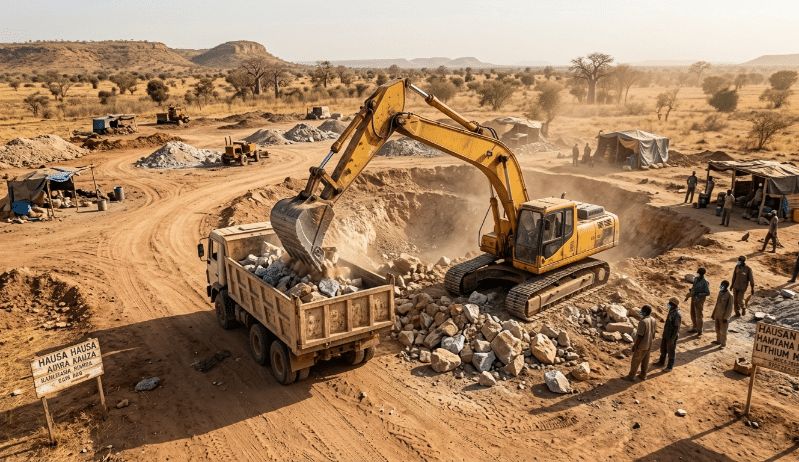
A foreign legislature may debate Nigeria’s illegal mining crisis, but the more urgent reckoning lies at home. The uncomfortable truth is no longer debatable: illegal extraction in Nigeria has outgrown artisanal trespass. In key mineral corridors, it now operates as a structured underground economy—financed, protected, and increasingly intertwined with armed violence.
Recent security operations have begun to expose the scale of this convergence. In parts of the North-West and North-Central, military offensives against bandits have uncovered not just camps and weapons, but mining sites, stockpiles of extracted minerals, and logistics chains linking resource theft to armed groups.

This is no longer a theory. It is a system.
The Shadow Economy of Critical Minerals
Foreign operators are not peripheral to this system. Across multiple enforcement actions, foreign nationals—particularly Chinese operators—have been arrested in connection with illegal mining networks. Excavation equipment worth millions has been seized. Lithium and gold consignments bound for export have been intercepted. Official statements have followed.
Yet the operations persist. That persistence is the evidence.
Illegal mining at industrial scale does not survive on secrecy alone. It survives on protection—administrative, political, logistical, and in some regions, armed. Excavators do not vanish into forests unnoticed. Ore does not move without coordination. Trucks do not cross states without facilitation. Containers do not reach ports without documentation.
Where such systems endure, governance is not merely weak—it is compromised, fragmented, or circumvented. Nigeria’s solid minerals sector sits within a structurally fractured framework.
Licensing is federal. Land control is local. Security enforcement is diffused across multiple agencies with overlapping mandates and uneven coordination. Oversight is episodic. Prosecutions are inconsistent. Convictions remain rare.
From Economic Assets to Conflict Resources
Into this vacuum has surged a new global demand: gold, lithium, and rare earth elements—minerals now central to global technology supply chains and the energy transition. With rising demand, incentives have intensified. Informal subletting of licenses has expanded. Middlemen have emerged as brokers between local title holders and foreign capital.
Regulation has not kept pace. What began as opportunistic involvement has, in several regions, matured into operational dominance by shadow networks. But the most dangerous evolution is not economic—it is security-linked.
Recent counter-bandit operations have revealed a troubling pattern: illegal mining zones overlapping with territories controlled or influenced by armed groups. In such areas, extraction does not occur independently of violence. It is taxed, protected, and in some cases directly controlled by armed actors.
This transforms minerals from economic assets into conflict resources. Gold and lithium, when extracted outside the law, do not remain neutral commodities. They become currency for survival, leverage for control, and in some cases, fuel for insurgency.
The Cost of Sovereignty
This is the dimension too often approached with caution in public discourse. The issue is not nationality. It is not rhetoric. It is the convergence of resource extraction and shadow governance. Where mineral wealth flows outside state oversight, it begins to fund parallel authority structures.
Nigeria cannot afford to treat this as peripheral. Globally, critical minerals are no longer just economic assets—they are strategic commodities. Countries are tightening supply chain scrutiny. Traceability standards are rising.
Investors are increasingly sensitive to conflict-linked extraction. “Sovereignty is not asserted through declarations. It is demonstrated through control.”
Nigeria cannot claim authority over its territory while allowing strategic resources to be extracted in defiance of its own laws—and, increasingly, under the shadow of armed actors. Yet focusing solely on foreign operators risks obscuring a deeper truth. No illegal mining network of this scale operates without local facilitation. Licenses are informally sublet. Inspection regimes are weakened. Documentation channels are exploited. Enforcement surges briefly—then recedes.
A Failure of System Integrity
What emerges is not chaos, but a layered protection economy—adaptive, resilient, and deeply embedded. This is not simply a failure of enforcement. It is a failure of system integrity.
Nigeria once recognised crude oil as strategic and built a centralised security architecture around it. Solid minerals are entering a similar phase—but regulatory seriousness has lagged behind economic transformation. A Mining Police Unit exists, but its capacity remains dwarfed by the scale of activity. Export data remains opaque. Inter-agency coordination remains inconsistent.
Meanwhile, extraction accelerates—and with it, the risk of deeper entrenchment.
The danger is cumulative. Each year of weak enforcement strengthens informal networks. Each unprosecuted case signals impunity. Each intercepted shipment that is not followed by systemic reform becomes symbolic rather than corrective. By the time a system is widely acknowledged as compromised, it is often already institutionalised.
The soil beneath Nigeria holds enormous promise. But promise without control becomes plunder. And plunder, when shielded by protection networks and intersecting with armed actors, evolves into something far more dangerous than economic loss. It becomes a parallel order.
The debate abroad will continue. Allegations will multiply. But the decisive reckoning must begin internally: transparent licensing, coordinated security enforcement, mineral traceability aligned with global standards, and prosecutions that move beyond spectacle to consequence. Gold and lithium are no longer just buried wealth. They are now security variables.
Beneath Nigeria’s soil, a quiet war is already underway.