
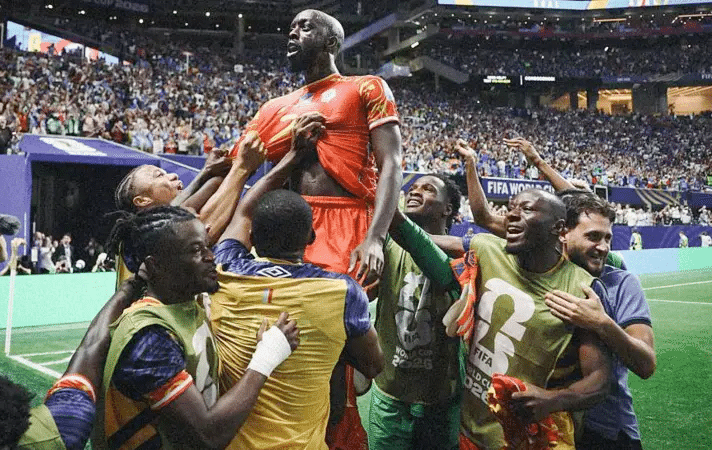
The dramatic transformation of African teams in the 2026 World Cup knockout stage marks a meteoric shift in global football power, driven by years of deliberate investment in African football development. At the 2018 World Cup in Russia, not one of Africa’s five teams made it out of the group stage, recording just three wins out of a possible 15. Fast forward to the current tournament, and Africa stands as the ultimate vindication of Gianni Infantino’s controversial expansion project.
Of the 10 African teams competing, an astonishing nine progressed. Only Tunisia failed to make the cut. Cape Verde, Egypt, Ivory Coast, Morocco, and South Africa advanced as runners-up, while Algeria, DR Congo, Ghana, and Senegal secured their places from third-party berths. It is a completely different story for Asia, with only two of its nine nations surviving the group phase. For Africa, it is cause for immense celebration, while Asia is left to reflect on a bitter sporting disaster.
The Morocco Football Blueprint Changes the Game
This remarkable turnaround in fortunes did not happen by accident; it stems directly from the long-term commitment of the Moroccan FA. Confederation of African Football (CAF) president Patrice Motsepe puts it down to the “hard work and investments in youth football development, coaching and professional football leagues” across the continent.
The initial signs of this shift emerged in Qatar four years ago, when two African nations reached the knockout stage for the first time. Before that, only three African teams had ever reached the quarter-finals—Cameroon in 1990, Senegal in 2002, and Ghana in 2010. Morocco then broke the glass ceiling by reaching the semi-finals, defeating Belgium, Spain, and Portugal before France ended their historic run. This success established a clear Morocco football blueprint that inspired the rest of the continent to reform their own internal structures.
Former Nigeria captain William Troost-Ekong highlighted this structural revolution to BBC Sport Africa this month:
”Morocco created a blueprint of how it can be done, which is years and years of investing in grassroot football and academies. Morocco have invested not just money but also time and effort, with a clear idea of how they can progress. The facilities they have, the consistency throughout their age groups, I think that’s the only blueprint you can follow.”
Navigating the 2026 World Cup Knockout Stage
While the expanded tournament format created more pathways, it does not fully explain the massive performance gap between the two continents. In previous tournaments, the top 16 teams were concentrated in fewer groups. Now, those 16 teams are spread over 12 groups, creating statistically weaker pools. Third-placed teams also advanced, turning the first knockout round into a massive 32-team bracket.
The critical question now is how far these African teams can go. South Africa fell to a late Canada goal on Sunday, leaving the co-hosts out of the running. The attention now turns to Morocco’s highly anticipated fixture against the Netherlands. Morocco enters the tie as African champions, though only after CAF overturned the Africa Cup of Nations final following Senegal’s controversial walk-off.
A decade ago, critics would have given Morocco little chance against the Dutch. Today, the North Africans are sixth in the FIFA world rankings—one place above the Netherlands—making them legitimate favourites.
However, repeating the semi-final run will be exceptionally tough. The top four ranked countries—Argentina, Brazil, England, and France—are kept apart in the bracket. Consequently, an African team must defeat one of these heavyweights to reach the final four. Morocco remains on a collision course with France for a potential quarter-final. Meanwhile, defending champions Argentina face Cape Verde on Friday, sitting in a section that features four separate African teams. In that same bracket, Algeria face Switzerland, and Ghana meet Colombia, creating a strong possibility of an all-African tie in the last 16.
European Exposure Exposes Asian Football Decline
If the expanded format offered a golden opportunity for Africa, it exposed a severe Asian football decline. From 27 matches played, Asia’s nine representatives managed a measly three victories, averaging just 0.67 points per game. In contrast, African nations played 30 matches, secured 10 wins, and averaged 1.33 points per game. Crucially, during the final round of group games, five head-to-head Africa-v-Asia matches took place; Asian countries lost four and won none.
Four years ago, Australia, Japan, and South Korea all made the knockout phase. This year, only Australia and Japan remain. Uzbekistan head coach Fabio Cannavaro did not mince his words after his team lost all three matches:
”Other than Japan, Australia and maybe Iran, every team needs to improve.”
The fallout from South Korea’s elimination—sealed by a shock defeat against South Africa—has caused a political storm. South Korea President Lee Jae Myung called for an official investigation into the performance, calling it “a failure of organisation and personnel.” Hours later, head coach Hong Myung-bo resigned.
Jordan also endured a brutal debut, losing all three matches while conceding eight goals. Jordan head coach Jamal Sellami explained the massive performance gap clearly:
”Because African players compete in the major European leagues. The most important thing for Jordanian football, if it is to have a greater chance of achieving results, is to have players competing in stronger and more competitive leagues.”
The squad data heavily supports Sellami’s view. Twenty of Morocco’s 26-man squad play their club football in Europe, with 15 stationed in the elite “Top Five” leagues. DR Congo features 24 European-based players, while even Egypt balances its domestic core with six European stars.
Conversely, Jordan has just one player in Europe: forward Musa Al-Taamari at French club Rennes. Iraq and Uzbekistan have three, and Iran have four. Even Asia’s top performers cannot match African depth; Japan has 23 players in Europe, Australia 16, and South Korea 15. The Asian confederation faces urgent work to bridge this developmental gap if its teams are to compete effectively in the modern, expanded World Cup format.